



Column
A vision to combat poverty with Zakat as a tool

An Independent Newsweekly


Column
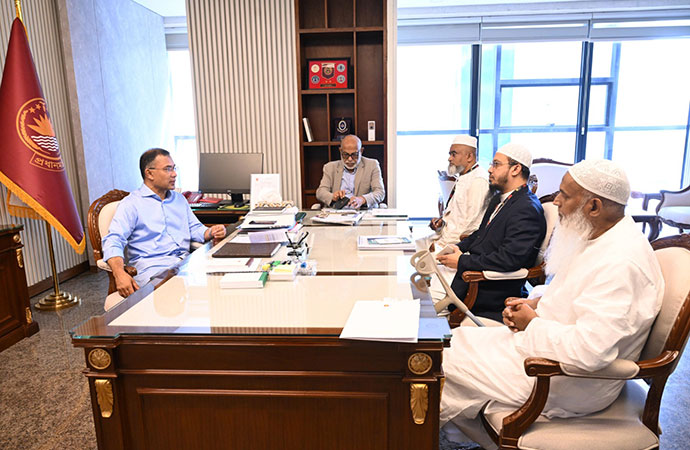
Image: Collected
Bangladesh, a country of over 176 million people, is still far away from rising above the poverty trap, as the World Bank estimates an increase in the number of poor. With over 3.5 million new people potentially falling below the poverty line due to economic disruptions, is there any quicker way to help them out? Yes, it is there - Zakat.
Just one month into office, Prime Minister Tarique Rahman feels that Zakat can serve as a vital redistributive tool to support the most vulnerable in the country.
The potential Zakat base in Bangladesh includes millions of individuals who meet the nisab (minimum threshold of wealth) requirement with over 91% of its population being Muslims though there is no exact Zakat payable population.
Zakat is widely practised in a Muslim-majority country like Bangladesh, but its management remains largely unorganised with many distributing their Zakat independently, and the number of those who contribute to the Central Zakat Board is negligible. But a coordinated and structured system can help tap the full potential of Zakat as an effective poverty alleviation tool.
The encouraging sign is that the World Bank recognises Zakat as a powerful instrument for reducing poverty and widening the scope of financial inclusion as estimates indicate that its potential value is 1.63 per cent of GDP. The World Bank gladly recommends integrating Zakat into national development frameworks to rapidly strengthen social safety nets and minimise economic inequality.
Under the circumstances, Prime Minister Tarique Rahman has outlined an aspiring plan to transform Zakat into a catalyst for sustainable poverty reduction in Bangladesh and directed the authorities concerned to make its management more organised, targeted and effective.
"Zakat is one of the five pillars of Islam," the Prime Minister said, emphasising the need for a coordinated national approach that combines private contributions with state-supported mechanisms. "If distributed in a planned and targeted manner, Zakat alone could significantly reduce poverty within the next 10 to 15 years."
According to various research estimates cited by the Prime Minister, annual Zakat collection in Bangladesh ranges between Tk 200-250 billion (Tk 20,000-25,000 crore), with some projections even higher. But questions persist about how effectively these funds reach the most vulnerable and whether they contribute to lasting poverty reduction as there is a lack of a structured system.
During a meeting at the Bangladesh Secretariat on March 9, 2026 with the Prime Minister in the chair, a directive was issued to streamline Zakat management. The Prime Minister also held consultations with Shaykh Ahmadullah, chairman of the Al-Sunnah Foundation, focusing on practical strategies to turn Zakat into a structured social investment that fosters long-term economic independence.
Prime Minister Tarique Rahman wants his government to play a facilitating and coordinating role, alongside reorganising the National Zakat Board under the Ministry of Religious Affairs. The restructuring is expected to bring together Islamic scholars, religious experts and government officials so that transparency could be ensured as per Islamic principles.
He said that Islamic teachings encourage distributing Zakat in a way that enables recipients to become self-sufficient, ideally eliminating their need for further assistance in subsequent years.
As part of this vision, the Prime Minister proposed identifying poor and extremely poor households among the country's approximately four crore families and providing 500,000 families with Tk 50,000-100,000 annually in phases from a central fund. "If implemented effectively, these families could become self-reliant within a year," he said, stressing the importance of empowerment over dependency.
The Prime Minister has called upon Ulema and Islamic scholars to play a proactive role in raising awareness among affluent Muslims about structured and impactful Zakat distribution.
He emphasised that stronger coordination between individual donors, charitable organisations and a reformed Zakat Board could ensure that funds are channelled into programmes that generate measurable improvements in income and livelihoods. "Through effective use of Zakat for poverty alleviation, Bangladesh has the potential to emerge as a model for the Islamic world," he noted.
Shaykh Ahmadullah shared the experience of the Al-Sunnah Foundation, demonstrating how skill-based interventions can transform Zakat into sustainable income. He noted that with minimal administrative costs, the foundation trained 2,100 unemployed youths who collectively earned Tk 420 million within a year.
"The Prime Minister expressed satisfaction with these outcomes and has directed the religious affairs ministry to explore similar government-led initiatives," he told reporters after the meeting.
Ahmadullah also proposed a regulatory framework for charitable organisations to encourage transparency, accountability and performance-based competition. There could be formal mechanisms, he said, to avail of a fair share of the nearly $600 billion annual global Zakat pool throughout OIC countries.
The vision may look ambitious, but the possibility is there to make it happen with accurate identification of eligible households, effective monitoring by the Zakat Board to ensure productive use of funds, and strong partnerships to convert one-time assistance into sustainable livelihoods.
To strengthen zakat management, a committee of five to seven members is being proposed, with the Minister of Religious Affairs serving as its chair. The committee is also expected to include the Khatib of Baitul Mukarram National Mosque, alongside several national and international experts in Islamic economics. Tasked with preparing recommendations, the committee will submit its proposals to the government for consideration.
Talking to news agency UNB, Executive Vice Chairman of the Microcredit Regulatory Authority (MRA) Prof Mohammed Helal Uddin said bringing zakat funds into a regulated system could have a strong economic impact. "If the government can mobilise and utilise this fund effectively for poverty reduction, it will inevitably benefit the economy."
Economist and former Vice-Chancellor of Jahangirnagar University, Prof Abdul Bayes, said unregulated use of zakat funds has often prevented the real beneficiaries from receiving support and bringing Zakat funds under regulation would ensure that the rightful recipients benefit from the resources.
Islamic economists have also suggested revising the Zakat Fund Management Act, 2023 to strengthen the Zakat Board and ensure transparency in zakat collection, distribution and utilisation. If Bangladesh can demonstrate that a planned, data-driven Zakat system can consistently lift families out of poverty, it could set a precedent for other Muslim-majority nations.
Prime Minister Tarique Rahman with a clear and strategic vision has rightly planned to harness the full potential of Zakat rooted in faith and guided by evidence.
Mahfuzur Rahman, Speech Writer to the Prime Minister
A Independent Newsweekly
© Copyright 2026 | Designed by ARK Reepon & Developed by Cosmos Group Software Team





Leave a Comment
Recent Posts
The government passes the test ...
One of the cornerstones of the political earthquake Bangladesh witness ...
The government hiked the price ...
The government hiked the price of a 12kg cylinder of liquefied petrole ...
Police in France stand accused of using excessive fo ..
The India-Pakistan Cold War
A week on from DNCC’s eviction drive, Mirpur-10 rema ..
Equal Service, Unequal Pensions: Time for a Fairer S ..