



Column
Electing a new Bangladesh

An Independent Newsweekly


Column
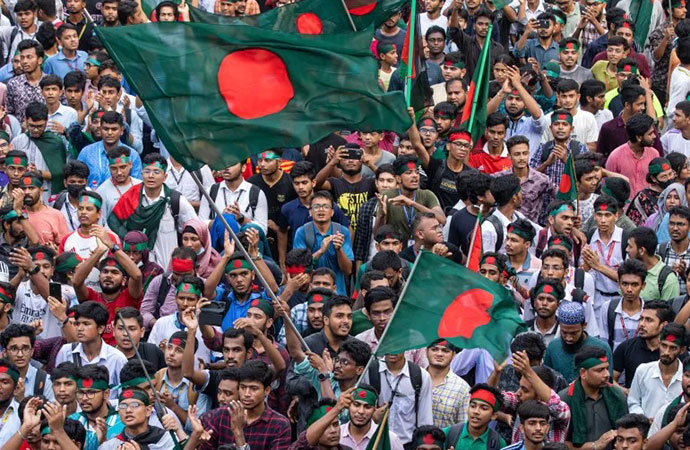
Photo: AP/UNB
Here I am in Singapore, a non-citizen of Bangladesh (although a fellow-Bengali) and celebrating the imminent general election. Why? Because as West Bengal's Chief Minister Mamata Banerjee says, and beautifully so, "Dharmo jaar jaar, utsob sobar" (Religion belongs to the individual, but festivals belong to the community). I consider elections to be the main festival of democracy. Hence, an election in Bangladesh or in West Bengal (which will go to the polls in May this year) or in Britain or in the United States or in Singapore is a festival that belongs to citizens of the world together no matter what their particular nationalist "religion", so to say, is.
Of course, elections are a joke in non-democracies and they are flawed even in Western democracies that deliver unwanted tutorials to the Third World on how to conduct their political affairs. However, everything said, universal suffrage is and has to be better than legislative absolutism, whether it is based on confessional faith or ethnic identity or class warfare. Even elected dictatorship, such as that which plagues parts of Africa and Latin America, is better than the non-elected "democracy" produced by a party that foretells the popular will even before it has been expressed in the exercise of the vote. You know which countries I mean. Bangladeshis, like West Bengali Indians and Singaporeans are lucky. We live in democracies. Our countries are different. They are different.
Clearly, this is what might be called the first existential general election in Bangladesh. Earlier elections recorded the political consequences of the separation from Pakistan, the fight against authoritarianism, and internecine contests over the shape of a democratic Bangladesh. The July 2024 mass uprising cut the political ground from beneath the feet of a political disposition that had sought to equate the future of Bangladesh with the past achievements of its founding leader. Those achievements were real, but even iconic leaders do not rule forever, particularly if their legacy is co-opted for despotic and corrupt ends.
This election, which comes with a referendum on the national character of Bangladesh that people want, quite apart from the question of who gains parliamentary power, begins where the July revolution did not end - that is, it is a kind of Permanent Revolution of which Trotsky spoke in the context of the Russian Revolution of 1917. Trotsky came to a nasty end. There is little reason to believe that the youth revolutionaries who came to the fore in 2024 will follow him. However, the issue is: What is it that has to become permanent in the mass upsurge of 2024?
The results of this existential election will tell. The Awami League's absence from the polls obviously represents a contraction of their representative scope (although party supporters are free to vote for whichever party they still want and make their mark on the results of the referendum as well). What international observers are focusing on is the long-known Islamic turn in Bangladesh politics and what that will mean for the country's character as a religiously-inclusive state. Again, the results will tell. In the enforced absence of the Awami League, Bangladesh's Muslim politics spans quite a range, from the Left-of-Centre Bangladesh Nationalist Party to the Centrist Jamaat-e-Islami to various forces assembled on the religious Right, some with parliamentary credential and others with mass-mobilisation capabilities that are not to be dismissed lightly. Together, this Muslim spectrum can deliver strong and durable governance to Bangladesh.
However, one cautionary idea needs to be kept in mind. Majoritarian politics determines how votes are cast, but no majoritarian politics can control how minorities will respond. Bangladesh's majoritarian political landscape cannot ignore the presence of religious minorities (Hindus, Buddhists and Christians); sexual minorities (women and third-genders); demographic minorities (children); aesthetic minorities (writers, actors, singers and sculptors); and spiritual minorities (Sufis and Bauls). Attacks on Sufi shrines and Bauls in recent times are a bad omen. The attacks, and the almost-biological viciousness behind them, detract from the eclectic geography of an inherited Bangladeshi soil, which remains a microcosm of an indivisible Bengali soul against the backdrop of the Partitions of 1905 (reversed in 1911) and 1947 (which created the incipient conditions for eventual Independence in 1971).
I hope that the general election and the referendum are held peacefully and their results respected, no matter which way they go.
Democracy is a way of life. Elections are festivals that make the way worth travelling.
Here in Singapore, I await the arrival of the latest festival on the Bengali calendar.
Go ahead, elect a new Bangladesh.
The writer is Principal Research Fellow of the Cosmos Foundation. He may be reached at epaaropaar@gmail.com
A Independent Newsweekly
© Copyright 2026 | Designed by ARK Reepon & Developed by Cosmos Group Software Team





Leave a Comment
Recent Posts
ART SG 2026: Reflections from ...
Singapore, for a brief moment, becomes an entire city-sized gallery. E ...
The Final Act
The 13th Jatiya Sangshad elections, the final act in a three-stage tra ...
How Undecideds May Decide the Election
Curtain Falls on Bangladesh’s Interim Government as ..
US President Donald Trump said that he plans to lowe ..
The Gaza ceasefire began months ago. Here’s why the ..