



Reportage
How Undecideds May Decide the Election

An Independent Newsweekly

Reportage
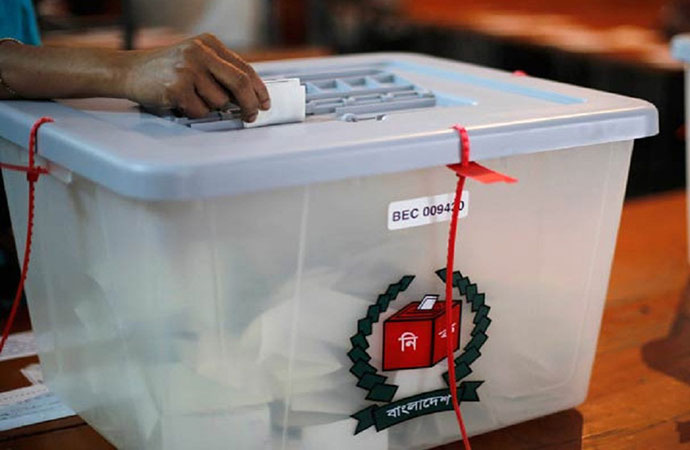
Image: Collected
With less than a week to go before Bangladesh's 13th general election on February 12, more voters are saying "I haven't decided yet" than choosing a party outright. That is surprising in a country where elections tend to be predictable and it has turned undecided voters into one of the most important blocs in the race.
A nationwide Pulse Survey conducted by the BRAC Institute of Governance and Development (BIGD) shows that 48.5 percent of voters have not yet decided whom they will support, up from about 38 percent eight months earlier. In the same survey, 14.4 percent refused to say who they might vote for and 1.7 percent said they will not vote at all. (BIGD Pulse Survey: July 2025 - Citizens' Perceptions, Expectations, and Experiences)
That means nearly half of the electorate remains in "thinking mode," even as campaign rallies intensify, debates are held and political narratives are repeated across social media platforms.
How Big Are the Undecideds Really?
Multiple opinion polls show a similar pattern of uncertainty.
In the most recent People's Election Pulse Survey (PEPS Round-3) by Innovision Consulting, party preference figures among decided voters show the Bangladesh Nationalist Party (BNP) and its allies leading with 52.8 percent support, while the Jamaat-led alliance stands at 31.0 percent. Yet the same poll records 13.2 percent of voters as undecided on party choice itself. (PEPS Round-3)
Leadership projections from the same survey reveal further ambiguity. About 22.2 percent of respondents said they could not yet say who would become the next prime minister, even while 47.6 percent named a specific leader and 22.5 percent chose another candidate. (PEPS Round-3 prime minister projection)
Among younger voters, uncertainty is even more pronounced. A separate youth-focused study, the Youth Matters Survey 2025, found that nearly 30 percent of young respondents were undecided about their vote, with only smaller shares committing to parties or leaders.
These undecideds are not a marginal group. Their numbers rival those of entire voting blocs and make them impossible to ignore.
Voices from the Ground
Efforts to speak with voters who say they are unlikely to cast a ballot often meet quiet resistance. Many decline to comment for reasons they do not fully explain. Still, a handful agreed to share their views on condition of anonymity, offering insight into the hesitation behind the statistics.
A young lecturer of Political Science at a time-honored educational institution in Dhaka pointed to the unusual political configuration of the election.
"The two main political forces contesting the 13th parliamentary election, the BNP and Jamaat-e-Islami, have been long-time allies with overlapping ideological positions. Although they are now competing against each other due to the absence of a major political party, that absence itself shapes how voters see the election."
He argued that the participation deficit that marked the 12th national election in 2024 has not been fully resolved.
"For the same reasons the 2024 election was not truly participatory, the 13th election also lacks full participation. This may not be discussed forcefully in the post-uprising environment, but it will matter in historical analysis. That is why I believe a segment of voters will stay away from polling centres."
On the referendum being held alongside the election, he expressed cautious approval mixed with concern.
"There are positive elements in the referendum that could make future governments more accountable. But the way the questions are framed is problematic. Multiple issues are bundled together and voters are asked to answer only 'yes' or 'no.' It is not realistic to expect citizens to agree with every component at once."
He cited provisions on increasing women's representation, proposals involving the Supreme Court and changes that would curtail prime ministerial power while expanding presidential authority as areas where reasonable disagreement exists.
"Reaching a single 'yes' or 'no' decision on so many complex matters is extremely difficult. That is why there is uncertainty about the referendum as well. Nearly a quarter of the population remains illiterate and many voters are not fully aware of what the referendum entails. If voters do not understand the questions, how meaningful is the vote?"
A student from the Institute of Leather Engineering and Technology at the University of Dhaka expressed a more resigned pragmatism: "Looking at the situation, I do not expect much. This time, my vote is for what I see as the lesser of evils and for forces aligned with democratic freedoms. That means the BNP."
Others were more dismissive of the process altogether. A former student of the law department at Chattogram University said he has decided not to vote: "None of the public's expectations have been fulfilled. The promises that were made were not delivered, not even a fraction of them. Instead, a group of people have benefited enormously. I do not believe ordinary people's expectations will be met after this election either."
This election also introduces a new variable which is the inclusion of expatriate voters through postal ballots. Yet even among overseas Bangladeshis, enthusiasm appears limited.
Sumaiya Jannat, a Bangladeshi expatriate living in the United Kingdom, offered a blunt assessment: "I do not see this as a real election. It feels more like a consolation prize to keep mass people calm."
Kashpiya Badhon, another expat-voter based in the United States, cited the absence of her preferred party: "The party I support is not contesting this election. Not just me, my entire bloodline supports that party. If I were in Bangladesh, fear and social pressure might have pushed me to a polling centre. But since I am in the United States, voting is simply not an option for me."
Together, these voices suggest that indecision is not rooted in apathy alone, but in doubts about participation, representation and the meaning of the vote itself.
Why the Undecideds Matter
In most elections, undecided voters shrink as polling day approaches. Campaign messaging intensifies, loyalties harden and choices become predictable.
This election is different. The absence of a previously dominant political party has altered the competitive landscape. International coverage has noted that many voters remain uncertain precisely because of this absence, creating an unusual and fluid electoral environment for Bangladesh.
Undecided voters also matter beyond party competition. Their views shape attitudes toward the constitutional referendum being held alongside the election. In another Innovision survey, about 59.5 percent of respondents favoured a "Yes" vote, while 12 percent remained undecided on the referendum question itself.
(Innovision referendum poll)
Surveys also show that economic pressures, law and order concerns, and demands for timely elections strongly influence voting intentions, suggesting that undecideds are grappling with tangible issues rather than abstract political messaging.
(Survey reveals economic woes and poll urgency)
A Snapshot of Voter Confidence
Despite widespread uncertainty, some indicators point to relatively strong confidence in the election process. One survey reports that 72.3 percent of respondents believe the interim government can conduct a free and fair election, while 82.3 percent expect to vote safely at polling centres. (PEPS Round-3 confidence metrics)
These figures suggest that many undecided voters are not rejecting the process itself. Instead, they are weighing their options carefully in an unfamiliar political context.
The Final Days
As election day draws closer, undecided voters remain the closest thing Bangladesh has to a wildcard. Their decisions in the final days could shape constituency-level outcomes and influence national results in ways early polls may fail to capture.
For journalists, analysts and citizens alike, paying close attention to this group is essential. Understanding why undecided voters hesitate, and what ultimately motivates their choices, may offer deeper insight into the future direction of Bangladesh's politics.
Rather than forming a quiet background chorus, the undecideds may end up setting the tempo of this election.
A Independent Newsweekly
© Copyright 2026 | Designed by ARK Reepon & Developed by Cosmos Group Software Team




Leave a Comment
Recent Posts
ART SG 2026: Reflections from ...
Singapore, for a brief moment, becomes an entire city-sized gallery. E ...
The Final Act
The 13th Jatiya Sangshad elections, the final act in a three-stage tra ...
How Undecideds May Decide the Election
Curtain Falls on Bangladesh’s Interim Government as ..
US President Donald Trump said that he plans to lowe ..
The Gaza ceasefire began months ago. Here’s why the ..