



World this week
Human rights experts commissioned by the UN’s top human rights body


An Independent Newsweekly



World this week
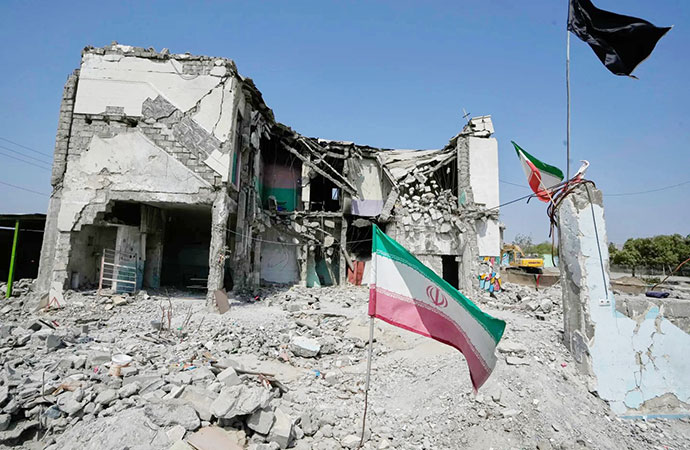
Photo: AP/UNB
Human rights experts commissioned by the UN's top human rights body say they have found "reasonable grounds" to believe the United States committed war crimes in two strikes in Iran, including on a school in the southern city of Minab. The international fact-finding mission on Iran says the findings center on a pair of airstrikes that killed at least 178 civilians, including women and children. At the start of the US-Israeli war against Iran in February, at least one US missile hit the Shajareh Tayyebeh school in Minab, according to an AP investigation. There has been no final accounting of what happened. Iranian state media have said 168 people were killed in the strike, most of them children.
"Following the United States and Israeli attacks on 28 February, the mission found reasonable grounds to believe the US committed the war crime of launching indiscriminate attacks resulting in the loss of life or injury to civilians or damage to civilian objects," the fact-finding team said in a statement.
India and Pakistan have summoned each other's top diplomats in Delhi and Islamabad after two of their naval vessels collided in the Arabian Sea. Both sides blamed each other for the collision, which happened on Tuesday. They also accused each other of violating a 1991 bilateral agreement that requires either side to give advance notice of military exercises. The incident comes more than a year after the South Asian neighbours conducted military strikes against each other before agreeing on a ceasefire.
India said it had lodged a strong protest with the Charge d'Affaires of the Pakistani High Commission in Delhi over what it called "unacceptable and unprofessional conduct" of the naval unit. Pakistan said that its navy was conducting its biennial exercise, SEASPARK-26, in its exclusive economic zone when the Indian vessel "carried out aggressive manoeuvres in dangerously close proximity" of its ship.
Climate breakdown probably weakened the glacier that collapsed causing catastrophic floods and killing over a thousand people in Nepal and Tibet last month, the first scientific study of the disaster has found. Researchers identified unusually warm conditions before the glacier's collapse, which sent an avalanche of 110m cubic metres (3,885 cu ft) of snow and ice into the valley below. This triggered flash floods on an almost unprecedented scale, hitting communities downstream without warning.
"Communities in Nepal are paying with their lives for a crisis driven by fossil fuel emissions thousands of miles away," said Dr Friederike Otto, a climate science professor at Imperial College London, which carried out the study. "When warming destabilises the roof of the world, no amount of local adaptation can fully shield vulnerable people downstream from this scale of destruction. Without much faster action to transition to zero fossil fuel emissions we will inevitably see more disasters of this scale occurring in the years to come."
At least 48 people have died and around 100 others are receiving treatment in southern Nigeria after consuming a drink suspected to contain methanol, officials said on Thursday. Banji Ajaka, Ondo state's commissioner for health, said the cases had been reported in the Odigbo and Irele local government areas. A total of 182 people are believed to have been affected, he said. "This thing happened rapidly. Once they consume, depending on the quantity, the kidneys will pack up, the eyes will go, the brain will be damaged," Ajaka told The Associated Press.
Some of those who became ill after consuming the liquid have since been discharged from hospital, he added. Ondo state police spokesman Abayomi Jimoh said one of 15 people who have been arrested in connection with the incident had been producing drink "suspected to contain methanol and is currently assisting the police with investigations." Local media reports said the first death was reported nearly two weeks ago.
A Independent Newsweekly
© Copyright 2026 | Designed by ARK Reepon & Developed by Cosmos Group Software Team





Leave a Comment
Recent Posts
The right time for an apology
The publication of the posthumous memoirs of lawyer Abdur Razzaq, who ...
Human rights experts commissio ...
Human rights experts commissioned by the UN’s top human rights b ...
Teesta erosion leaves several hundred families homel ..
Housing Without Houses: The Hidden Cost of Banglades ..
The Election Commission will review the timeframe
The story behind the Arafat brothers' ‘Kolpona’