



Column
Resting in Peace in Pirojpur

An Independent Newsweekly





Column
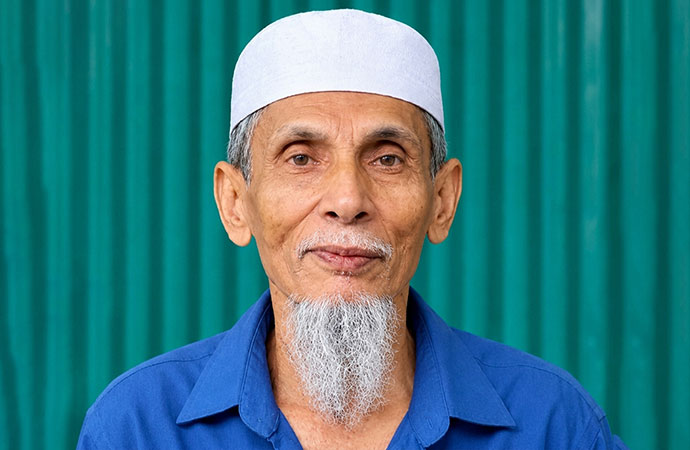
Freedom fighter Manik Pashari. Photo: Collected
I never had the privilege of meeting freedom fighter Manik Pashari, who has just died at 87. So, I looked him up on the Internet. Here is what I found.
"Manik Pashari (1939 - October 24, 2026) was a Bangladeshi gazette-listed freedom fighter, complainant, and a key prosecution witness in the high-profile war crimes trial against the late Jamaat-e-Islami leader Delwar Hossain Sayedee." Indeed, he was a central figure in the International Crimes Tribunal-1 as a plaintiff and crucial state witness against Delwar, who faced charges of crimes against humanity. "Based partly on the testimonies presented, Sayedee was initially sentenced to death in 2013, a sentence the Supreme Court later commuted to life imprisonment. Following a major mass uprising in Bangladesh in August 2024, Pashari reportedly went into hiding due to security concerns and spent his final months moving between Jashore and Gopalganj districts."
Understandable. You have to go into exile of some kind when the citadel in which you lived crumbles.
What is difficult to believe is what happened when he died. Here is the rest of the Internet account.
"When his family brought his body back to Pirojpur for funeral rites, local Jamaat-e-Islami activists and supporters allegedly massed and opposed his burial and state honours, claiming he was a 'fake freedom fighter'." Given the protests and a blockade, the local administration was obliged to administer him the state guard of honour privately, within the confines of the Pirojpur Police Lines.
Then, following a delay of nearly 15 to 17 hours, Pashari was finally buried under heavy police protection. "Due to the blockade and lack of public assistance, reports and video footage emerged showing his wife, daughter, and sister digging his grave using the light of their mobile phones."
Pashari's fate was condemned by progressive political figures, student wings, and civil society groups. District-level Jamaat leaders "officially denied orchestrating the blockade, asserting they did not oppose the burial itself but rather the granting of state honours".
Physician and young politician Tasnim Jara posted an incensed comment about those who had opposed his burial with state honours. She asked, regarding Jamaat: "They are blocking someone from being buried on his own homestead while still in opposition. What will they do if all state power falls into their hands?"
I am not going into Tasnim Jara's quarrel with Jamaat, which long predates the Manik Pashari incident. What concerns me is the way in which even the dead, let alone the living, are avowedly being treated in Bangladesh.
Tasnim Jara posed a cultural issue. According to a Prothom Alo English report, she wrote that "in Bangladesh, when someone dies, there is usually no need to ask anyone to come and dig a grave. Once word spreads, young men from the neighbourhood arrive with spades. Some bring bamboo, while others bring mats. She said she had grown up hearing that the burial of a deceased person should not be delayed... Tasnim Jara said Jamaat leaders and activists spoke as though they owned the land when they declared that Manik Pashari would not be allowed to be buried in Pirojpur. It was as if a person needed their permission to be laid to rest in his own family graveyard".
Exactly. That is what is troubling. There are certain customary norms and practices - and not merely legal obligations - in every country whose observance strengthens a community's coherence for all its members regardless of their economic, ethnic or political differences. Hence, everyone suffers once those normative structures begin to break down.
Today, certain Jamaatis, although they are in the opposition, may try to block the burial-with-state-honours of a person in Pirojpur because of his association with a previous era when he acted as a witness against a Jamaat leader. Tomorrow, another opposition party in a Jammat government could flex its political muscles by trying to block the burial (with or without state honours) of a prominent Jamaati leader or ideologue who is active and vocal today wherever in Bangladesh.
Down the road, another opposition party in a differently-ruled Bangladesh could force some unfortunate to find a resting place outside the upazila where he was born - then outside the zila, then outside the division, and finally outside Bangladesh itself. Bad enough for Muslims in Muslim-majority Bangladesh, imagine the consequences were a minority Bangladeshi's cremation or burial to be prohibited by mobs. Death would then become a communal issue. Life being communalised is bad enough.
May that day never come.
The writer is the Principal Research Fellow of the Cosmos Foundation.
A Independent Newsweekly
© Copyright 2026 | Designed by ARK Reepon & Developed by Cosmos Group Software Team









Leave a Comment
Recent Posts
Resting in Peace in Pirojpur
I never had the privilege of meeting freedom fighter Manik Pashari, wh ...
An impending disaster in the h ...
There has been a fresh spike in both dengue and measles cases, hospita ...
‘Stories bring us together’: Laetitia Troussel-Luber ..
A high-speed train slammed into another that had sto ..
Bangladesh and Malaysia concluded the first round of ..
CPC's international department head Liu Haixing to v ..