


Culture
Being, Belonging and Becoming: The artistic world of Tayeba Begum Lipi

An Independent Newsweekly
Culture
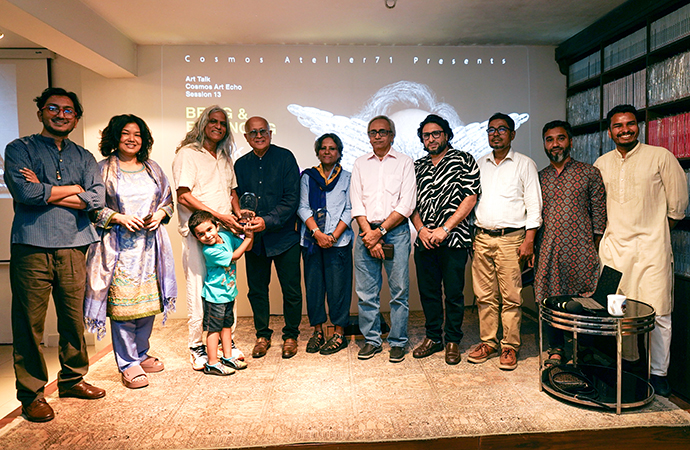
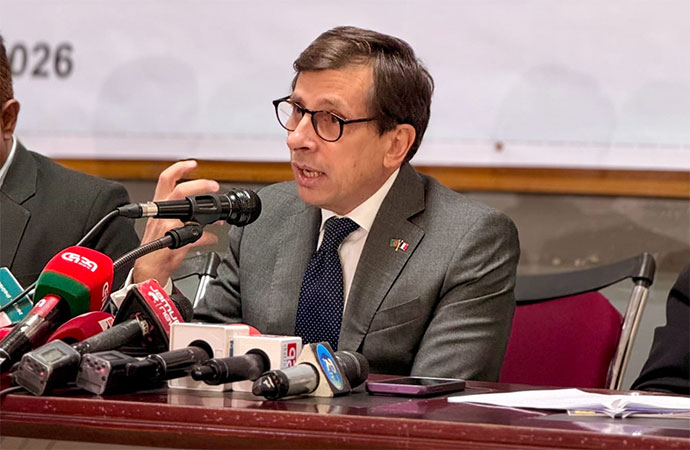
Photo: Md Rakibul Hasan/ UNB
At the 13th edition of Cosmos Art Echo, the acclaimed Bangladeshi artist reflected on the memories, relationships and experiences that have shaped her life and artistic vision.
Every life is made of fragments: places left behind, faces held in memory, objects that outlive their original purpose and relationships that gradually become part of who we are. For Tayeba Begum Lipi, these fragments have also become the raw material of art.
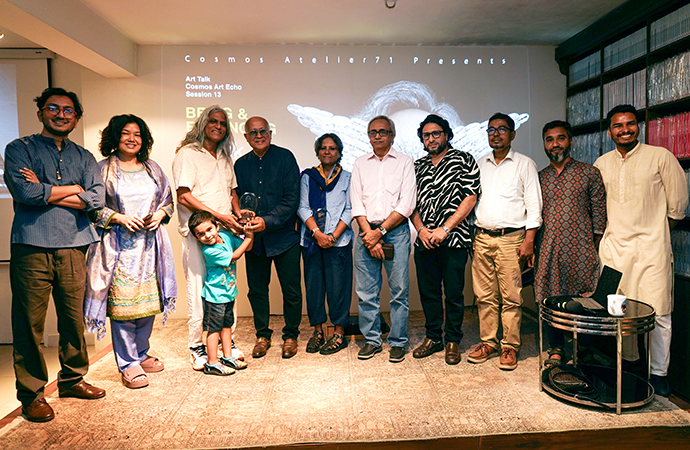
Last Friday's rain-soaked evening at Cosmos Centre, the prominent Bangladeshi artist revisited some of the experiences that have shaped her creative life during 'Being and Belonging', a conversation presented by Gallery Cosmos and Cosmos Atelier-71. As the audience gathered around her story, the boundaries between biography and artistic expression began to blur, revealing how the personal can speak to something far beyond the self.
Organised by Gallery Cosmos and Cosmos Atelier-71, the 13th session of Cosmos Art Echo brought together Enayetullah Khan, Chairman of Cosmos Foundation and editor emeritus of United News of Bangladesh (UNB); Catherine Grace Gardner Khan, Creative Artistic Director of Cosmos Global Resources; Vraîe Cally Balthazaar, the current Mayor of Colombo, Sri Lanka; Mahbubur Rahman, Lipi's husband and fellow Co-Founder of Britto Arts Trust; architect Rafiq Azam, and Mahfuzur Rahman, speechwriter to the Prime Minister, among other guests which included artists, diplomats, art enthusiasts, journalists and people from all walks of life.
For Lipi, the idea of belonging is inseparable from the freedom to discover oneself. Her journey into art did not begin with certainty. Although she initially considered other academic paths, it was her elder brother, Tahmidul Islam Doll, who encouraged her to pursue Fine Arts. Other family members, including her brother AKM Maynul Islam Paul, now a Professor at Rajshahi University, had hoped she would choose a different subject.
After attending schools in Gaibandha, Rajshahi, Dinajpur and Khulna, Lipi completed her SSC and HSC in Gaibandha before enrolling at the Institute of Fine Arts at Dhaka University, where she eventually found the openness she had been longing for. Her Master of Fine Arts degree marked an important milestone in a journey shaped by perseverance and a desire to work beyond conventional boundaries.
That spirit of exploration soon carried her beyond the classroom. Art tours took her to Kathmandu, Jaflong and the Sundarbans, where a group of young artists encountered robbers while seeking permission to enter the forest but continued with their plans. The experiences became part of a formative period in which travel, collective work and experimentation helped expand her understanding of art.
"We never really sat idle; we were always doing something," Lipi recalled.
International residencies subsequently opened further possibilities. Her experience at the Irish Museum of Modern Art exposed her to new artistic environments, while a project at Gasworks in London explored the history of indigo cultivation. In 2007, she worked on a project concerning political prisoners on Taiwan's Green Island. Across these experiences, her practice moved beyond painting to encompass performance, installation and site-specific work, allowing her to explore the relationship between the body, history, place and society.
Yet some of the most compelling material in Lipi's work comes from the intimacy of everyday life. At the Cosmos Art Echo session, she discussed objects that carry personal histories: her grandfather's gramophone, her mother's dressing table and wheelchair, and a steel suitcase associated with her wedding. These are not simply possessions. They are reminders of people, relationships and moments that continue to inhabit the present.
Her use of razor blades and safety pins further illustrates how ordinary materials can acquire complex emotional meanings. In 2012, she created a baby cot from stainless-steel razor blades, bringing together the vulnerability associated with childhood and the sharpness of the material. Explaining the personal sentiment behind the work, she said, "We don't have a baby; I wanted, if I had a baby, it to be a girl, or if I could be born again, I would want to be born a woman myself."
The work invites viewers to confront tenderness and danger within the same frame. Her later experiments with performance and large-scale works, including pieces made during the Covid years using Lokta fabric and thread, continued her exploration of the human body and its vulnerabilities.
Lipi also spoke candidly about the health challenges that interrupted her life. "After Covid, I had a lung infection and I suffered a stroke. Towards the end of 2023, I was diagnosed with cancer. I am now well, and I am on medication," she said. The matter-of-fact account added another dimension to an evening centred on the ways personal experience shapes artistic expression.
Her relationship with husband and prominent Bangladeshi artist Mahbubur Rahman formed another important thread in the discussion. Having met while studying Fine Arts, the two developed a partnership grounded in shared creative pursuits and companionship. Lipi emphasised that their relationship was never defined solely by conventional expectations of marriage.
"Looking back, I feel that my relationship with Mahbub is essentially a friendship," she said. "Friendship has always been the biggest part of our relationship. We are still much like friends. Being able to come this far together is a great achievement."
Tayeba Begum Lipi and Mahbubur Rahman rented the house of the eminent Bangladeshi writer Shawkat Osman in 1998, shortly after his death, and lived there until 2005. "We have great memories of that house," Lipi said. The couple never owned or occupied the property as owners. Since 2018, Lipi and Mahbubur have been living in their own house and studio in Hasnabad, South Keraniganj, built on Mahbubur's ancestral land.
Their shared commitment to art extended into institution-building through Britto Arts Trust, which they co-founded to support contemporary art and artistic exchange. Their international experiences helped reinforce the importance of creating opportunities for artists to experiment, collaborate and build sustainable creative networks. Lipi also highlighted the need for stronger support from commercial galleries in Bangladesh, particularly for younger artists who often face uncertainty while establishing their practices.
The title "Being and Belonging" also resonated with a 2023 group exhibition at the Royal Ontario Museum in Canada in which Lipi participated. At Cosmos Art Echo, the theme became a way to connect her personal history with broader questions about artistic identity, relationships and the communities that sustain creative work.
At the end of her talk, Lipi announced that her next exhibition would be held at Bengal Gallery in 2027.
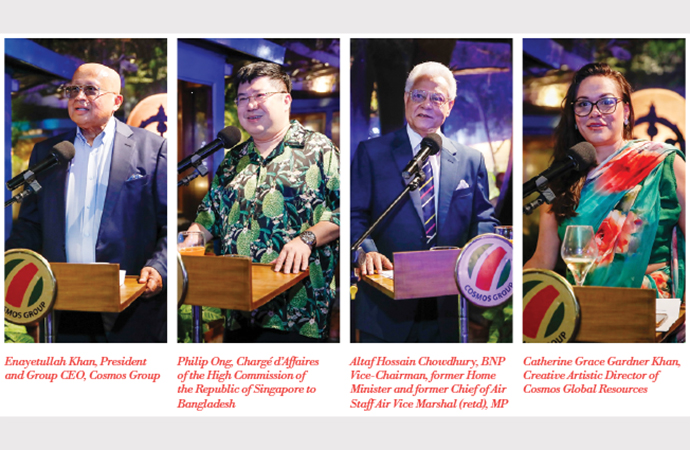
Enayetullah Khan, speaking at the event, described art as a force that brings people together in a world increasingly consumed by daily pressures and material concerns. Recalling his lifelong interest in collecting artworks and his friendships with artists, he said, "Art is everything. Art is conversation, and whatever we do is art."
He also spoke about the potential of artistic expression to challenge social problems. Referring to earlier initiatives such as Art Against Genocide, Art Against Fake News and Art Against Terrorism, Khan expressed his intention to organise an event titled 'Art Against Corruption' in the future. Recalling how he had wondered as a child what people who took bribes looked like, he said the question today seemed to have become what people who did not take bribes looked like.
Enayetullah Khan believes artists can help society become more sensitive by encouraging people to see familiar realities differently. During the evening, he presented mementoes to Lipi and Mahbubur in recognition of their contributions and the artistic journey they have shared.
As the rain accompanied the gathering towards its close, the conversation returned to the questions at its heart: what we carry from the past, what gives us a sense of place, and how the things we experience become part of who we are. In Lipi's art, belonging is neither fixed nor easily defined. It is assembled through memory, material, relationships and the continuing freedom to create.
A Independent Newsweekly
© Copyright 2026 | Designed by ARK Reepon & Developed by Cosmos Group Software Team



Leave a Comment
Recent Posts
Is the international community ...
A spate of downgraded economic projections, from Bretton Woods to Mani ...
A Childhood Lesson in Arithmet ...
As children, we learned a simple mathematical rule: if we know the pri ...
Indian authorities launched a major security crackdo ..
Police dispersed garment workers from the Azampur ro ..
Why Saudi Arabia has struggled to defend itself agai ..
Iran-backed Houthis strike Saudi oil company Aramco’ ..