



Column
Equal Service, Unequal Pensions: Time for a Fairer System

An Independent Newsweekly



Column
AI Generated Image
A practical and affordable path to delivering Bangladesh’s 2030 pension commitment
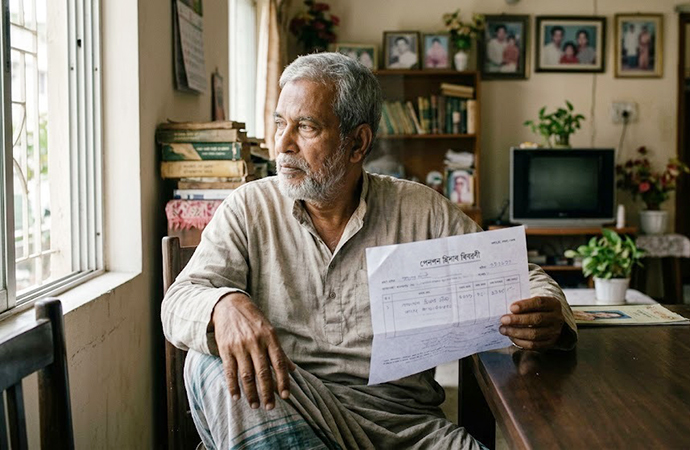
The current system bases a public servant's pension on the final basic pay earned while in the pay grade to which they were assigned when they retired. This means that an employee who retired early could see a difference in pension payout, merely as a result of differences in pay scales over time. But inflation doesn't discriminate between retirement ages: higher prices for food, medicine, housing and other necessities hit everyone today. The government's planned gradual implementation of the One Rank, One Pension (OROP) till 2030 is a positive move to remedy the imbalance. But this may be a long wait for older retirees whose pension benefits are too low, and who are already having trouble making ends meet. This is where speedy relief comes in handy. The issue is how the government will start to narrow the biggest gaps now whilst finishing the reform down over a transparent and price-affordable programme by 2030.
How the Present System Creates Different Outcomes
Civil-service pensions depend on final basic pay and qualifying service. With at least 25 years' service, gross pension is 90 per cent of final basic pay. When half is exchanged for gratuity, final basic pay of Tk 40,000 yields an initial monthly pension of Tk 18,000, before allowances and adjustments. Different pay scales create unequal starting pensions for comparable retirees. Uniform percentage increases do not remove this disparity and may widen the gap in taka. They may also fall short of inflation, so pension parity and purchasing-power protection require separate attention.
A Welcome Decision, with Work Ahead
The government identifies two barriers to pension parity: substantial costs and missing records for civilian employees who retired before 2019. Meanwhile, phased pension increases range from 100 per cent for monthly net pensions of Tk 9,000 or less to 55 per cent for Tk 40,001 or more. These provide welcome relief but do not equalise pensions for comparable service. A clear, funded plan is therefore needed to close verified gaps.
What's Pension Fairness?
One Rank, One Pension should provide equivalent pensions for comparable rank or grade, service length and pension conditions, regardless of retirement date. Higher existing pensions should be protected, and recipients should receive clear calculation statements. Parity corrects historical disparities; inflation adjustment preserves purchasing power. Both need separate calculations to avoid double counting.
Lessons from Asia
India's military One Rank, One Pension (OROP) system compares rank and service length, revises pensions every five years, includes eligible family pensioners and protects higher existing pensions. Malaysia adjusts eligible public-service pensions using an updated equivalent final salary and years of service. Bangladesh can adapt these approaches to its own circumstances and financial capacity.
Why public Fund usage will make good sense?
Fairer pensions can strengthen trust, help retirees meet essential expenses and reduce dependence on their children while supporting local businesses. However, pension parity requires recurring funding. Reform should disclose its costs and funding sources while safeguarding healthcare, education and support for older citizens outside government service.
Turning the 2030 Decision into Delivery
The government can fulfil its commitment through five simple steps.
First, check the records and calculate the gaps. By the end of 2027, verify each retiree's rank or grade, length of service and pension conditions. Then calculate the pension they should receive under the new system. For example, if the comparable entitlement is Tk 20,000 but a retiree receives Tk 15,000, the monthly gap is Tk 5,000. Provide help with missing documents and a way to challenge incorrect calculations.
Second, help those facing the greatest hardship first. Begin adjustments as soon as records are verified, giving priority to small pensions and large gaps. For example, an average increase of Tk 2,000 monthly for 3 lakh eligible recipients would cost Tk 720 crore a year. This illustrates the cost of one step, not the whole reform, and excludes administration and arrears.
Third, close the gaps in yearly steps by 2030. One possible approach is to close one-quarter of the verified gap each year from 2027. A Tk 4,000 monthly gap would therefore require an additional Tk 1,000 at each annual step, reaching full parity in 2030. This is a suggested schedule. Other pension increases must be considered so the same gap is not corrected twice. People whose records are verified later should receive catch-up adjustments.
Fourth, protect pensions against rising prices. Review pension increases against inflation. For example, if prices rise by 8 per cent but pensions rise by 5 per cent, pensioners can buy less than before. Establish a clear, affordable rule for reviewing this shortfall.
Fifth, provide funding and report progress. Each budget should state how much is allocated, how many people will benefit and how much remains to be done. Permanent increases need dependable annual funding. Any payment for past shortfalls should be decided separately.
Final Remarks
Bangladesh has announced the direction of reform. The task now is to make the 2030 commitment dependable. Verified records, clear comparison rules, priority corrections and funded annual milestones can deliver pension fairness while respecting taxpayers' resources. Comparable service deserves consistent retirement treatment-and retirees deserve to see that promise becoming reality.
Md. Nazrul Islam, PhD, is a retired Major General from Bangladesh Army. He was the Executive Chairman of BEPZA and also served in BEZA. He is a regular columnist and writes on technology, workforce transformation and industrial competitiveness. He is the author of Zi-DoNa Trilogy, a book on self-development.
A Independent Newsweekly
© Copyright 2026 | Designed by ARK Reepon & Developed by Cosmos Group Software Team




Leave a Comment
Recent Posts
The government passes the test ...
One of the cornerstones of the political earthquake Bangladesh witness ...
The government hiked the price ...
The government hiked the price of a 12kg cylinder of liquefied petrole ...
Police in France stand accused of using excessive fo ..
The India-Pakistan Cold War
A week on from DNCC’s eviction drive, Mirpur-10 rema ..
Equal Service, Unequal Pensions: Time for a Fairer S ..