



Featured 2
The loss no damage report will ever price


An Independent Newsweekly

Featured 2
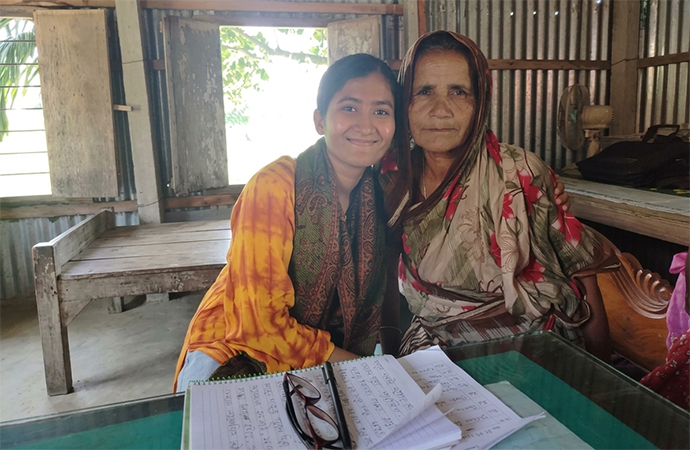
Author Jarin Tasnim Mim with Rahima Begum
At 71, Kurigram's Rahima Begum knows how to begin again. She has done it 17 times. Each time, the river took her home, washing away the walls, roofs and floors of the home she built. Each time, she gathered what could be salvaged and started over. Today, Rahima stitches kantha quilts to survive. Her grandson lives with her; not her own children. In that simple arrangement lies a story rarely captured by conventional accounts of climate damage: a grandmother raising a grandson because the generation between them has stepped away.
Rahima's story emerged from fieldwork under EBAAN, or Evidence-Based Approach to Address Non-Economic Loss and Damage, a project of the International Centre for Climate Change and Development (ICCCAD). EBAAN looks beyond houses destroyed, land submerged and crops ruined, to understand losses that cannot easily be converted into money. This is where Non-Economic Loss and Damage, or NELD, becomes important. It includes losses of home, identity, social ties, dignity and ways of life. For Rahima, those losses have accumulated over the decades.
Her story begins long before the river. Rahima was married at nine, an age when a child might ordinarily be learning, playing or discovering the world. Instead, she was given into marriage without the age or agency to understand what it meant. At 20, she had her first child, and she would eventually have three. Somewhere between those ages, a girl became a wife and then a mother without the years most people associate with growing up. There is no compensation scheme for a childhood that never happened, or an easy calculation for the loss of agency that comes with child marriage.
For much of her adult life, Rahima worked in other people's homes. She cooked, cleaned and did whatever work was required, but she was not paid a wage. Instead, she was fed. Her labour was exchanged for survival, leaving her without the financial security that comes from being paid for one's work. She spent years giving her labour to households that were not hers without building savings or property. It was work, but it did not create independence. Each time the river took her home, Rahima had to start again without resources of her own.
It was much later that Rahima began stitching kantha quilts. Kantha is often romanticised as heritage, with old sarees transformed into blankets through the running stitch. For Rahima, however, it became a way for her labour to finally put money directly into her own hands rather than being exchanged for food. The quilts carry cultural value, but also represent a late form of economic agency. At 71, the needle in her hand is not simply a symbol of tradition. It is one of the few tools through which she can still exercise a measure of independence.
Then there is the river. Seventeen times, it took her home. Climate change is often narrated through numbers: hectares of land lost, households displaced, crops destroyed and homes damaged. Those numbers matter, but they do not tell us what repeated displacement does to a person. Every destroyed home carries other losses. Someone has to gather what remains, find somewhere to go and rebuild. Much of that invisible work falls on women, who may also lose land, savings, social relationships or bargaining power within a household.
Rahima rebuilt 16 times. Then came the 17th loss, and she says she does not have another rebuilding left in her. The sentence is striking because of how easily the language of climate adaptation celebrates resilience. People affected by displacement are expected to endure, recover and begin again. But resilience becomes an uncomfortable word when it is repeatedly demanded from people who have already endured more than they should have had to. At some point, resilience stops being a compliment and starts becoming an expectation.
Old age has brought no clean end to that struggle. Rahima's children do not care for her, and her grandson lives with her. A lifetime of work has not given her security in old age. What remains is a grandson, a needle and whatever a finished quilt can bring. This too is a form of loss, not simply the absence of money, but the loss of security after decades of work and displacement.
This is what a NELD lens makes visible. It asks not only how much land was lost, how much a house cost or how many families were displaced, but what happened to the person who lived there. What did repeated displacement take from Rahima? What did early marriage take? What did decades of unpaid labour take? These questions resist measurement. A house can be valued and rebuilt. Land can be assessed. But there is no straightforward formula for the cost of losing a childhood, a home 17 times, a sense of belonging or the dignity of growing old with security.
Rahima cannot recover the years she lost, nor can she rebuild the homes the river took from her. What remains is more basic: the possibility of living out the rest of her life with dignity. That may sound small beside 17 lost homes, but it is not. It is precisely the kind of loss conventional damage reports struggle to see, and the kind climate accounting will underestimate until it counts what remains inside the lives of survivors. For Rahima, the river has already taken enough.
Jarin Tasnim Mim is an independent researcher with ICCCAD's Evidence-Based Approach to Address Non-Economic Loss and Damage project. She currently works as a Research Assistant at BBC Media Action Bangladesh.
A Independent Newsweekly
© Copyright 2026 | Designed by ARK Reepon & Developed by Cosmos Group Software Team


Leave a Comment
Recent Posts
The government passes the test ...
One of the cornerstones of the political earthquake Bangladesh witness ...
The government hiked the price ...
The government hiked the price of a 12kg cylinder of liquefied petrole ...
Police in France stand accused of using excessive fo ..
The India-Pakistan Cold War
A week on from DNCC’s eviction drive, Mirpur-10 rema ..
Equal Service, Unequal Pensions: Time for a Fairer S ..