



Reportage
War and Peace


An Independent Newsweekly



Reportage
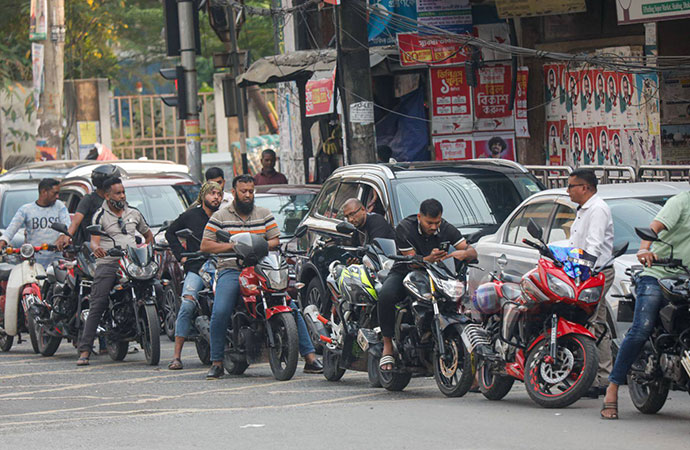
Photo: UNB/ Md. Rakibul Hasan
On March 2, day three of the "sweeping, reckless and almost certainly lawless" military campaign launched by the United States and Israel against Iran, US President Donald Trump said the war it triggered may last "four weeks or less", even as Tehran launched far-reaching retaliatory strikes on Gulf nations as well as Israel itself, amid intense bombardment by US and Israeli planes.
We have now completed those four weeks, and truth be told, there is no viable end in sight, despite all the talk of various peace initiatives. After initially suffering heavy losses, including in the earlier 12-day campaign last June by the same actors that targeted Iran's nuclear program, and the loss of almost an entire layer of its top leadership including Supreme Leader Ayatollah Khamanei, the Islamic Republic has shown itself to be capable of standing its ground. While talk of regime collapse has now faded, there has also been no groundswell of grassroot opposition to Velayat-e faqih, or guardianship of the Islamic jurist - the system of governance that has underpinned the way Iran operates since the country's Islamic Revolution of 1979.
The conflict pits US and Israeli military superiority against Iran's determination to widen the battlefield and impose mounting costs on its adversaries, and the global economy. At this stage, with neither side positioned for a decisive victory, the risks of a prolonged and escalating confrontation remain high. While all parties could now script a victory narrative to justify ending the war, each also appears to see reasons to keep fighting, according to analysis by the International Crisis Group.
Whether President Donald Trump's claims to be seeking a deal are genuine remains to be seen. His deployment of thousands of elite American forces to the Gulf suggests he is preparing for escalation, not an off-ramp. If he is serious about finding a way out, reaching a workable ceasefire with Iran will be hard. Tehran may want concessions beyond an end to the US-Israeli campaign before it allows the vital shipping lane through the Strait of Hormuz to fully open, particularly if hardliners believe that a protracted confrontation, despite the costs, will better protect the Islamic Republic from strikes in the future.
Trump, in turn, appears to be pushing for Iran to not only account for missing fissile material but forgo all enrichment. His administration's 15-point ceasefire plan was submitted to Iran by intermediaries from Pakistan, who have offered to host renewed negotiations between Washington and Tehran.
Pakistan Prime Minister Shehbaz Sharif wrote on X that Pakistan is ready to "facilitate meaningful and conclusive talks" to end the Iran war. The US has agreed in principle to join talks in Pakistan, according to three Pakistani officials, one Egyptian official and a Gulf diplomat who briefed the Associated Press on condition of anonymity, while mediators were still working to convince Iran.
One diplomat from the region said the talks could happen by early next week, and that special envoy Steve Witkoff and Trump's son-in-law Jared Kushner are expected to represent the US.
Iran remains highly suspicious of the United States, which twice under the Trump administration has attacked during high-level diplomatic talks, including with the Feb. 28 strikes that started the current war.
Iran's Foreign Minister Abbas Araghchi said in an interview on state TV that his government has not engaged in talks to end the war, "and we do not plan on any negotiations." That followed a report from Iranian state TV's English-language broadcaster quoting an anonymous official as saying Iran rejected America's ceasefire proposal and has its own demands to end the fighting.
Ending the war absent a broader understanding would leave major issues unresolved, says Comfort Ero, the ICG's president.
"Beyond the nuclear file, Iran's missile and drone programs are degraded but not destroyed," she wrote, in an ICG Newsletter this week. "Gulf Arab states face a more volatile region, more pressing questions about US reliability and an Iranian regime whose deterrence of further strikes would rest on the threat of closing the Hormuz chokepoint and attacking Gulf states directly. Whenever it ends, the campaign has left another scar on the UN Charter and its prohibition of the use of aggressive force."
Continuing the war, which means Trump doubling down on his flawed assumption that military pressure can make Iran capitulate or even catalyse political change, risks something much worse. An escalation, including reciprocal strikes on energy infrastructure, could upend the region and trigger a global economic crisis.
The price of oil has skyrocketed as Tehran has essentially closed the critical Strait of Hormuz and many oil and liquefied natural gas producers in the Persian Gulf have shuttered or cut back operations. Every major stock market has fallen since the war started, and central bankers, economists and policymakers have projected that a drawn-out war could cause inflation to spike and undermine economic growth worldwide.
The Burden on Bangladesh
According to the International Monetary Fund's managing director, Kristalina Georgieva, a 10 percent increase in energy prices that lasts a year would increase global inflation by 40 basis points and slow global economic growth. Indeed, the war has already plunged the world into its "largest-ever" disruption in oil supplies, according to the International Energy Agency.
The impact of the oil and LNG (liquefied natural gas) shock has been pronounced in Asia, where many leading economies produce limited amounts of nuclear energy and depend heavily on imported fossil fuels from West Asia. The Philippines became the first country to declare an energy emergency this week, in light of the US-Israel war on Iran, after local diesel and petrol prices more than doubled. President Ferdinand Marcos said he is working to secure new sources of oil for the Philippines, which imports 98% of its oil from the Gulf.
The war has put Bangladesh's energy security under major threat once again, as one-third of its total gas supply comes from Qatar and Oman in the form of (LNG). The energy crisis is also expected to strain the nation's financial resources as it buys fuel from an already volatile international market. A global fuel price hike will further drain Bangladesh's foreign reserves, leaving the country with a heavy subsidy burden. The country has already been forced to turn to the spot market to purchase LNG at expensive rates right from the start of the war, to keep the local gas supply at a tolerable level. It was reminiscent of the global energy crisis following the Russian invasion of Ukraine, when Dhaka was forced to stop buying LNG from the global open market due to price volatility amid dwindling reserves.
More recently though, it has managed to buy from the spot market at more favourable rates. The Cabinet Committee on Government Purchase this week approved the procurement of two LNG cargoes for delivery in late April at prices lower than at the start of the month, as global fuel rates eased amid diplomatic efforts to de-escalate the war.
UK-based TotalEnergies Gas and Power Ltd offered $19.77 per MMBtu (metric million British thermal unit) for both cargoes, down from over $20 per MMBtu in deals struck earlier this month. The total cost is estimated at Tk 1,667 crore. Officials at the Ministry of Power, Energy and Mineral Resources said the lower rate reflects a recent dip in global energy prices, driven by expectations of "a negotiated end" to the conflict, which have outweighed concerns over supply disruptions in the Gulf.
According to US media reports, prices fell as a diplomatic push by the US to end the war gathered pace, eclipsing news of more troops being sent to the region and the Strait of Hormuz remaining largely shut. This however, may not last, given the contrasting signals discussed earlier.
Thus to avoid future energy shocks, the authorities should focus on diversifying energy supplies and developing the country's renewable energy infrastructure to ensure stable prices and a reliable supply.
Whither energy security?
Currently, Bangladesh has a daily demand of 4,000 million cubic feet (mmcf) of gas, while the supply remains below 2,700 mmcf. Of the total supply, LNG accounts for 800 mmcf, according to data from Petrobangla, the country's hydrocarbons agency.
As the war broke out and continued for two weeks, the Bangladesh government further reduced gas supplies as a precautionary measure.
"As a precaution, we have reduced gas supply by 150 mmcf to 200 mmcf compared to last month. With these measures, we will be able to keep the gas supply at a tolerable level," said Md. Arfanul Hoque, Chairman of Petrobangla.
For the RMG (Ready-Made Garment) and textile industries, an uninterrupted gas supply is compulsory for operations, as textile machinery is predominantly gas-based. Factories use gas for captive power generation, spinning machines, and running steam boilers. The reduced gas supply has significantly hurt the RMG sector, which accounts for over 80% of national exports. A lack of adequate supply and gas pressure disrupts production, resulting in "dual costs"-damaged raw materials and wasted energy.
Many textile mills have long suffered from low gas pressure. Production in some mills has dropped to just 30% to 40% of capacity solely due to the energy crisis. Combined with long-standing supply issues, US trade barriers have dealt a further blow to the industry. Even before the war in Iran broke out, the sector saw an over 13% fall in exports in February compared to the previous month, according to Export Promotion Bureau (EPB) data.
The volume of exports may fall further if the energy shortage persists for a prolonged period, according to the Bangladesh Garment Manufacturers and Exporters Association (BGMEA).
For years, RMG factory owners used diesel as an alternative fuel for generators during gas shortages or grid interruptions. However, the scope for using diesel is now limited as the Bangladesh Petroleum Corporation (BPC) has set daily sales limits for filling stations.
According to Energy Tracker Asia, until 2018, Bangladesh was completely dependent on domestic gas, though supply struggled to keep up with the energy-hungry industry, power plants, fertiliser factories, and household demand. Before entering the expensive and volatile LNG regime, Bangladesh produced around 2700 million cubic feet (mmcf) of gas per day. Many power plants could not run at full capacity, and some fertiliser plants remained shut for months due to an actual supply gap of 800 mmcf.
Amid declining domestic production and industrial outcry, Bangladesh started importing LNG in August 2018, injecting 500 mmcf into the national gas grid. LNG supply capacity was expanded to 1,000 mmcf per day with the addition of a second regasification facility the following year.
Qatar and Oman found a long-term consumer in Bangladesh, as the country signed two separate Sales and Purchase Agreements (SPA) for 15 years and 10 years, respectively. Initially, shifting to LNG was seen as a blessing, scaling the total supply to over 3,200 mmcf per day. However, that benefit faded as domestic production continued to decline.
Bangladesh then began importing LNG cargoes from international spot markets in September 2020 to meet the growing demand from RMG industries and power plants. While these contracts slightly improved supply, Bangladesh's reliance on LNG placed it under significant financial strain.
The fiscal impact of imported LNG is substantial. While it constitutes only about one-third of the total supply, it is far more expensive. Local gas production costs only Tk 3 per cubic meter, while imported LNG costs nearly Tk 55 per cubic meter-18 times higher, according to Energy Tracker Asia.
Bangladesh's dependence on imported LNG has become a burden for its economy. To afford these costs, the government has increased gas tariffs several times over the last few years. The highest price hike occurred in January 2023, when tariffs were raised across different sectors by 14% to 179%. Despite this, authorities raised prices again-by 2.5% to 5.36% for the power sector and captive plants in February 2024, and by 33% for industries in April 2025.
Repeated price hikes have still failed to cover the LNG import bill. Importing at high prices and distributing at lower rates has left a massive price gap that remains a liability for the state-run Petrobangla, and can only be filled by subsidies.
Between the start of LNG import in 2018 and 2025, the Bangladesh government spent Tk 35,215 crore on subsidies. This figure could rise further this fiscal year as global markets remain volatile following the Middle East/West Asia tensions. For the 2025-26 fiscal year, the initial subsidy allocation was Tk 6,000 crore, but Petrobangla has already proposed increasing this to Tk 26,000 crore to cope with rising costs.
Meanwhile, the Bangladesh Petroleum Corporation (BPC) reports it was forced to spend an additional Tk1,200 crore to import 10 oil consignments in March. Despite the surge, the government has kept domestic fuel prices unchanged, meaning BPC will absorb most of the extra expenditure as losses.
According to BPC data, global diesel prices jumped from $88.44 per barrel on 27-02 to $236.60 per barrel by Monday, marking an increase of nearly 167%. Octane rose about 108% to $163.71 per barrel, while jet fuel climbed roughly 155% to $228.40 per barrel.
"As prices are rising almost daily, each vessel is adding Tk100-150 crore in extra costs," said BPC General Manager (Finance) Mohammed Jahangir Kabir, while talking to business daily The Business Standard. "Based on this, the extra expenditure for 10 vessels could reach at least Tk1,200 crore."
Kabir however was keen to reassure the paper's readers that there is no immediate diesel shortage. About 150,000 tonnes have been imported from Singapore and Malaysia this month, 15,000 tonnes arrived via pipeline from India, and another 7,000 tonnes are expected by month-end. He urged consumers not to panic-buy or stockpile fuel.
Panic persists
Such reassurances however, continue to fall on deaf ears, as the panic buying witnessed at the start of the war continued to persist through the Eid holidays. It all prompted a section of filling station owners to urge consumers to stop panic buying, warning that the rush is worsening an already strained fuel supply.
In a Facebook post on March 24, a faction of the Bangladesh Petrol Pump Dealers, Distributors, Agents and Petrol Pump Owners Association said daily allocations from oil distributors are falling short of surging demand, leaving pumps unable to meet the needs of millions of motorcycle users and other customers.
It followed the same assurances from Power, Energy and Mineral Resources Minister Iqbal Hasan Mahmud Tuku. Speaking to reporters at the Secretariat, the minister said Bangladesh has sufficient fuel stocks, and added that an unexpected surge in demand has temporarily strained distribution at the pump level amid reports of fuel shortages during the Eid-ul-Fitr holidays.
He urged consumers to remain rational and avoid unnecessary stockpiling, assuring that normal supply would prevail if purchasing behaviour stabilised.
The energy minister also said that the recent spike in fuel purchases has been "abnormal," placing additional pressure on the supply chain and inadvertently fuelling public anxiety.
"We have repeatedly said that fuel is available. But due to over-purchasing, pumps are running dry sooner, which is creating an unnecessary sense of crisis," he said.
It remains to be seen whether the spate of panic buying can be eased by confirmation from a senior Iranian government official that Iran has agreed to ensure the safe passage of Bangladesh-bound energy vessels through the Strait of Hormuz, potentially offering a major relief from fuel supply anxieties triggered by the ongoing war.
Iranian Foreign Minister Abbas Araghchi confirmed on state television on Wednesday (Mar. 25) that Bangladesh is among the "friendly nations" permitted to navigate the waterway under coordinated arrangements, alongside China, Russia, Pakistan, Iraq, and India. Officials in Dhaka immediately said the announcement could play a crucial role in easing the country's energy supply pressures.
The development follows a formal request from Dhaka on March 15, seeking Tehran's assistance to secure its energy imports. In response, the Iranian Embassy in Dhaka this week requested comprehensive details of the vessels carrying fuel and LNG for Bangladesh.
The Energy Division on Wednesday provided the Ministry of Foreign Affairs with a detailed list of six vessels scheduled for transit in April to facilitate diplomatic communication with Tehran. These vessels are carrying approximately 5 lakh tonnes of LNG and 79,000 tonnes of crude oil.
In his state television speech, the Iranian foreign minister said many countries requested them to ensure the safe passage of their ships through the strait, according to a report by Reuters.
"Many of the ship owners, or the countries that own these vessels, have contacted us and requested that we ensure their safe passage through the strait. For some of these countries that we consider friendly, or in cases where we have decided to do so for other reasons, our armed forces have provided safe passage," Araghchi said.
He added, "You have seen on the news: China, Russia, Pakistan, Iraq, and India. Two of its ships passed through a few nights ago, and some other countries, and even Bangladesh, I believe. These are countries that spoke with us and coordinated with us, and this will continue in the future as well, even after the war."
When that would be though, is something even the foreign minister cannot answer.
A Independent Newsweekly
© Copyright 2026 | Designed by ARK Reepon & Developed by Cosmos Group Software Team




Leave a Comment
Recent Posts
The government passes the test ...
One of the cornerstones of the political earthquake Bangladesh witness ...
The government hiked the price ...
The government hiked the price of a 12kg cylinder of liquefied petrole ...
Police in France stand accused of using excessive fo ..
The India-Pakistan Cold War
A week on from DNCC’s eviction drive, Mirpur-10 rema ..
Equal Service, Unequal Pensions: Time for a Fairer S ..