



Reportage
Now for the finale


An Independent Newsweekly

Reportage
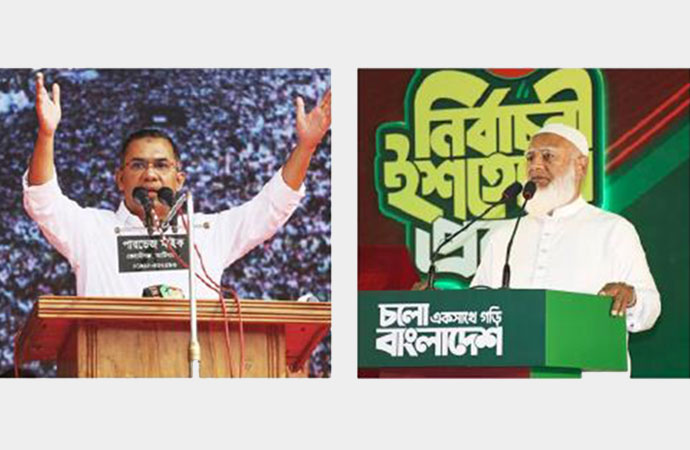
It is an election where the winners may take a while to be determined, but we do already know the losers. Come February 12, Bangladesh will revert to democratic rule following parliamentary elections and a referendum on the July Charter. The new government will face a plethora of challenges, including reviving the economy, addressing demographic pressures, and healing the divides caused by the ousted Awami League regime - who are the ones set to lose most from a free-and-fair election, coupled with a verdict in favour of 'Yes' in the referendum.
As for who forms the next government, with a week to go, there is an apparent panic in Dhaka's elite circles and chatterati, regarding the Islamist wave represented by the resurgent Jamaat-e-Islami. They have even formed an alliance whereby they have more-or-less swallowed the child of the July 2024 Uprising, the National Citizen Party, or NCP. It has always been known that the young revolutionaries who brought down the authoritarian regime led by the Awami League enjoyed some ideological affinity with Jamaat. They represent a generational shift in which the old Islamists are no longer castigated for their role at the country's founding in 1971. Rather, they attract the support of even emancipated women such as the students of Dhaka University, who flocked to the polling booths to elect students affiliated with Jamaat's student wing, to represent them in student union elections last September.
Subsequent elections in four other universities have confirmed this generational shift favouring Jamaat. The Bangladeshi electorate this time is very young, and following the Uprising, this young segment is not only the largest - 44% of the electorate is aged 18-37 - it is also the most politically conscious and active. Expect turnout to be highest among this segment too. If they vote in line with the students of the five universities, Jamaat is entering the race with a huge advantage In terms of sheer momentum.
But it is far from a given that they will. Pitted against the Jamaat-led alliance is the one led by the BNP, perceived as a vanguard of the old order, over the course of its decades-long rivalry with the Awami League. It's an image that doesn't sit comfortably with the party, one they would like to shed. And in the leadership style of their new chairman, Tarique Rahman, they may have the perfect person to pull off a 'bridging effect', between the old and the new.
Since arriving back in Bangladesh on December 25, Tarique Rahman has been the centre of attention, treated almost as a godsend by liberal sections of society fearing an Islamist takeover. He has not hesitated in pushing his daughter Zaima into the spotlight, having her accompany him during important meetings, for example with the Indian foreign minister, Subramaniam Jaishankar, when he came to attend the funeral of the BNP's late chairperson, the thrice-former premier, and of course Tarique's mother, Begum Khaleda Zia. The massive crowds greeting Tarique on his return, followed by huge turnout at Begum Zia's subsequent funeral, served to shift the momentum of the election back towards the BNP, some would say decisively, from a point where it seemed to be slipping away for the BNP, that we ourselves have described before as a "government in waiting".
That momentum behind Tarique has continued on the subsequent tour he has undertaken across the nation. Wherever he has gone, the crowds have thronged in numbers few can remember for any other politician in the post-1991 era. This week his wife Zubaida too entered the campaign, perhaps a bit later than most people expected. Bangladeshis love a taste of Camelot, and the Rahmans have certainly given it to them. They are also generally averse to radical change, which is why the smart money is still on the BNP to fulfil its destiny and form the next government, despite all the gains Jamaat is expected to make, towards improving on its previous best showing of 18 seats and 12% of the vote. Pushing it all the way to cross the 150 mark needed for a parliamentary majority, is probably still a bridge too far for the Islamists. Even with NCP in tow.
Tarique, who comes across as quite a young 60-year-old, was in constant touch with the leaders of the 2024 Uprising, and directed the BNP's student wing to join the protests very early. He is on very good terms with most of the NCP leaders, and even hosted a Jamaat delegation at his home, soon after arriving back. In the days following the Uprising, he insisted his desire was to form a 'national government' comprising representatives from all the forces that brought down the AL regime, loosely termed as the anti-Fascist alliance.
All this is perhaps more than enough, for Bangladeshis to forget the allegations that swirled around him when the BNP was last in power, at the head of a 4-party alliance that included Jamaat. At the same time it must be acknowledged of course, that the Awami League, despite being at its most repressive, failed to prove even 5% of the allegations that cropped up against Tarique in those days.
The fact that the BNP and Jamaat are competing so fiercely against each other today, from forming that formidable alliance in 2001-6 that spooked Sheikh Hasina's Awami League into turning dictatorial, is less a reflection of the two parties going their separate ways, than the failure of the AL's divisive politics, that culminated in the Uprising. A 'national government' may still be on the cards.
What are they promising?
There is also potential for renewed social unrest if voters perceive a return to business as usual.
Relations with India, China, Pakistan, the EU and the US will also be priorities for a new administration. Navigating the current geopolitical turbulence will not be easy for any new government, not least for a country with the level of social, economic, political and historical baggage as Bangladesh, according to Chatham House, the London-based think tank.
What happens in Bangladesh offer lessons to other countries in South Asia and the Global South, notably those who have experienced Gen Z protests in recent times. How Bangladesh recovers and implements its renewed democracy will be a prominent signal for other countries in the region and around the world.
The fact that Jamaat chooses to pursue its ultimate aim of establishing a Shahriah-based society through democratic means, choosing the path of electoral politics, has driven other Islamists to condemn it as munafiq (hypocrite). Yet choosing that path has also forced it to be less fundamentalist in its messaging, allowing it to appeal to a wider cross-section of the electorate. It unveiled its election manifesto ahead of the upcoming election this week, pledging to include a significant number of women in the cabinet if voted to power.
The pledge comes after the circulation of a screenshot of a post from Ameer-e-Jamaar Shafiqur Rahman's verified X account that began spreading on social media recently. The post has since been deleted, with Jamaat claiming the account had been hacked. It brought the troubling issue of women and their place in Islamist (as opposed to Islamic) societies. Influential London-based weekly The Economist described Jamaat as "Taliban-lite".
Jamaat also promised to introduce state funding for political parties contesting the parliamentary election, with annual allocations to be provided from the national treasury in proportion to the number of seats and votes secured.
Although Jamaat has not fielded any female candidates in the upcoming election, other parties within the Jamaat-led 11-party alliance have nominated women candidates. Jamaat Ameer Shafiqur Rahman and Secretary General Mia Golam Porwar formally unveiled the party's election manifesto, titled "A safe and humane Bangladesh's manifesto" at a city hotel in the capital.
The 41-point manifesto - with priority given to 26 points - also promises a safe and dignified working environment for women. It states that during maternity, working hours will be reduced to five hours per day with the mother's consent. The reduced hours (3 per day) will be subsidised.
Addressing the programme, Shafiqur Rahman said the country must come before any party, and a party before any individual, adding that the opposite had been practised over the last 54 years.
"We would not have had a map without 1947. Without that map, we would not have fought in 1971. And without the state achieved in 1971, we would not have had the opportunity to repair it in 2024. So each of these is interconnected," he said.
He said the party's manifesto focuses on ensuring a safe environment for women, the healthy development of children, and bringing about a transformative improvement in the lives of farmers.
Shafiqur also said his party does not seek to form a partisan government or celebrate Jamaat's victory alone.
"We do not want Jamaat's victory; we want the victory of the 18 crore people of the country. We do not want family-based politics," he said.
Referring to criticism and personal attacks against him, he said, "Missiles have been launched at me from all sides... Those who engaged in character assassination, I have forgiven them."
Stressing that retaliation does not align with his values, he added, "Politics of revenge has ruined us. We want to practise a new kind of politics and move forward together with the youth."
According to the manifesto, priority has been given to national interest, safeguarding independence, sovereignty; establishing a discrimination-free, just and humane state; empowering youth and prioritising them in governance; and ensuring a safe, dignified and participatory state for women.
The manifesto also emphasises improving law and order to build a drug-, extortion- and terror-free society, establishing honest leadership and institutional reforms to eliminate corruption, and building a technology-driven modern society with large-scale employment across technology, manufacturing, agriculture and industry.
It further pledges merit-based recruitment and free application for government jobs, comprehensive reforms in the banking and financial sectors to restore confidence and create a transparent, investment- and business-friendly economy, and ensuring a strong and functional democracy through proportional representation elections and a strengthened caretaker government system.
The manifesto promises justice for what it described as state-backed killings, extrajudicial actions of the past, protection of fundamental human rights, preservation of the July Uprising's history, and rehabilitation of families of martyrs and injured July fighters.
Other priorities include a technology-led agricultural revolution, ensuring fully adulteration-free food security by 2030, implementing the "three zero" vision - zero environmental degradation, zero pollution and zero flood risk - to build a green and clean Bangladesh, and promoting industrialisation through the development of small and medium enterprises alongside heavy industries.
It also highlights fair wages, improved living standards and safe working environments, particularly for women; guaranteeing expatriates' voting rights and participation in nation-building; ensuring equal citizenship rights beyond majority-minority divisions; and providing special support to disadvantaged groups.
The manifesto further commits to universal healthcare system, phased free advanced treatment for the poor, fundamental reforms in education with gradual introduction of free education, keeping commodity prices within purchasing capacity, ensuring full provision of basic necessities, overhauling transport systems to reduce travel time between Dhaka and divisional cities to two to three hours, affordable housing for lower- and middle-income families.
Priority has been given in prevention of the resurgence of fascist systems through continued reforms and trials, introducing a universal social security system, and establishing a transparent, accountable welfare state.
Senior party leaders, including Nayeeb-e-Ameer and former MP ANM Shamsul Islam, and other central leaders of Jamaat-e-Islami, were present at the event.
A large number of foreign diplomats also attended the programme. They included ambassadors, high commissioners and representatives from the United States, United Kingdom, China, Pakistan, Turkey, Malaysia, Sri Lanka, Australia, Italy, Singapore, Maldives, Iran, Canada, Japan, France, Germany, Norway, Sweden, the Netherlands, South Korea, Switzerland, Spain, Brazil, Bhutan, Brunei, Kosovo and the Vatican, as well as representatives of the European Union.
Representatives from international and multilateral organisations were also present, including the United Nations, UNDP, International Republican Institute (IRI), National Democratic Institute (NDI), Democracy International and the International Labour Organization (ILO).
In addition, leaders of various political parties, senior journalists, academics, business leaders and prominent professionals from different sectors attended the manifesto unveiling ceremony.
Jamaat rewriting history
Apart from the issue of women, another thing that has been bothering the electorate since Jamaat's return to prominence has been its attempts at rewriting the history of Bangladesh's Liberation War. While it is true that the younger demographic today is naturally less attached to the nuances of Bangladesh's birth story, historic revisionism aimed at whitewashing one's role is not all that different from the Awami League's attempts over the years, to monopolise the glory of attaining independence - especially where objective versions of history exist that tell us otherwise.
Jamaat's latest attempt at 1971 revisionism would seem to consist of claiming their (newly) man, Oli Ahmad, as the very first soldier to have revolted against the Pakistanis on the night of March 25, 1971, even within the 8 East Bengal Regiment that we know rose up first under the then-Major Ziaur Rahman.
The Ameer-e-Jamaat said as much during a tour of Chattogram this week, and while facing backlash online, their supporters and activists were careful to make the distinction: they are not claiming Oli Ahmad declared independence before Zia - only that he revolted first.
Their source for this would seem to be some of Oli Ahmad's own interviews and speeches, his biography on the website of his party LDP, and his book on the war. With all due respect to Oli Ahmad, who was undoubtedly one of the heroes of the war and clearly one of the first to revolt, without some degree of corroboration from other sources, this claim to have been the very first can hardly be entertained.
Jamaat supporters have questioned why the BNP or anyone else for that matter, have never challenged him over this claim, since he wrote the book decades ago, and has been saying this for years apparently. So let's have a look at what he has actually written or said.
In his memoir on the war, Oli Ahmad wrote:
"On the night of March 25, as soon as I received the news that the Pakistan Army cracked down in Dhaka, I was the first to rebel against Pakistan with the 8th Bengal Regiment under the leadership of Major Zia."
In an interview with BSS in December 2024, he said almost exactly the same thing.
These statements are a bit confusing. He seems to want to claim it, but doesn't quite. And by always adding "under the leadership of Major Zia", Oli Ahmad never left any scope for BNP to dispute what he said. Indeed by doing so, he nullifies his own claim of being the first. When you revolt under someone's leadership, you cannot be the first. That much should be understood.
Elsewhere, like on his party's website, the claim is more categorical:
"On 25th March 1971, at midnight Capt. Oli Ahmad was the first officer to revolt against Pakistan occupational Army after hearing that, Pakistan Army started massacre at Dhaka."
But your own party's website can hardly be a credible source for such a claim. You can proclaim yourself to be the Queen of England on your party's website, and no one would bat an eyelid. Without corroboration, it means nothing.
At the end of the day, it doesn't matter who was the very first. Zia, Oli Ahmad, Khaliquzzaman, Shamsher Mubin, Mir Shawkat, and others were all among the first, and it would be just very petty of any one of them to try and seek credit for being the very first.
Even Zia we know, had to be briefed by some of his junior officers on what the West Pakistanis were upto, before arriving at his fateful decision. Only then did he utter those famous words: "(In that case) We revolt."
Incidentally the Ameer in his speech also misappropriated those words, wrongly attributing them to Oli Ahmad. It led to even more anger from the BNP.
The BNP's manifesto
The BNP, for its part, is set to roll out its election manifesto on Friday (February 6), after Dhaka Courier goes to press this week, outlining eight key pledges it says will guide the country if it returns to power, with a focus on tackling corruption, strengthening good governance and promoting economic freedom.
BNP Chairman Tarique Rahman will formally unveil the manifesto at 3pm at Sonargaon Hotel in the capital, his press secretary Saleh Shibly told our sister newsagency UNB on Wednesday night.
Diplomats and intellectuals and noted citizens and prominent figures from various professional groups are expected to attend the programme.
Party sources said the manifesto has been prepared by combining BNP's previously announced 31-point reform outline, the July Charter, commitments made by Tarique Rahman at election rallies and the party's recent political directions.
The manifesto will give priority to young people, females, farmers and workers, with corruption eradication, establishment of good governance, creation of new jobs and economic liberation of people set as the party's main goals.
Special programmes have also been included to attract new voters.
According to party insiders, BNP's core promises will centre on eight major areas, including family cards, farmer cards, social security, job creation, youth and women's empowerment, demand-based education, improved healthcare and family-friendly policies. These programmes, already shared with the public, will receive the highest priority in the manifesto.
The manifesto will also include pledges to waive agricultural loans of up to Tk 10,000 including interest, construct the Padma Barrage in response to India's Farakka Barrage, implement the Teesta mega plan and address region-specific problems across the country.
Restoration of democratic governance, rebuilding the electoral system, judicial independence, administrative decentralisation, protection of human rights and strengthening anti-corruption institutions have been included as central themes.
Party policymakers said BNP's commitment is to return state ownership to the people and establish an administration free from partisan influence.
BNP leaders expressed hope that the combined manifesto, based on the 31-point agenda, the July Charter and target-group-focused commitments, will meet public expectations.
Sources said Tarique Rahman directly supervised the preparation of the manifesto, with the slogan 'Bangladesh First' given special importance.
BNP Standing Committee member Salahuddin Ahmed said the party has already presented practical programmes aimed at ensuring economic freedom for the people, which will be reflected prominently in the manifesto.
"The main objective of the BNP manifesto is to rebuild the collapsed state structure, establish a strong democratic state and consolidate our independence, security and democracy through constitutional reforms, ultimately ensuring economic freedom for the people," he said.
BNP announced its 31-point reform outline on July 13, 2023, aiming at constitutional and state reforms and economic emancipation.
The manifesto will elaborate on key issues including free and fair elections under a non-partisan government, independence of the Election Commission, protection of human rights, freedom of expression, transparent administration and economic recovery.
In line with the July Charter, the manifesto will also prioritise full independence and neutrality of constitutional bodies such as the Election Commission, Human Rights Commission and Anti-Corruption Commission.
The manifesto will include commitments to develop Qawmi madrasah, establish an Islamic research fund, modernise religious education and ensure an environment free from barriers to religious practice.
It will also promise special tribunals to prevent land grabbing from religious and ethnic minorities, security cells, state support during festivals and strict action to prevent communal violence.
Targeting the youth, BNP has pledged large-scale job creation, including one crore new jobs within the first 18 months in office, startup funds, IT training, access to new overseas labour markets and formation of an anti-drug task force.
Agriculture has been given special emphasis, with commitments to reduce input costs, ensure fair prices, simplify agricultural loans and ensure transparent procurement of rice and paddy.
Tarique Rahman has recently said farmers will no longer be forced to sell crops at a loss.
Women's safety, equal opportunities at workplaces, women entrepreneurs' fund, increased maternity allowances and fast-track tribunals to prevent violence against women have also been included.
BNP has already shared its eight priority social policy areas with the diplomatic community and development partners. These include family cards, farmer cards, health, education, sports, environment, employment and welfare-oriented roles for mosque- and madrasa-based religious leaders.
On January 21, BNP highlighted these eight sectors at a policy dissemination programme held at a city hotel in Banani, attended by ambassadors and diplomats from around 30 countries, including the United States, the United Kingdom, China, India, Pakistan and Russia.
A Independent Newsweekly
© Copyright 2026 | Designed by ARK Reepon & Developed by Cosmos Group Software Team




Leave a Comment
Recent Posts
ART SG 2026: Reflections from ...
Singapore, for a brief moment, becomes an entire city-sized gallery. E ...
The Final Act
The 13th Jatiya Sangshad elections, the final act in a three-stage tra ...
How Undecideds May Decide the Election
Curtain Falls on Bangladesh’s Interim Government as ..
US President Donald Trump said that he plans to lowe ..
The Gaza ceasefire began months ago. Here’s why the ..