



Society
Mosque in my memory


An Independent Newsweekly
Society
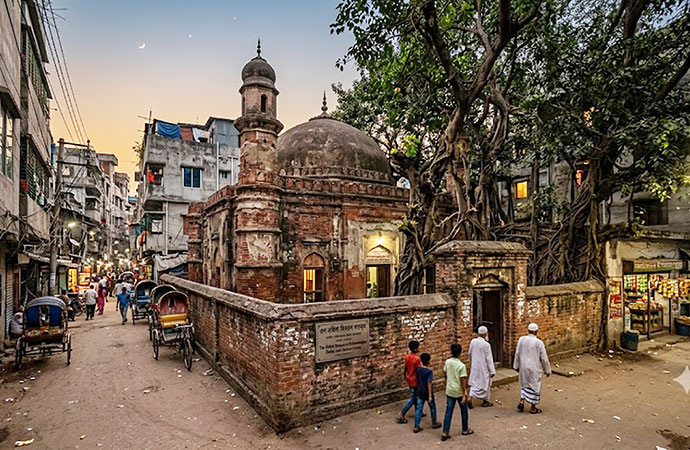
Recently, I saw a pamphlet published by the Islamic Foundation which states that Bangladesh is home to 350,465 mosques, with 71,596 located within the Dhaka division alone. This is an immense number. Consider the demographics: with Muslims making up roughly 90% of the population, if we assume Muslim males account for approximately half of the entire population, we have an estimated 8 crore male worshippers. Dividing this population by the total number of mosques reveals a fascinating ratio: approximately one mosque for every 228 people. Notably, almost every mosque serves as a place of worship primarily for men, while dedicated spaces for women remain exceedingly rare. These figures and analytics are meant simply for common understanding, rather than to serve as precise spiritual data or a definitive census of the pious.
These numbers are not my focus; as a 90s kid, I simply recall my memories of mosques. The roots of my own observations begin in that defining decade.
A Childhood Memory in Mohammadpur
I was about six or seven years old when I entered a mosque for the very first time. While the exact age is a wild guess, the memory of that day remains etched in my mind. My mother had gone to visit an old friend whose house was adjacent to a mosque in our neighbourhood of Mohammadpur. The structure was then known as the Masjid A/B Block, though it was later renamed Masjid-e-Bilal. While my mother became lost in gossip with her friend, my attention was drawn to this fascinating structure-an aesthetic style I had never encountered before.
It was maybe after prayer so there were a few man sitting a side moving back and front and read something. The structure itself was a large, tin-shaded hall supported by three or four prominent round pillars. The central front area was colourfully decorated and adorned with elegant Arabic calligraphy. Built into the pillars were small pockets designed to hold candles. The floor was a striking, pitch black, and a few racks stood filled with books bound in red and green cloth covers. In the right corner, water taps were secured behind an iron grill. While the ceiling of the hall was not exceptionally high, it possessed a decent, comfortable height. I stood there, utterly amazed by these intricate details.
Suddenly, a man scolded me sharply, demanding to know why I had entered and telling me to go away. Terrified, I stood frozen, unable to answer him. Fortunately, my mother appeared at the entrance just in time to rescue me.
To this day, I remember exactly who that man was, though I prefer to keep his name private. Interestingly, over the years, my resentment transformed into admiration. I deeply respect him for being a steadfast, practicing Muslim in our community; he was committed to his prayers when I was just a child, and he continues to pray today as I approach my own half-century.
Finding a Place in the Main Hall
That incident marked my introduction to the mosque. For a long time afterward, I would pass by the building and look at the beautiful Mimber (pulpit) from a distance, keeping my distance and choosing not to step inside.
Gradually, by the age of 12 or 13, I began attending the mosque regularly. However, I still could not enter the main prayer hall, as younger children were expected to pray in designated areas at the back.
My sense of empowerment arrived when I turned 15 or 16. As a grown-up, no one scolded me for stepping into the main hall anymore. With this newfound confidence, I began exploring other mosques across the neighbourhood. Among the prominent ones I visited were the Qaderia Mosque, Jame Masjid (popularly known as the Kobrostan Masjid), and the GonoBhavan Mosque, located directly opposite the Ministry of Defence office.
Jumma prayers on Fridays were always festive occasions for us-marked by taking a refreshing shower and wearing our finest clothes. Gathering with friends to pray at the GonoBhavan Mosque became a deeply cherished tradition. Looking back, I lose track of how many years we kept up that weekly ritual. It brings a profound sense of nostalgia.
From Tin Shades to Multistory Concrete
Over the decades, the architectural landscape of mosques in Dhaka has undergone a drastic transformation. The traditional tin-shaded structures have largely been replaced by multistory concrete buildings that closely resemble modern residential apartments.
During my childhood, the most ubiquitous term for a local place of worship was Chapra Masjid (tin-shaded mosque), found on almost every street corner of the city. Today, these institutions have upgraded not only their physical structures but also their identities, adopting grand names like Mokka Masjid, Modina Masjid, Baitul Aqsa, and Baitul Falah.
Generations come and go. People are born, they pray, they grow in piety, and they pass away. Hesitant children grow into confident teenagers who walk into the main prayer halls with ease, eventually growing old and leaving a void for the next generation to fill. While the number of mosques in the city has risen dramatically over the years, so too has the number of Musollis (worshippers). Along the way, one encounters all kinds of people-some who scold, some who are exceptionally friendly, and some who are rude. Yet, as the city's mosques multiply, the community of Musollis grows alongside them, ensuring that as one generation passes, another always steps forward to fill the gaps.
A Independent Newsweekly
© Copyright 2026 | Designed by ARK Reepon & Developed by Cosmos Group Software Team




Leave a Comment
Recent Posts
Is the international community ...
A spate of downgraded economic projections, from Bretton Woods to Mani ...
A Childhood Lesson in Arithmet ...
As children, we learned a simple mathematical rule: if we know the pri ...
Indian authorities launched a major security crackdo ..
Police dispersed garment workers from the Azampur ro ..
Why Saudi Arabia has struggled to defend itself agai ..
Iran-backed Houthis strike Saudi oil company Aramco’ ..