



Reportage
Bangladesh urged to build AI capacity, strengthen digital sovereignty


An Independent Newsweekly






Reportage
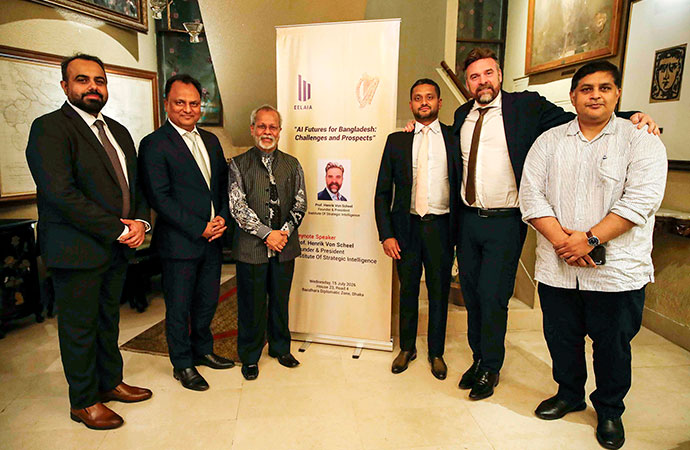
Bangladesh should invest in artificial intelligence (AI) talent, digital infrastructure and research while strengthening digital sovereignty to emerge as a competitive AI-enabled economy, speakers said at a discussion in the capital on Wednesday.
They said the country has a unique opportunity to harness AI for sustainable economic growth by capitalising on its youthful workforce, expanding digital infrastructure and ongoing policy reforms. However, they cautioned that the rapid rise of AI also presents challenges related to data privacy, intellectual property, surveillance and the erosion of human creativity and critical thinking.
The observations came at a discussion titled "AI Future for Bangladesh: Challenges and Prospects" held in the Baridhara diplomatic zone.
President of Eelaia Foundation and Honorary Consul of Ireland in Bangladesh Masud Khan said Bangladesh is well positioned to transition towards an AI-driven economy under the National AI Policy 2026-2030.
He said the country's priorities should include developing AI skills among young people, promoting AI adoption in high-impact sectors such as agriculture, healthcare and education, and transforming the ICT outsourcing industry into a knowledge-based AI services sector capable of competing in global value chains.
President and Founder of the Institute of Strategic Intelligence Professor Henrik von Scheel described AI as a transformative technology that raises serious concerns over intellectual property and data ownership.
He warned against overreliance on consumer AI platforms, saying current large language models depend heavily on user-generated information and cannot replace human creativity, intuition or critical thinking.
Senior diplomat and AI policy strategist Mohammad Khorshed A. Khastagir said AI is reshaping the concept of sovereignty, making digital infrastructure, data governance and technological capability increasingly important for national security and economic competitiveness.
He said Bangladesh must become an active participant-not merely a consumer-in the global AI ecosystem by strengthening its own technological capabilities.
Professor Shahab Enam Khan of Jahangirnagar University said Bangladesh should focus on long-term investment in AI research, computing infrastructure and technological sovereignty.
He noted that the country remains dependent on imported high-performance AI chips and called for the establishment of a national GPU infrastructure to support universities, research institutions, government agencies and the private sector.
Executive Director of the Centre for Alternatives Imtiaz Ahmed stressed the need for a long-term national AI strategy, saying investment in education and AI literacy from the school level would be essential for preparing future generations.
Speakers agreed that countries investing strategically in AI skills, innovation and responsible governance today would be better positioned to shape the future global economy while safeguarding national interests and human capabilities.
A Independent Newsweekly
© Copyright 2026 | Designed by ARK Reepon & Developed by Cosmos Group Software Team






Leave a Comment
Recent Posts
Is the international community ...
A spate of downgraded economic projections, from Bretton Woods to Mani ...
A Childhood Lesson in Arithmet ...
As children, we learned a simple mathematical rule: if we know the pri ...
Indian authorities launched a major security crackdo ..
Police dispersed garment workers from the Azampur ro ..
Why Saudi Arabia has struggled to defend itself agai ..
Iran-backed Houthis strike Saudi oil company Aramco’ ..