



Column
Jamaat-e-Islami won the battle. But it may have lost the future.

An Independent Newsweekly

Column
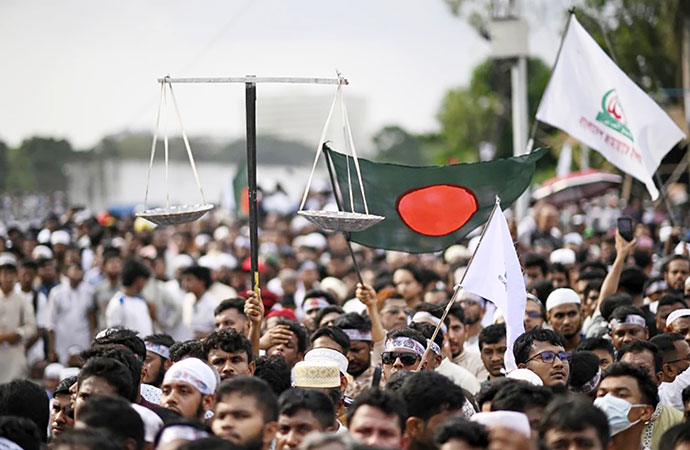
Photo: AP/UNB
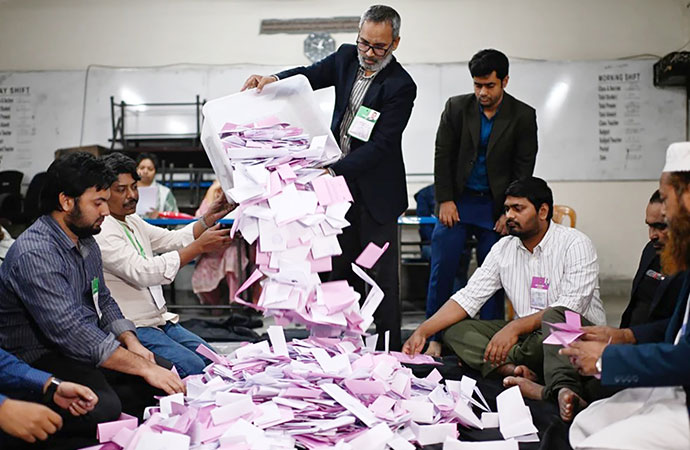
In an analysis published before Bangladesh’s Feb. 12 election, I argued that the widening chasm between Jamaat-e-Islami and the country’s women could shape the outcome. Jamaat did make historic gains. Yet the final results suggest another, less visible force at work: a quiet but consequential negative vote by women that may have prevented Jamaat from capturing power outright.
In Bangladesh's Feb. 12 national election, Jamaat achieved something once thought improbable. A party long marginalized for its association with the atrocities of 1971 secured 77 parliamentary seats through alliances-about 31 percent of the vote. By any measure, it was a political resurrection.
Yet Jamaat fell short of the ultimate prize: power. In the campaign's final weeks, its leaders spoke openly of forming the next government. Television pundits and YouTube commentators echoed that confidence, their certainty swelling into inevitability. Listening to them, one could not help but wonder whether Bangladesh had finally closed the book on its past.
It had not. And one of the decisive reasons may have been Bangladesh's women.
Jamaat's appeal to female voters was rooted in a familiar script. Its leaders promised protection. At a rally in Barishal, party chief Shafiqur Rahman pledged he would sacrifice his life to defend the nation's "mothers and sisters." But in the same breath, he insisted that women-no matter how educated or accomplished-could never surpass men.
This was less a promise than a warning. It revealed a worldview anchored in hierarchy, not equality.
For much of Bangladesh's history, such rhetoric carried political weight. The idea that men are women's natural guardians has deep roots in South Asian society and betond. But modern Bangladesh has changed in ways Jamaat appeared unwilling-or unable-to recognize.
Women today are not confined to the margins of economic life. They are its backbone. They make up roughly 44 percent of the country's labor force, and the garment industry-the engine of Bangladesh's export economy-is overwhelmingly female. In millions of households, women are not dependents. They are providers.
Economic independence has reshaped political consciousness.
Jamaat's proposal to reduce women's working hours was presented as a compassionate gesture, designed to ease childcare burdens. But many women saw it for what it implied: a return to dependency. Protection, in this formulation, came at the cost of autonomy.
The reaction was quiet but unmistakable. A domestic worker known to a relative of mine insisted on traveling back to her village to vote, fearing that Jamaat's rise would jeopardize her daughter's job in a garment factory. Across the country, similar anxieties surfaced. Some women reportedly faced divorce for defying their husbands' voting instructions. Yet they voted anyway.
These individual acts of defiance point to a broader transformation. Women turned out in large numbers, many casting ballots freely for the first time. They came not merely as participants, but as independent political actors.
The key to this change: women's entry into labor market.
The political scientist Naila Kabeer has long argued that access to paid work fundamentally alters women's decision-making power. Employment does more than raise incomes; it shifts authority. Women who earn are more likely to assert control over their lives-and their votes. In Bangladesh, that shift has been underway for decades.
Jamaat's electoral gains suggest it successfully mobilized a substantial segment of the electorate. But its failure to secure power suggests it misread another segment entirely. Its rhetoric spoke to a Bangladesh that no longer exists-a society in which women's political choices were mediated through male authority.
That Bangladesh is fading.
This transformation is visible across the Muslim world. In Turkey and Indonesia, women's political participation has steadily increased, including within religiously conservative parties. The trend reflects not ideological conversion, but structural reality: modern economies require women's labor, and political systems must eventually accommodate their voices.
Bangladesh has reached that point.
Women voters did not march in protest. They did not organize mass rallies. They did something far more consequential. They voted. Quietly. Individually. Autonomously.
Jamaat's leaders promised to protect women. Instead, women protected their own future. That may prove to be the most important political fact of Bangladesh's 2026 election.
Hasan Ferdous is a journalist and author, based in New York
A Independent Newsweekly
© Copyright 2026 | Designed by ARK Reepon & Developed by Cosmos Group Software Team




Leave a Comment
Recent Posts
Energy Security At Stake
For the last ten days, Bangladesh has been grappling with a severe gas ...
The strange disappearance of M ...
The Bangladeshi authorities should immediately comply with a July 12, ...
It’s important to address some irritations in Dhaka- ..
The government is set to import Liquefied Natural Ga ..
The US military struck dozens of targets in Iran
When Politicians Ignore Economic Expertise