



Column
The journey ahead


An Independent Newsweekly

Column
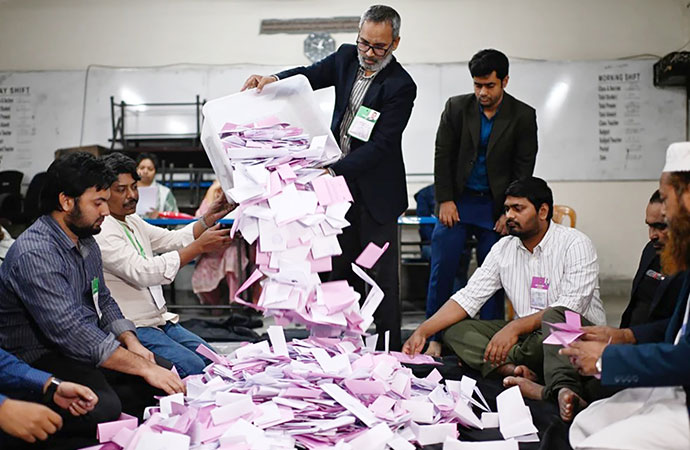
Photo: AP/UNB
The Bangladesh Nationalist Party's (BNP) two-thirds majority in the February 12 general election is a resounding vindication of its struggle to retain political relevance during the long and vindictive years of the Awami League's (AL) rule. The Jamaat-e-Islami's (Jamaat) tremendous electoral achievement in this election is no less telling. It has reclaimed its role in post-Pakistan Bangladesh's history. The National Citizen Party (NCP), initiated by the Students Against Discrimination protesters and the Jatiya Nagorik Committee of 2024, has not managed to find exclusive space for itself in this election but has won a few seats in alliance with Jamaat. Yet, it is now a part of the parliamentary spectrum. That is no mean achievement.
Both the government and the opposition will be headed now by two parties that came under the previous regime's repressive scanner, though for different reasons. Jamaat was viscerally suspect because of its support for Pakistan during the Liberation War of 1971 and for its overt use of religion to defend its political position thereafter. The secular AL, unquestionably the party of Independence, obviously found itself in mortal ideological combat with the religious remnants of the reviled Pakistan era. As for the BNP, its father figure, Ziaur Rahman, was seen as a rival of Sheikh Mujibur Rahman - the AL's Bangabandhu - for a place in the annals of the Liberation War and thence of independent Bangladesh's history. Here, the conflict was not ideological but personal.
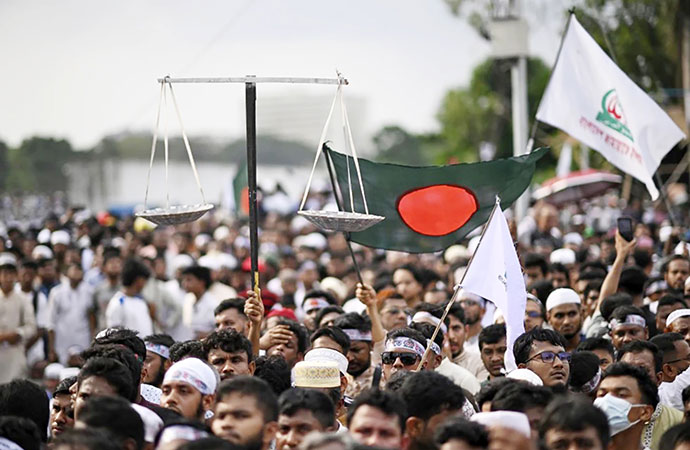
What resulted was a hiatus that had begun at least as far back as the dawn of this century. What destroyed the hiatus was the Mass Uprising of July 2024, which broke through the cordons of a garrisoned past - whether of the AL's, the BNP's or Jamaat's - to snatch back Bangladesh here and now. In the historically short months from July 2024 to the February 2026, Bangladesh went from hosting a revolution to holding an election. This achievement attests to the capacity of the Bengali people to wage war so as to make peace. East Bengal/East Pakistan emerged from the embers of the Partition of India in 1947. Bangladesh emerged from the ruins of the Pakistan dream in 1971. The Bangladesh of 2026 follows in that tradition.
What is admirable is that the latest convulsion - the general election - has occurred peacefully on the whole. Political parties contested against one another; politicians old and young entered the fray; citizens weighed their options in the privacy of their minds and homes; women acted as humans with full political agency even in a patriarchal world; religious minorities did not believe that their status deprived them of the right to vote for the national future that they desired; and the election for the next government and the referendum on the future political structure of Bangladesh all proceeded.
This is truly a new beginning for Bangladesh. Where will the journey lead? For that question to be answered, a previous question must be tackled: Where is the journey beginning?"
Here's my two-cents-worth of an answer. This journey is beginning at a junction between past and present. For the future to take shape, Bangladesh must break with its winner-takes-all culture, which has distorted its democratic landscape for far too long. That culture has produced a neo-patrimonial polity which conflates the roles of the political leader, his or her political party, the government, and the state. Ideally, at least in a Westminster system, the leader is not the party, the party is not the government, and the government is not the state. The leader owes his power to the party, the party owes its power to elections, the government is the bureaucratic expression of party power, but the state rises above them and belongs to all - to the leader, to all parties, to the government, to the opposition, to civil society and to business, that is, to the people at large. There is no way in which the political leader can arrogate to himself or herself the reality of the party, the party that of the government, or the government that of the state.
In this evolving context, democracy has to be inclusive if it is to mean anything. Observers have pointed to a possible need for the victorious BNP to move beyond its visceral hostility with the disgraced Awami League, even if this means confronting even more viscerally-driven parties that can take to the streets. Whether or how the AL would be rehabilitated is a hypothetical question. In fact, it is not the most urgent question facing Bangladesh. That question is: Is a new Bangladesh in the offing, or only old mineral water in new plastic bottles?
It is to be hoped that the Constitutional changes inherent in the July Charter, which formed the backbone of the Referendum in which a majority of Bangladeshis have said "yes", will provide the formal blueprint of a Bangladesh where dynastic or money politics does not prevail over the expressed wishes of the people.
That should be the Bangladesh Way. That should be the Bangladeshi Journey.
The writer is the Principal Research Fellow of the Cosmos Foundation. He may be reached at epaaropaar@gmail.com
A Independent Newsweekly
© Copyright 2026 | Designed by ARK Reepon & Developed by Cosmos Group Software Team




Leave a Comment
Recent Posts
Dhaka, Tokyo relationship to c ...
Deputy Chief of Mission of the Embassy of Japan in Bangladesh Yoshida ...
Democracy puts a premium on et ...
And just like that, the deed was done. With a volley of 'Ayes!’( ...
Dhaka still eyeing ‘conducive’ setting for PM’s Delh ..
Gallery Cosmos Artist Residency, 2026
Summit seeks reinstatement of FSRU deal
Hatful of medals for Bangladeshi whiz kids at WMI 20 ..