



World this week
Israeli Prime Minister Benjamin Netanyahu


An Independent Newsweekly
World this week
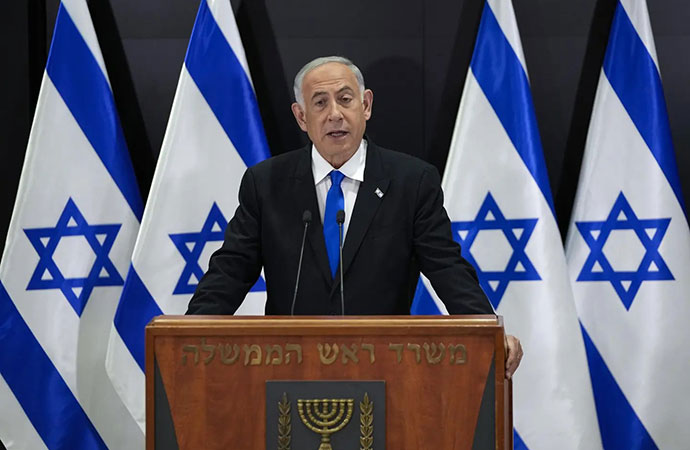
Photo: AP/UNB
Israeli Prime Minister Benjamin Netanyahu said that he has approved a $35 billion natural gas export deal to Egypt, the biggest gas deal in Israeli history. The agreement could also help repair relations between the two countries strained during the two-year war in the Gaza Strip. The gas will be delivered to Egypt over the next 15 years by US energy giant Chevron, a key owner of the gas field off Israel's coast in the Mediterranean Sea. Half of the proceeds are expected to go to Israel's state coffers. In a recorded video statement, Netanyahu said "it contributes to stability in our region."
Egypt, which borders both Israel and Gaza, has served as a key mediator between Israel and the Palestinian militant Hamas group leading up to the US-brokered ceasefire that was agreed on in October. Cairo has also been a vocal critic of Israel's offensive, which has killed tens of thousands of Palestinians and caused widespread destruction in Gaza.
A father and son duo, Sajid and Naveed Akram, unleashed terror and killed 15 people on a popular Australian beach, shocking a country where gun violence is rare. The target was a Hanukkah celebration where hundreds had gathered to celebrate the first day of the eight-day Jewish holiday. The dead included a 10-year-old girl, a rabbi and a Holocaust survivor. Dozens of others were injured, some seriously. Prime Minister Anthony Albanese called it an act of antisemitic terrorism.
Albanese said that Australia's main domestic spy agency, the Australian Security Intelligence Agency, had investigated the son for six months in 2019. The Australian Broadcasting Corp. reported that the agency had examined the son's ties to a Sydney-based Islamic State group cell. The carnage stopped when a Syrian immigrant, Ahmed Al Ahmed, appeared to tackle and disarm one of the gunmen, before pointing the man's weapon at him, then setting the gun on the ground. Sajid Akram was killed by police.
The presidents of Latin America's two largest countries urged restraint in the face of escalating actions from the United States toward regional neighbour Venezuela. US President Donald Trump on Tuesday ordered sanctions against all oil tankers entering and leaving Venezuela, a move that the government of Venezuelan President Nicolas Maduro called a "grotesque threat." Trump's administration has moved thousands of troops and nearly a dozen warships - including an aircraft carrier - to the region, spiking tensions. Maduro's government has rejected Trump's moves and has alleged that the US military aims to control Venezuela's vast oil reserves.
The US military said Monday (Dec. 15) that it attacked three boats accused of smuggling drugs in the eastern Pacific Ocean, killing a total of eight people, even as scrutiny over the boat strikes is intensifying in Congress. Mexican President Claudia Sheinbaum, at her morning press conference, called for dialogue and asked the United Nations to act to prevent violence in Venezuela.
Italy signaled that it might not support a massive transatlantic free trade deal between the European Union and South American countries, casting further doubt on the agreement as European leaders gather for a summit in Brussels and farmers enraged by the trade pact descend on the capital. Premier Giorgia Meloni told Italian parliament on Wednesday that signing the deal between the EU and the five active Mercosur countries - Brazil, Argentina, Uruguay, Paraguay and Bolivia - would depend on key changes to the accord.
Meloni said that signing the agreement in the coming days "would be premature.'' She called for a package of measures to protect Italian farmers before she can approve the deal. "This doesn't mean that Italy intends to block or oppose (the deal), but that it intends to approve the agreement only when it includes adequate reciprocal guarantees for our agricultural sector.''
A Independent Newsweekly
© Copyright 2026 | Designed by ARK Reepon & Developed by Cosmos Group Software Team




Leave a Comment
Recent Posts
Dhaka, Tokyo relationship to c ...
Deputy Chief of Mission of the Embassy of Japan in Bangladesh Yoshida ...
Democracy puts a premium on et ...
And just like that, the deed was done. With a volley of 'Ayes!’( ...
Dhaka still eyeing ‘conducive’ setting for PM’s Delh ..
Gallery Cosmos Artist Residency, 2026
Summit seeks reinstatement of FSRU deal
Hatful of medals for Bangladeshi whiz kids at WMI 20 ..