



Reportage
When dreams are shattered


An Independent Newsweekly


Reportage
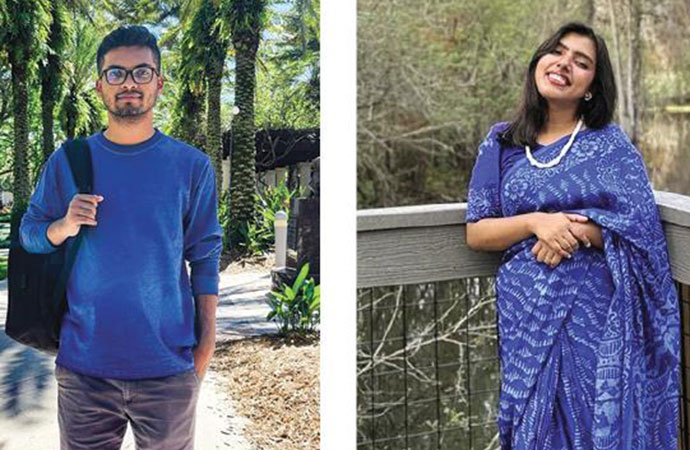
Zamil Ahmed Limon and Nahida S. Brishty. Photo: Collected
On April 22, the University of South Florida Police Department and the Hillsborough County Sheriff's Office put out an alert requesting the public's assistance in locating two Bangladeshi graduate students at the University of South Florida, Zamil Ahmed Limon and Nahida S. Brishty, who had been reported missing for almost a week at that point. Detectives with them were last seen separately in different parts of the USF campus in Tampa about an hour apart on a Thursday morning (April 16). In an interview with FOX13, Limon's brother said the two of them were a couple considering marriage at some point, but more serious about finishing their studies first, so this was highly unusual.
The police also confirmed there were no immigration issues with either student, and so being picked up by ICE was not a concern (some members of the community and Limon's family had raised this concern).
Limon was a USF doctoral student pursuing a degree in geography and environmental science and policy, while Bristy was a USF doctoral student studying chemical engineering.
On April 24, the body of Limon was found on a bridge over Tampa Bay, and his flatmate was taken into custody, law enforcement authorities said. Limon's remains were found on the Howard Frankland bridge, but Nahida Bristy remained missing at that point, Hillsborough County Chief Deputy Joseph Maurer said.
Limon's flatmate in an off-campus apartment, Hisham Saleh Abugharbieh, 26, was taken into custody at his family's home nearby on preliminary charges that included unlawfully moving a dead body, failure to report a death, tampering with evidence, false imprisonment and battery.
Officers encountered Abugharbieh as they responded to a report of domestic violence at his family's home, just north of the campus, and were able to remove his relatives to safety. But then he barricaded himself inside and refused to come out. A SWAT team responded, along with a drone, a robot and crisis negotiators, before Abugarbeih came out with his hands up, apparently wearing nothing but a blue towel.
"This is a deeply disturbing case that has shaken our community and impacted many who were hoping for a safe resolution," said Sheriff Chad Chronister. "While the discovery of Zamil Limon's remains is heartbreaking, I want the public to know that our detectives worked and are working tirelessly and relentlessly to uncover the truth."
Abugharbieh had been a USF student but was not currently enrolled. University records showed he had attended the school from Spring 2021 through Spring 2023, and had pursued a BS in Management, a university spokeswoman said.
Abugharbieh also had several previous arrests, the sheriff's office said. He was charged with battery and burglary of an unoccupied dwelling in September 2023, and with battery that May - both classified in court records as misdemeanors. Court records show Abugharbieh may have entered into a diversion program.
Soon after, Bristy's family confirmed they had been contacted by the US authorities to confirm she too had been killed.
"Our sister is no longer with us. Inna lillahi wa inna ilaihi raji'un," her brother Zahid Hasan Pranto said in a Facebook post on Saturday.
Further human remains were found near the same bridge where Limon's remains were found.
The timeline
In a motion prosecutors filed to keep Abugharbieh in jail while he faces the charges, they laid out a detailed timeline of how investigators think the two University of South Florida students may have died as well as their and the suspect's actions around the time they went missing:
April 7 and 11: Amazon purchases
Abugharbieh allegedly makes several purchases on Amazon, including duct tape, trash bags, lighter fuel and fire starter, according to the arrest warrant affidavit in the case.
April 13: A ChatGPT conversation
A ChatGPT conversation cited in the motion for pretrial detention shows Abugharbieh asks: "What happens if a human has a put in a black garbage bag and thrown in a dumpster," to which the chatbot responds that it sounds dangerous.
"How would they find out," Abugharbieh replies, according to prosecutors.
April 16: Last contact with the two students
Friends of Limon and Bristy are in touch with them during the day, but they can't reach them later, according to the motion filed by prosecutors Saturday in Hillsborough County Court. Bristy and Limon speak briefly on the phone several times.
Around midday, Bristy is seen on surveillance video walking on the university's campus, according to the motion. But she doesn't show up to a planned meet-up that evening with a friend to get her eyeglasses and doesn't answer the friend's calls.
Limon's phone location shows him in the vicinity of his home and campus before going to Clearwater - roughly 32 miles from his residence - around 7:43 p.m.
Abugharbieh's white Hyundai Genesis G80 is seen traveling in the same area within about 10 minutes of that, according to prosecutors.
Phone and traffic data show consistencies between the suspect's and Limon's devices' locations throughout the night.
About 10:30 p.m., a DoorDash order for trash bags, Lysol wipes, Febreze and other items from CVS is placed from Abugharbieh's phone and delivered to the apartment door about half an hour later.
Limon and Abugharbieh's other flatmate sees Abugharbieh using a cart to move cardboard boxes from his room to a compactor dumpster at their apartment complex, according to the motion.
April 17: Students reported missing
A ChatGPT search on Abugharbieh's phone asked "are cars checked at the Hillsborough River state park," the affidavit says.
The suspect goes to the Howard Frankland Bridge - a strip of I-275 spanning Tampa Bay - twice between 1 a.m. and 4:30 a.m., according to the affidavit, citing phone and traffic data.
Meanwhile, Limon and Bristy are officially reported missing.
The next day, police search Bristy's campus workplace and find she left personal items including her lunchbox, a MacBook and her iPad.
April 22: Investigators question suspect's mother
Authorities speak with Abugharbieh's mother, who says she last saw her son Saturday, April 18, the motion reads. She mentions Abugharbieh struggles with anger management and was violent with his family in the past, according to the document.
The suspect was arrested twice in 2023 on charges of battery, which were later dropped, according to court records. But after one of those incidents, his brother filed for an injunction that prohibited Abugharbieh from coming near him or his home. When the injunction expired last May, a request for extension was denied.
April 23: Searches underway
The Hillsborough County's Sheriff's Office elevates the status of the two missing students to "endangered."
Authorities search a dumpster, in which they find a black cushion floor mat with blood, Limon's wallet, Bristy's phone case, Limon's glasses and clothing all stained with blood. Around this time, Abugharbieh gives authorities permission to search his car, which prosecutors say appeared to have "recently been cleaned."
Abugharbieh also lets investigators access the vehicle's data, but there didn't appear to be any, the affidavit said.
Abugharbieh gives inconsistent accounts of when he last saw Limon and Bristy, according to the affidavit. He first tells detectives the pair had "never been in his vehicle nor did he go to Clearwater." When confronted about his vehicle being in Clearwater, he says he went there to look for fishing spots and later changed his story again, telling detectives Limon had asked to be driven with his girlfriend to Clearwater, the document says.
During these interviews, Abugharbieh's left pinky finger is wrapped in a bandage, a wound he later says he got while cutting onions, the motion says. Detectives also observe a fresh laceration on his left upper tricep and additional cuts on both legs, according to the filing.
Prosecutors say Abugharbieh asked ChatGPT on April 23, "What does missing endangered adult mean."
April 24: Limon's body found, suspect arrested
Detectives searching the Howard Frankland Bridge find a black trash bag where phone data shows the suspect stopped early on April 17, according to the motion.
Prosecutors say the bag is similar to those found under Abugharbieh's bed. A man's remains are discovered inside and positively identified as Limon, they say in the filing.
Limon's death is ruled a homicide, the motion states, citing "multiple sharp force injuries," and a medical examiner's report that noted a deep stab wound to his lower back that penetrated his liver, among other wounds.
That morning, Abugharbieh is arrested hours later at a home in Lutz, Florida, after law enforcement respond to a domestic violence incident involving a family member, the sheriff's office says.
April 25: Suspect appears in court and detailed evidence is unveiled
The pretrial motion is filed, with prosecutors alleging Abugharbieh made the purchases on Amazon and citing his alleged ChatGPT conversations.
Abugharbieh makes an initial appearance in court Saturday morning.
In addition to two counts of first-degree murder, he faces charges of unlawfully moving a dead body, failure to report a death with intent to conceal, tampering with physical evidence, false imprisonment and battery, the Hillsborough County Sheriff's Office says.
The Hillsborough County Public Defender's Office says it is appointed to the case but declines to share details, citing Abugharbieh's right to a fair trial.
"We remain focused on representing our client through the legal process," the office says in a statement.
April 26: Human remains found in waterway
A second black trash bag is spotted on the shoreline, just south of where Limon was found.
Inside, investigators discover another set of human remains in an "advanced stage of decomposition," according to an arrest affidavit.
The bag is found tied in a knot, in the same manner as the one containing Limon's remains, according to the affidavit. Investigators also note the body was wearing clothing consistent with the distinctive outfit Nahida Bristy was last seen wearing in surveillance video.
Like Limon, the victim has multiple stab wounds. Formal identification is pending.
April 27: Killings added to investigation into OpenAI
The state of Florida expands its criminal investigation into OpenAI, the parent company and creator of ChatGPT, to include the killings of Limon and Bristy, Florida Attorney General James Uthmeier announces.
"This is a terrible crime, and our thoughts are with everyone affected," OpenAI spokesperson Drew Pusateri says in a statement. "We're looking into these reports and will do whatever we can to support law enforcement in their investigation."
Uthmeier said last week his office is looking into whether ChatGPT helped the suspect in a deadly shooting at Florida State University carry out the crime and "whether OpenAI bears criminal responsibility for ChatGPT's actions."
April 28: Suspect held without bond
A status conference is held to determine how the case against Abugharbieh will proceed.
Hillsborough County Judge J. Logan Murphy grants the prosecutors' request to hold Abugharbieh without bond on the two first-degree murder charges as he awaits trial. Abugharbieh does not appear in court for the meeting, according to Erin Maloney, a spokesperson with the State Attorney's Office.
Friends of University of South Florida victims Nahida Bristy and Zamil Limon remembered the doctoral students on Tuesday as their family away from home and said they were "shocked" by their deaths.
OpenAI's role in the murder
The investigation into the deaths of Limon and Bristy took a twist when prosecutors said that the suspect asked ChatGPT about body disposal in the lead-up to the students' disappearance, raising questions about the role tech companies have in preventing the misuse of the powerful chatbots.
It wasn't long after Limon and Bristy went missing on April 16 that law enforcement began to suspect Limon's flatmate Hisham Abugharbieh of killing both Bangladeshi students. Abugharbieh's OpenAI search history has emerged as a prominent piece of evidence. Specifically, in the days before Limon and Bristy went missing, Abugharbieh asked the artificial intelligence chatbot a slew of questions about guns and the disposal of bodies.
Abugharbieh was charged with two counts of premeditated murder in the first degree with a weapon in the deaths of Limon and Bristy, and he was ordered held without bond at a hearing on Tuesday.
Ahead of the hearing, court records painted a clearer picture both about how people planning crimes may be using chatbots and how law enforcement is able to leverage the artificial intelligence data that usage creates. The case also raises questions about what obligation tech companies have to prevent criminal misconduct, as well as to cooperate with and aid investigations.
Prosecutors filed a pretrial detention report on Saturday that detailed Abugharbieh's ChatGPT history both before and after Limon and Bristy went missing.
Days before the two students were last seen, Abugharbieh asked the artificial intelligence chatbot what would happen if a human body was put in a garbage bag and thrown in a dumpster. Abugharbieh also asked the artificial intelligence chatbot whether the vehicle identification number on his car could be changed and whether he could keep a gun at home without a license, according to the report. ChatGPT responded that Abugharbieh's question sounded dangerous.
Like texts, emails and regular search histories, artificial intelligence chatbot records can be obtained by law enforcement throughout the course of an investigation.
OpenAI spokesperson Drew Pusateri said Tuesday that the company was looking into the reports on Abugharbieh and would support law enforcement in any way with their investigation, AP reports.
That cooperation comes on the heels of another inquiry into the company launched by Florida's Attorney General James Uthmeier last week, when he announced his office had opened a rare criminal investigation into whether ChatGPT offered advice to a gunman who killed two people and wounded six others last year at Florida State University.
Specifically, Uthmeier said that prosecutors had done an initial review of chat logs between ChatGPT and the alleged gunman, Phoenix Ikner, to determine if the AI app aided, abetted or advised the commission of a crime.
Prosecutors believe the chatbot advised Ikner on what type of gun and ammunition to use, whether a gun would be useful at short range, and the time and place that would allow for the most potential victims, Uthmeier said.
OpenAI spokeswoman Kate Waters called the FSU shooting a tragedy but said the company had no responsibility. The company proactively shared information with law enforcement and continues to cooperate with investigators, she said when asked last week.
"In this case, ChatGPT provided factual responses to questions with information that could be found broadly across public sources on the internet, and it did not encourage or promote illegal or harmful activity," Waters said in an email.
Uthmeier said on Monday that his office would expand the investigation into the FSU shooting to include Abugharbieh's case.
But there have been several criminal prosecutions and lawsuits across the country that delve into similar questions about how the powerful AI technology can be used in the commission of a crime, and the harmful impact that chatbots can have on mental health.
Last month, a man sued Google for the wrongful death by suicide of his son, the latest in a growing number of legal challenges against AI developers that have drawn attention to the mental health dangers of chatbot companionship.
Before that, in late 2025, OpenAI was sued for it's alleged role in the murder of an 83-year-old Connecticut woman by her son, accusing the company's artificial intelligence chatbot of exacerbating her son's "paranoid delusions" before he killed her and died by suicide.
Bright futures cruelly snuffed out
Limoan was not merely a student grinding through coursework. He was a man of quiet purpose and infectious warmth. He had spent 2 years working on his doctoral thesis, studying the uses of generative AI to monitor shrinking wetlands in South Florida. After completing his PhD, his plan was to return to Bangladesh and build a career as a university professor. His younger brother, Zuber Ahmed, would later describe him simply, "My brother is very decent and a very simple person. He always put a smile on his face."
Bristy had arrived at USF in the fall of 2025 to pursue her doctorate in chemical engineering. Her academic record was already remarkable. She held a master's of engineering from the Bangladesh University of Engineering and Technology and a bachelor's of science in applied chemistry and chemical engineering from Noakhali Science and Technology University.
Her brother, Zahid Pranto, later told CNN that Bristi's dream was to come back to Bangladesh, work here, do something big, and contribute to society. He described her as the jolly, smiling, happy soul. Someone who sang, cooked, and experimented with recipes she would make her brother taste. Those who knew her at USF described her as outgoing and kind, someone who always included others. Limon and Bristy had known each other long before Tampa. Their bond had grown from friendship into something deeper. Limon had spoken highly of Bristy to his family back in Bangladesh, and over time the two had begun thinking about a future together, about marriage.
Limon lived off campus in an apartment on Avalon Heights Boulevard in Tampa, a residence just three blocks from the USF campus. He shared that apartment with two flatmates. One of those flatmates was a quiet presence who largely stayed out of the way. The other was Hisham Abugharbieh, a 26-year-old man who had once sat in USF's classrooms himself, but no longer did. University records showed Abugharbieh had enrolled at USF from spring 2021 through spring 2023, pursuing a bachelor's degree in management, but had not continued his studies. He had a girlfriend. He had a family home nearby. And he had, in the estimation of those who shared walls with him, a presence that was deeply unsettling.
According to Limon's brother, Zuber Ahmed, he had not simply tolerated Abugharbieh's behavior. He had tried to do something about it. Zuber said Limon described Abugharbieh as someone who rarely left his room and displayed what Limon characterized as disturbing, erratic behavior. When Limon and the third flatmate discovered that Abugharbieh had a prior criminal record, they filed a formal complaint against him with Avalon Heights, the off-campus student housing facility where all three lived. Zuber recounted his brother's words plainly. He said he didn't come out of his room often and was kind of a psychopath, but his brother wasn't sure about it. Then he found out that he had criminal charges. So, his brother and another flatmate filed a complaint against him. Zuber later clarified that Limon never specifically used the term psychopath to describe Abugharbieh and did not intend to offer a clinical diagnosis, only to convey that something felt dangerously wrong. The complaint filed with Avalon Heights was not taken seriously. Fifteen days later, Limon was dead.
No official motive has been confirmed by the Hillsborough County Sheriff's Office, which has stated only that the investigation into motive is ongoing. But the behavioral pattern, the criminal history, and the circumstances of the killings paint a picture that investigators and criminal justice experts have found deeply telling. Court records showed two domestic violence petitions filed by a family member against Abu Gharib in 2023. A judge granted an injunction in one case and denied the other. He had also been charged with battery and burglary in 2023, entered a diversion program for first-time offenders, completed it in 2024, and had the charges discontinued. Dr. Brianna Fox, a former FBI special agent and co-director of the USF Center for Justice Research and Policy, observed that Abu Gharib's criminal history suggests a rapid escalation of violence in a short time, which could ultimately be tied to the motive of this case.
Additional reporting by AP
A Independent Newsweekly
© Copyright 2026 | Designed by ARK Reepon & Developed by Cosmos Group Software Team





Leave a Comment
Recent Posts
Is the international community ...
A spate of downgraded economic projections, from Bretton Woods to Mani ...
A Childhood Lesson in Arithmet ...
As children, we learned a simple mathematical rule: if we know the pri ...
Indian authorities launched a major security crackdo ..
Police dispersed garment workers from the Azampur ro ..
Why Saudi Arabia has struggled to defend itself agai ..
Iran-backed Houthis strike Saudi oil company Aramco’ ..