



Reportage
Digital Media Asia 2026 spotlights newsroom reinvention, revenue and evolving audience habits


An Independent Newsweekly


Reportage
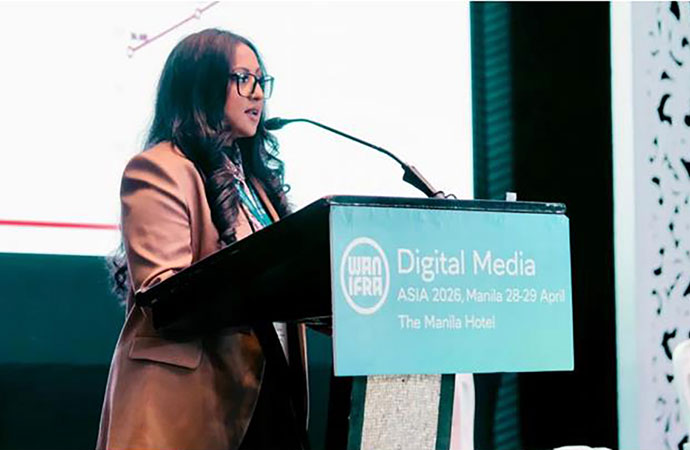
Nahar Khan of Marana Media addresses 'Digital Media Asia 2026' in Manila.
Media leaders from across Asia and beyond have gathered in the Philippine capital to examine how journalism is evolving amid shifting audience behaviour, platform dynamics and revenue pressures.
Manila Mayor Francisco "Isko Moreno" Domagoso and Vice Mayor Chi Atienza opened the Digital Media Asia 2026, organised by World Association of News Publishers (WAN-IFRA) on Thursday.
Opening remarks were delivered by Kah Whye Lee, Director, Asia at WAN-IFRA, who underscored the need for news organisations to innovate across both editorial and business fronts as the industry undergoes rapid digital transformation.
The conference brought together leading regional and international media organisations, including Channel NewsAsia, SPH Media, Agence France-Presse and South China Morning Post, among others.
A key session moderated by OneNews Anchor Regina Hing (Lay), featured speakers including Nahar Khan of Marana Media and United News of Bangladesh (UNB) and Cania Citta of Malaka Indonesia, focusing on how changing audience behaviour is reshaping the use of platforms, crafting messages, addressing target audiences, and asks what traditional media can learn from it.
Drawing on her presentation, Nahar Khan highlighted a fundamental shift in how audiences consume news, noting that social media has become a top source of news for most of Generation Z.
"The hook must land in three seconds - or they scroll," she said.
She emphasised that the transformation goes beyond platforms to a deeper change in communication itself.
"It's not just that they use different platforms. It's that they think in a different language - visual language," she said.
"The headline is now an image. The argument is a meme. The news is a 30-second video."
Khan said visual storytelling is increasingly central to how information is processed and shared. She also highlighted that different platforms now play distinct roles in the news ecosystem, requiring newsrooms to tailor content and strategy accordingly.
Short-form video platforms such as TikTok, Reels and YouTube Shorts have become the "front page", where audiences encounter the headline, hook and first read before engaging further. Facebook, she noted, continues to function as a "public square" across Bangladesh and South Asia, where stories evolve into discussion and community engagement.
She added that Instagram broadcast channels are increasingly used as direct, one-to-many communication tools delivering verified updates, while X (formerly Twitter) acts as a "global megaphone," amplifying local stories to international audiences within hours.
"Memes carry political points wrapped in humour, and they spread instantly, while cartoons cut through complexity that a 1,000 word article cannot."
She also reflected on UNB's experience maintaining uninterrupted news operations during a period of communication disruption, relying on internal systems, correspondent networks and manual workflows to keep the wire active.
Turning to lessons for the industry, Khan outlined what traditional media organisations must adapt.
"Lead with the human story, not the institutional angle. Personal voice earns trust and credibility while faceless brands lose it," she said.
She stressed the importance of meeting audiences where they are.
"Short-form is the baseline and cross-platform is the default. That is a growth strategy."
At the same time, she underscored the enduring value of credibility and heightened verification channels in an age of increased misinformation.
"Speed may reach the audience, but credibility will keep them."
Beyond editorial transformation, discussions at the conference focused on business sustainability, with participants exploring diversified revenue streams including subscriptions, digital advertising, branded content and platform partnerships.
Sessions also examined how publishers are building direct audience relationships through memberships, newsletters and data-driven products, while leveraging analytics and artificial intelligence to enhance both editorial and commercial performance.
Across the two-day event, a central theme emerged: news organisations must evolve simultaneously in storytelling, technology and business models to remain relevant in a rapidly changing digital landscape.
A Independent Newsweekly
© Copyright 2026 | Designed by ARK Reepon & Developed by Cosmos Group Software Team






Leave a Comment
Recent Posts
Is the international community ...
A spate of downgraded economic projections, from Bretton Woods to Mani ...
A Childhood Lesson in Arithmet ...
As children, we learned a simple mathematical rule: if we know the pri ...
Indian authorities launched a major security crackdo ..
Police dispersed garment workers from the Azampur ro ..
Why Saudi Arabia has struggled to defend itself agai ..
Iran-backed Houthis strike Saudi oil company Aramco’ ..