



Reportage
From Sudan’s Darfur Atrocities to “Order” in Yemen: The UAE’s New Clean-War Script


An Independent Newsweekly


Reportage
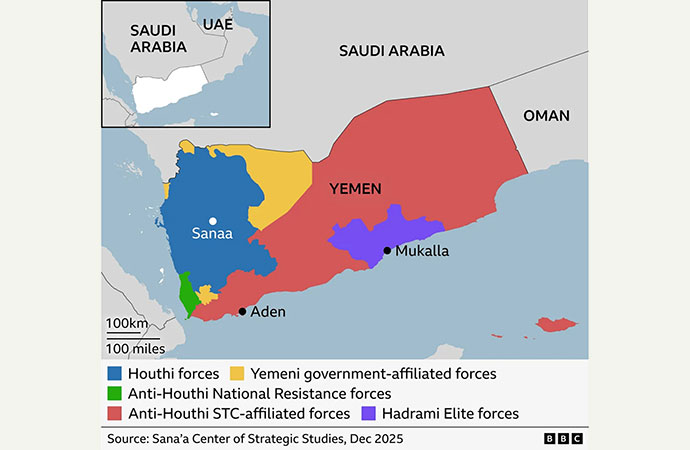
On the tenth of December 2025 port of Mukalla in southern Yemen commenced like countless mornings before; the docks opened at first light, and ships began unloading grain and fuel as usual. No irregularities were observed, no addresses by different factions were heard, no flags were seen hoisted with particular drama as though the preceding weeks chaos had been an administrative impediment rather than a military campaign. People started their usual daily activities, businesses reopened and shopkeepers who had shuttered their stalls previous weeks lifted them once more. Checkpoints that had bristled with nervous young men holding weapons now waved cars through with barely a glance. The city may have changed hands, yet there were no atrocities of war left; no bodies were left lying in the streets, no destroyed homes, or smoke rising from buildings. Just the hum of a place learning to function again under new management. This kind of quiet aftermath, when a new armed force steps in and the usual horrors are kept offstage, is not accidental. It is learned, and the learning happened elsewhere, in a place where the same patron of the armed force made very different choices.
The Sudan Lesson
To make sense of this change in takeover tactics, and the diplomatic nuance surrounding it, requires a step back to Sudan, where the Rapid Support Forces have perpetrated a series of barbarities that even sympathetic governments struggle to ignore. At the heart of this story lies the UAE's backing for the RSF, now widely documented, which has eventuated as a reputational disaster for Abu Dhabi and its aspiration to regional superpower status in the Middle East.
Mass killings in Darfur, the systematic use of sexual violence, cities reduced to zones of predation; a catalogue of crimes that pushes even cautious diplomats towards talk of sanctions, cannot be belittled by filing it away as a mere "moral failure". It constituted a long-established strategy, reiterated since antiquity in the conquest of territories: subdue through violence, sow terror, and allow fear to dictate governance. Yet in an age of mass communication when information is ubiquitous, this strategy boomerangs: very little can be buried, and what is buried tends to return and bite; a power that once announced itself with terror has lost the luxury of being discreetly accommodated by an international system now forced to answer to a wider public at least feign compliance. The UAE appears to have incurred significant costs as a result of this lesson, and it has taken that costly tuition into Yemen, where it now manages its proxies with a very different script.
The contrast between Yemen and Sudan is stark: where the RSF bludgeoned its way into power in Sudan, the Emirati‑backed Southern Transitional Council in Yemen portrays a very different story as it consolidates control over much of the south, a cleaner, more orderly storyline. Their subjugation did not catalyse the usual images of mass displacements, no viral videos of murders, no humanitarian agencies issuing emergency appeals, instead, the STC and its backers assiduously fostered a lexicon of equilibrium, stability and counterterrorism rather than naked brutality, that suggests someone was watching the publicity as closely as the maps.
A Three-Way Stalemate
Subsequent to this advancement, the STC governed pockets of the south, awaiting an opportune moment. For years, their chief confrontation was with the internationally recognised government based in Aden, a rival that existed more on letterhead than in daily life: procedurally legitimate, operationally irrelevant, kept on its feet by diplomatic muscle memory rather than popular support. And then to the northern highlands and Sanaa, is the Houthis, whos controls a hard‑fought strip of the western coast. The conlfict these three major groups have left Yemen less a failed state than a suspended one trapped in a stalemate that starved ordinary people while enriching the men and networks who learned to profit from the standstill.
The STC has never hidden its ambition to move beyond its enclaves and govern more than scattered pockets of the south. They had their backings that made this ambition seems possible; some local legitimacy with involvement of local tribal group and external backing a major power. Geographic advantage was on their side as well: the southern coast of Yemen is not a single, continuous block of territory but a chain of ports, oil sites and the corridors that connect them: Shabwa, Abyan, parts of Hadramawt; locations characterized less by their permanent inhabitants and more by the transit of goods and people. The STC read the map shrewdly, picking targets that secured the systems a proto‑state needs to function: revenue streams, access route, and control over what enters and exits, and only afterwards moving on to population centres, a tactic that helped limit bloodshed. In population centres, tribal elders chose neutrality rather than resistance, a decision driven as much by exhaustion as by calculation. And in the few places where militias did decide to resist, they mostly negotiated terms or simply stood down; there were skirmishes, but no prolonged fighting. The STC's strategy was consistent, concentrating on oil fields and ports rather than on cities full of people who would have to be subdued or governed under crisis conditions. It was "surgical" in the way of military jargon, but also in a way public‑relations professionals would recognise.
Performing Restraint
This is the appearance of a siege once it has been reframed as a public relations endeavor and executed with rigor for spectatorship beyond the sphere of military conflict; every war now unfolds in two theatres, the physical and the optical, and they knew the second can determine the value of victories in the first; journalists in Aden described a transition that felt managed, even boring, because atrocity is no longer just a moral problem for modern proxies, it is a branding problem. This is not to claim the STC has governed with mercy or justice, only that it has learned those notions are now under surveillance, using partial restraint to make its authority quietly palatable to observing outsiders. For legitimacy, the STC has banked on counterterrorism, an acceptable currency in places the international system has otherwise written off, and the STC has stressed its campaigns against al‑Qaeda in the Arabian Peninsula while casting itself as the least disruptive alternative to the Houthis, whose attacks on Red Sea shipping and ties to Iran and Israel‑focused rhetoric render them intolerable. The elements that Western capitals tacitly endorse is not merit but manageability; a southern Yemen under the jurisdiction of the STC, with patronage from the UAE, where oil flows, ports function and risks to international shipping are mitigated is the kind of order that is passively accepted, although publicly unacknowledged.
A Quiet Proxy Feud
Though Saudi Arabia, which underwrites Yemen's internationally recognised government, initially responded with little more than quiet non‑objection, with no explicit response to Abu Dhabi's tidy advance, it has since moved from that position: Saudi jets struck Emirati‑backed positions and even a suspected UAE arms shipment, forcing a partial STC pullback and an Emirati troop withdrawal. Though this confrontation neither ended the Saudi‑Emirati rivalry nor stilled their ambitions, it has slightly altered its trajectory, with both powers leaning more heavily on proxies: the UAE channelling support to non‑state allies such as the RSF, Somaliland‑linked forces and the STC, while Saudi Arabia tightens its embrace of formal state partners like Sudan's SAF and Somalia's federal authorities to vie for control of ports, mineral flows and sea lanes from the Red Sea to the Gulf of Aden. In Yemen, this power grab means both states opting for airpower, embargoes, financial pressure, arms pipelines, and cyber and intelligence tools rather than large ground deployments, a veiled mode of warfare that keeps their own hands looking relatively clean even as local actors bleed. The silence might have resulted in bitter demise, but the logic remains: a rivalry managed through proxies and perception, wherein the UAE in particular uses dispersed networks to step out of its "little brother" shadow while avoiding the contemporary Sudan‑style spectacle that once scorched its global image.
Rehearsed Calm, Hidden Domination
This kind of quiet order, with conflict pushed into the background and violence kept limited and tidy, can feel seductive, a veneer of calm laid over something far less stable. Mukalla's order may look stable: the port hums, people buy bread, but this normalcy is curated, a lesson the UAE drew from Sudan's post‑Darfur fiasco: that power must look clean, even when it is enforced through proxies, arms pipelines and quiet deals rather than spectacle, if a positive global image is to be preserved. Though the STC's rise and partial rollback might be read as a setback for the UAE's bid for regional dominance, it is better seen as one episode in a broader playbook: step back from overt carnage, wield influence through calibrated restraint, cyber and financial tools, and a far-flung constellation of clients from Yemen to Sudan and the Horn, all designed to repair a scorched reputation while loosening the old "little brother" grip of Saudi Arabia. In such a world, the decisive struggle is less about territory but over packaging and transmission of the violence, and Yemen's rehearsed calm is a reminder that what passes for stability may be less a new beginning than a refined method of rendering domination fade into the background.
Asif Amer is an international development strategist and diplomat dedicated to driving systemic change and social development, currently employed at the UK Government's Foreign, Commonwealth and Development Office (FCDO).
A Independent Newsweekly
© Copyright 2026 | Designed by ARK Reepon & Developed by Cosmos Group Software Team




Leave a Comment
Recent Posts
Is the international community ...
A spate of downgraded economic projections, from Bretton Woods to Mani ...
A Childhood Lesson in Arithmet ...
As children, we learned a simple mathematical rule: if we know the pri ...
Indian authorities launched a major security crackdo ..
Police dispersed garment workers from the Azampur ro ..
Why Saudi Arabia has struggled to defend itself agai ..
Iran-backed Houthis strike Saudi oil company Aramco’ ..