



Reportage
Breathing Death


An Independent Newsweekly


Reportage
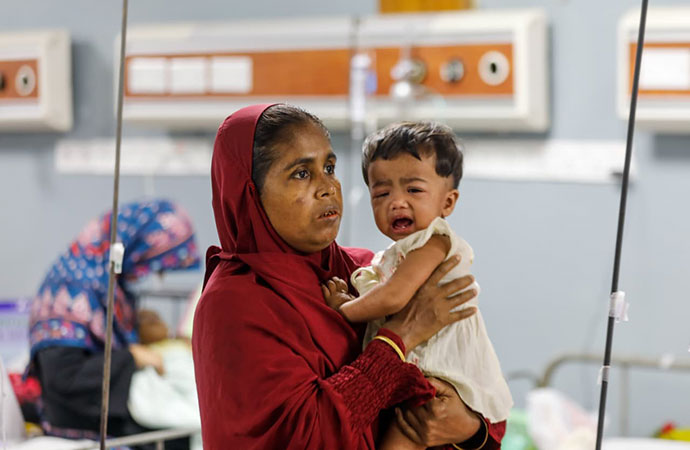
Photo: UNB
A deadly measles outbreak has resulted in scores of children, anywhere from 40 to 100, dying of the disease in Bangladesh in the first three months of 2026. While there is no official death toll, a writ petition filed with the High Court this week sought the formation of a high-level investigation committee over the deaths of 47 children from measles across the country. The outbreak has spread across multiple districts, including Dhaka, Barishal, Mymensingh, Rajshahi, Chapainawabganj, Pabna, Chittagong, Jashore, and Natore.
In the capital's Mohakhali, the 100-bed Infectious Diseases Hospital, once dedicated to treating Covid patients, has been overwhelmed in recent weeks, admitting over 560 suspected cases of measles by late March. Patients have been forced to lie in corridors and on floors, which is all the more dangerous given the highly contagious nature of the disease. According to hospital authorities, more than 20 children died from measles at the IDH in March alone.
Dr Shrebash Paul, medical officer at the IDH, says children with measles symptoms are being admitted daily. "Currently, over a hundred children are undergoing treatment here," according to Dr Paul.
Measles, also known as rubella, is a highly contagious viral infection that spreads through the air. It is characterised by high fever, cough, runny nose, red eyes, and a distinct rash starting on the face before spreading down the body. It mostly affects children. The measles virus's extraordinarily high basic reproduction number (R₀ = 15-18, i.e. one infected person goes on to infect another 15-18) is likely contributing to rapid spread in crowded spaces. Without proper isolation procedures, there is potential for spread in overwhelmed, crowded healthcare facilities.
The highly contagious nature of the infection makes vaccination imperative. The WHO's Expanded Programme on Immunisation (EPI) initiative was introduced in Bangladesh in 1979 with six conventional vaccines- BCG, DPT, OPV, TT and measles. The latest MR vaccine against Measles-Rubella was introduced in the country in 2012.
According to a paper in the Bangladesh Journal of Child Health, in 2009, when the measles vaccine was still administered in one dose, the EPI programme managed to reach 90% coverage nationally, but in 11 out of 64 districts (17%), coverage was less than 80%.
Additionally, some 35 million children were immunised during the measles catch-up programme in 2006 and 2010. Two more major campaigns in 2014 and 2020 successfully vaccinated between 35-50 million children.
This obviously flies in the face of Health Minister Sardar Sakhawat Hossain Bokul's recent statement that no measles vaccines had been administered in Bangladesh in the last 8 years. Did he simply miscalculate, and say 8 years when it was actually six? Or is the new minister simply unaware of the annual vaccination campaigns that are run under his ministry, apart from the large campaigns every four years that seek to net anyone who may have been missed (hence, "catch-up") during the annual campaign?
In a post-fact world
The health minister's statement was just the first strike in what would soon turn into a cascade of misinformation and fake news tearing through social media way too fast for facts to keep up.
The EPI (Expanded Program on Immunization) measles dashboard provides real-time tracking of measles cases, vaccination coverage, and epidemiological trends, typically managed by regional health authorities like the WHO-AFRO or national entities like the UKHSA, NICD, or in Bangladesh's case, the Directorate General of Health Services, or DGHS. This data is publicly available.
One would think that makes it all the more imperative that the data available through the dashboard is accurate and up-to-date. Using the data available on the dashboard for Bangladesh, most of the country's media outlets published EPI data available on the website of the Department of Health. It provided information on various vaccinations, including measles, for children aged 12 months from 2017 to 2025.
According to that data, in 2025, the coverage of the MR-1 vaccine for measles and rubella was about 57.5 percent and the coverage of the MR-2 vaccine was 57.7 percent. The accompanying graphic that went viral showed a steep drop-off in 2025 compared to the previous years. Quite stunningly, despite hitting 90 percent consistently over the years, and sometimes even 95 percent, for some reason 2025 had witnessed a massive decline.
A group of politically motivated influencers immediately ran with this angle to paint the interim government led by Dr Muhammad Yunus, that was running the country in 2025, as guilty. We recalled the almost mute role throughout the 18 months played by Health Adviser Nurjahan Begum, possibly the venerable economist's most controversial pick for his council of advisers. Various personalities even sought to allege Dr Yunus himself had the blood of children on his hands.
Yet if you go to that same webpage today, you'll find the data isn't there anymore. It had to be taken down, once people realised it was outdated, incomplete data. So what were the real numbers then?
Using his access to the Health Department's MIS section, EPI specialist at Unicef's Bangladesh office Sarwar Alam Sanku published data for nine years covering 2017-2025 on his Facebook page as a riposte to the criticism being directed at the EPI programme. His information showed the immunisation campaign had continued under the interim government as well, and though there was a slight drop off in coverage to the low-90s (92.7 percent for MR-1 and 91 percent for MR-2) from the mid-to-high 90s in 2025, the difference was nowhere near as large as previously believed.
The accuracy of the information provided by Sarwar Alam was confirmed by Dr Shahriar Sajjad, Deputy Director of the Expanded Programme on Immunization in Bangladesh, to factcheckers at The Dissent.
He said, "MR-1 is 92 percent and MR-2 is 90 percent. This is not public data. Not everyone has access to it. We can see it ourselves. Only those who have access to our MIS can see it."
An official working in the Surveillance and Immunization Department of the WHO's Bangladesh office also confirmed the accuracy of this information. However, they did not wish to reveal their identity, saying "The data is correct. However, these are national protected data - not for public use."
Fair enough. Many will be disappointed certainly, to learn that Dr Yunus and his interim government were not the child killers they were being portrayed as. Yet it does leave the larger question still unanswered:
Why are the kids dying?
Resurgent Measles
Measles outbreaks are highly preventable. It's estimated that when 95% of people in a community are vaccinated, both those individuals and others in their community are protected against measles (herd immunity).
Yet data from every major source on public health, from leading medical journal The Lancet to the US Centres for Disease Control and Prevention (CDC), show that worldwide measles cases surged sharply in 2024 and 2025. Disruptions to immunisation programmes during the COVID-19 pandemic resulted in decreased measles vaccine coverage. The decreased coverage, coupled with a return to normal social interaction in 2024 and 2025, resulted in the highest number of global measles outbreaks seen since 2003.
Europe recorded its highest number of cases in over two decades, while the US saw its worst outbreak in more than 30 years, according to the CDC.
In Bangladesh, a total of 676 children have been diagnosed with measles in the first three months of this year, a sharp spike compared to previous years, according to DGHS data.
During the same period last year, only nine measles cases were reported, while in 2024 the figure stood at 64. This indicates a 75-fold increase compared to last year and nearly an 11-fold rise from 2024.
The DGHS data shows that the highest number of cases (245), or 36.24% of the total, were recorded in Dhaka division. Meanwhile, Rajshahi division reported 137 cases or (20.26%), followed by Chattogram with 93 cases (13.75%). Mymensingh division recorded 80 cases (11.83%), while Barishal and Khulna each reported 51 cases (7.54%). Sylhet recorded 13 cases (1.92%), and Rangpur had the lowest with six cases (0.88%).
In 2025, a total of 125 measles cases were reported nationwide. Health officials noted that the data reflects only cases recorded in government hospitals, suggesting that the actual number of infections could be significantly higher.
Is the Interim to blame?
Doctors at the Infectious Disease Hospital report that most of the admitted measles patients were found to be unvaccinated, causing experts and health officials to blame gaps in immunisation, particularly the long interval between special measles vaccination campaigns, as well as the cyclical pattern of outbreaks after a few years, among other factors.
Children aged nine months receive the MR-1 vaccine, and its second dose MR-2 at 15 months. The vaccination rate is 90 to 92 percent, so special vaccination campaigns are usually carried out every four years, with the latest one held in 2020. The planned special campaign in 2024 could not be conducted due to unrest in the country, according to health officials.
Besides, the regular vaccination programme was disrupted at least three times last year due to strikes by health assistants who administer vaccinations in rural areas. Resources were also redirected towards the rollout of the country's first ever typhoid vaccination campaign.
Health officials also point to a funding crisis that broke out last year, following the suspension of the so-called 'sector programme' which funded vaccination, that also disrupted services in 2025. Suspension of the programme was a divisive issue within the health sector, but it had its proponents. In this regard, Dr Sayedur Rahman, who served as special assistant to the Chief Adviser with executive powers in the Health Ministry, told Dhaka Courier:
"The sector-wide approach dependent on donor agencies (e.g. for vaccine procurement) had been going on for 22 years," said Dr Rahman. "At the time of approval of the 4th Health, and Population and Nutrition Sector Program (4th HPNSP), an exit plan was asked to be submitted. But the then government (AL) ended the 4th HPNSP without any Exit Plan, and formulated the 5th Health, Population, and Nutrition Sector Programme (5th HPNSP) as the method of managing the health sector from 2024 to 2029."
As fate would have it though, that government would be swept away in a tide of public anger just as the 5th HPNSP period started.
According to Dr Rahman, immediately after assuming office, the interim government decided to formulate an Exit Plan as "a way out of donor dependency in the health sector," and as a commitment to fulfilling the basic responsibilities of the government. In order to implement the decision, a required number of development project proposals were formulated and approved by the Council of Advisers and ECNEC (the Executive Committee of the National Economic Council).
On the specific issue of measles vaccines, Dr Rahman assured that there was no shortage of vaccines in the government's coffers, and they had planned a measles vaccine 'catch-up' campaign or programme, that has been held over since 2024, in April 2026.
"There is no shortage of this vaccine, rather it can be said that the stock of measles vaccine is the highest. Because a campaign was planned to cover all those who have been excluded from measles vaccine up to the age of 10, which the interim government planned to conduct in April after the elections. The government also has the necessary vaccines in stock to conduct that campaign," he asserts.
It's worth pondering if the special vaccination drive announced by the government, that is set to commence from the start of next week (April 5) owes a small debt of gratitude to the interim administration's drive planned for April. The government will launch an emergency measles vaccination campaign as soon as next week. The health minister shared the information with reporters after a meeting at the Secretariat. He said as an emergency measure, around 21.9 million doses of measles vaccines will be procured from Gavi - the Global Alliance for Vaccines and Immunization.
Dr Sayedur Rahman also raises another very interesting feature of the current outbreak in Bangladesh, that calls for serious research by experts in the field of medicine and child health.
"The rate of measles infection has increased slightly in the entire world," he begins rather complacently. But then his tone becomes much more serious. "The rate of infection is also increasing among children under 9 months of age. In that case, it is necessary to confirm whether any of the deceased and infected people could not get vaccinated due to lack of vaccination even after going to the vaccination center and as a result, they were infected with measles."
The age at which children are getting infected is significant. If they are catching the disease at six months or thereabouts, the vaccination campaigns under EPI's current protocols wouldn't have helped them, because the first shot of the measles vaccine (MR-1) is only given at 9 months. For the emergency campaign starting next Sunday however, the government has already announced it is lowering the eligible age to six months, after NITAG (the National Immunisation Technical Advisory Group) recommended lowering the age for receiving the measles vaccine to six months, as one-third of the children recently infected with measles are under nine months.
NITAG also decided to investigate the recent surge in measles cases to determine whether the cases originated within the country or not and has assigned the Institute of Epidemiology, Disease Control and Research (IEDCR) to carry out the task.
'Fully prepared'
The government is fully prepared to prevent the spread of measles, Health and Family Welfare Minister Sardar Md. Sakhawat Hossain said on Thursday.
"Measles has started to spread suddenly. We had no prior preparation, but we are now fully ready to prevent it in a short time," he said, while inaugurating a training programme on the use of bubble CPAP in treating measles-related pneumonia and respiratory problems at Bangladesh Shishu Hospital and Institute in Sher-e-Bangla Nagar, Dhaka.
The minister said the measles vaccination campaign will begin nationwide next Sunday. "We are shocked by the deaths of so many children. All necessary measures have been taken to prevent an outbreak across the country, including Dhaka and Rajshahi," he added.
He said special arrangements have already been made in some hospitals to treat measles patients. Ventilator systems have been increased in Rajshahi and Manikganj. Besides, ventilators have been arranged in other hospitals, and doctors and nurses are ready, according to a PID handout.
Requesting the support of health workers at all levels, Sakhawat Hossain said, "Our health workers are facing many challenges. I promise to address your problems as soon as possible, but for now, I seek your cooperation in this critical moment for the country."
The minister also noted that several health workers engaged in vaccination have not received their salaries for a long time, which is a significant problem. He added that thousands of health assistants, co-health assistants, and health inspectors have long-standing demands for promotions or grade improvements, which will be considered.
Referring to the contribution and humanitarian service of doctors, the health minister urged them to prioritise "trust," which he called the cornerstone of medical ethics, in their healthcare activities.
A Independent Newsweekly
© Copyright 2026 | Designed by ARK Reepon & Developed by Cosmos Group Software Team



Leave a Comment
Recent Posts
Is the international community ...
A spate of downgraded economic projections, from Bretton Woods to Mani ...
A Childhood Lesson in Arithmet ...
As children, we learned a simple mathematical rule: if we know the pri ...
Indian authorities launched a major security crackdo ..
Police dispersed garment workers from the Azampur ro ..
Why Saudi Arabia has struggled to defend itself agai ..
Iran-backed Houthis strike Saudi oil company Aramco’ ..