



Featured 1
Time to declare a public health emergency over measles?


An Independent Newsweekly




Featured 1
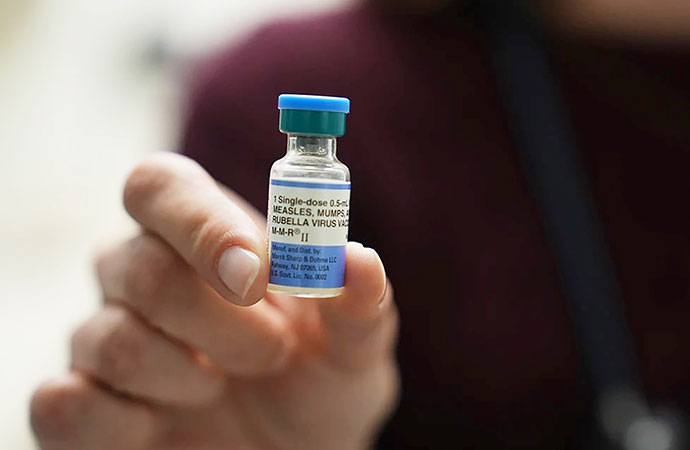
Photo: AP/UNB
The measles outbreak has ravaged the nation, with more than 400 children having died from confirmed or suspected measles in the past two months with government data estimating the number of cases at about 55,000. Nine out of 10 cases are in children between the ages of one and 14 years, according to the World Health Organization, with about three quarters of infections occurring in under-fives.
In Cox's Bazar, home to about 1 million Rohingya refugees, there have been four suspected deaths and nearly 500 confirmed or suspected cases, according to the Health Cluster. Of the 60 laboratory-confirmed cases so far reported in the camps in 2026, three quarters were either unvaccinated or partially vaccinated. In 2025, there were 125 cases of measles in total across Bangladesh.
The measles outbreak is affecting all eight divisions in Bangladesh, prompting an emergency vaccination campaign across the country. In the last month, nearly 18 million children have been reached with at least one dose of the vaccine, according to government data.
Measles is a highly contagious disease which affects individuals of all ages and is one of the leading causes of death among young children globally, especially for children who are malnourished or have weakened immune systems.
It is almost entirely preventable with two doses of a vaccine, administered from the age of nine months, but Bangladesh had a severe shortage of measles vaccines, with stock outs in 2024 and 2025 leading to gaps in immunisation. In April, the Government of Bangladesh, UNICEF, WHO, and Gavi launched an emergency Measles Rubella (MR) vaccination campaign in response to the spike in cases among children and infants. This is the first national measles campaign in Bangladesh since 2020, due to disruptions caused by the global COVID-19 pandemic, followed by recent political instability in the country.
In the wake of a public outcry, the government has announced it will form an investigation committee involving international organisations to probe the ongoing crisis, said Dr Zahed Ur Rahman, adviser to the prime minister on information and broadcasting. Health Secretary Quamruzzaman Chowdhury, on May 9, said an investigation had already been launched to determine whether negligence played a role in measles deaths and, if so, who is responsible.
However the government has refrained so far from declaring a public health emergency, despite the number of suspected and confirmed cases combined exceeding 50,000. At a meeting of the National Immunization Technical Advisory Group (NITAG) in April, experts agreed that deaths showing measles-like symptoms during an outbreak should also be counted as measles-related fatalities.
Over the past 25 years, measles cases in Bangladesh have never crossed the 50,000 mark. The previous highest recorded outbreak was in 2005, when 25,934 cases were reported. Since then, numbers had gradually declined. Between 2020 and 2024, reported cases stood at 2,410, 203, 311, 281, and 247 respectively. In 2025, only 132 cases were recorded. Given the history, the scale of the present outbreak is worrying to say the least. If this is not a public health emergency, what is?
A Independent Newsweekly
© Copyright 2026 | Designed by ARK Reepon & Developed by Cosmos Group Software Team




Leave a Comment
Recent Posts
An unaccountable process leave ...
The latest price hike of all four major petroleum products by Tk 20 pe ...
The French Connection in South ...
France Ambassador to Bangladesh Jean-Marc Séré-Charlet h ...
Ties with China enter new phase
Happy 61st birthday, Singapore!
In defiant speech, Pezeshkian calls out Trump and sa ..
The banality of evil