



Politics
War in an Age of Weak Powers


An Independent Newsweekly
Politics
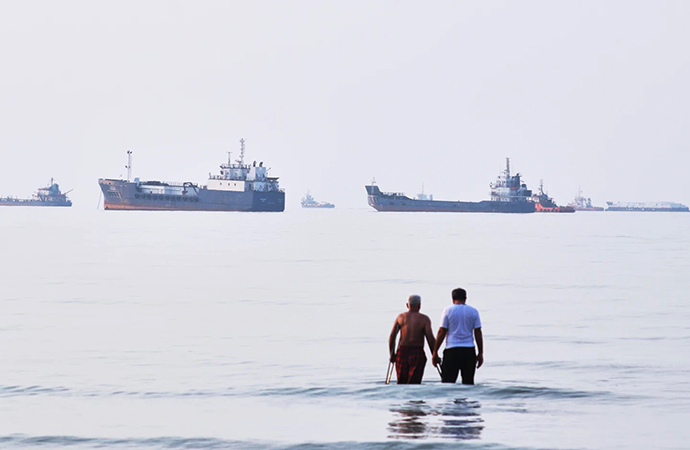
Photo: AP/UNB
The war in Iran has weakened both the United States and China, exposing the limits of their military power and strategic influence. Their troubles are creating a more dangerous geopolitical landscape while providing Europe with a rare opportunity to reform its governance model and reinvent its global role.
The decision by the United States and Israel to go to war against Iran is proving to be a turning point in the global balance of power, leaving both the US and China weaker than before. No one in Europe should cheer that, because Europe's current model is ill-suited to protect itself in the dangerous world of weak powers.
While US President Donald Trump's effort to force Iran to back down through military means has failed miserably and exposed the limits of American power, China has also been weakened by the war. The ongoing blockades of the Strait of Hormuz and the Red Sea are restricting supplies and trade, compounding China's existing structural problems: high public debt, an artificially low exchange rate, youth unemployment, economic inequality, and an aging population. If China misses its growth target, or even narrowly meets it, President Xi Jinping's regime may find itself increasingly boxed in.
In contrast, the war in Ukraine has been an economic boon for China. Sanctioned supplies of Russian and Iranian oil and gas have helped it meet its enormous energy needs while bearing hardly any of the costs of securing its maritime trade routes. It has also profited handsomely from selling dual-use goods to Russia. Cheap energy, alongside an artificially cheap currency and a credit-subsidized economy, has helped China sustain production and remain cost-competitive despite weakening domestic demand.
The war in Iran now threatens to upend China's fortunes. China, the world's largest oil importer, not only lost a large share of its energy supplies overnight, but also discovered how little sway it holds over its "partners." Despite its special relationship with Iran, China has failed to persuade the Islamic Republic to reopen the Strait of Hormuz or at least allow Chinese vessels through.
For the US, meanwhile, the Iran war is a foreign-policy and national-security disaster. None of its military objectives has been achieved, the cost to taxpayers is enormous, and there is no end to the conflict in sight.
Both China and the US are increasingly dependent on debt to paper over their underlying problems. A world in which even the two superpowers are weakened is a dangerous place. As their power and influence wane, new actors and alliances are rushing to fill the vacuum. The recently signed defense alliance between Turkey, Saudi Arabia, and Pakistan is a prime example.
The erosion of US and Chinese power provides the European Union with an opportunity to reinvent its global role, yet it seems mostly content with hollow rhetoric. Although the EU has long sought to become a geopolitical force, it remains bogged down in petty squabbles and cannot even free its economy from the tangle of bureaucratic obstacles holding it back.
Europe can lament these shifts and stay on the sidelines, or it can seize the opportunity to become a geopolitical power. But that requires standing up for its own interests, implementing far-reaching structural reforms, strengthening its defense capabilities, and safeguarding its strategic maritime trade routes and raw-material supply chains.
To remain globally relevant, the EU must also rethink its governance model. Its diversity is both its greatest asset and its biggest weakness, since the bloc's current model requires consensus among 27 member states whose interests do not always align. The result is a laborious and protracted process in which the need to accommodate everyone ensures that policies rarely rise above the lowest common denominator. Like-minded member states have little freedom to take the lead on particular issues, and their initiatives are often stifled by pressure for EU-wide solutions.
This insistence on uniformity also extends to relations with countries outside the EU. The bloc's post-Brexit relationship with the United Kingdom is a case in point, as are its protracted negotiations over free trade agreements and closer ties with Canada, Australia, and New Zealand.
None of this should come as a surprise: the European project grew out of the need to protect Europe from itself by overcoming centuries-old divisions. Today, however, Europe must protect itself from external threats-a fundamentally different challenge for which its current model is ill-suited.
European leaders could learn from the private sector. Like Europe, large corporations' greatest strength-a highly diversified product portfolio-was their biggest weakness. Keeping all products and services under a centralized structure had become too costly and cumbersome. The solution was to grant individual divisions greater autonomy while retaining legal control over the core businesses. By shifting from integrated conglomerates to holding company-style structures, many companies became more agile and efficient, reducing costs and administrative burdens.
The corporate model, of course, cannot be applied directly to relations between countries. But the EU could adopt its underlying logic and give democratic partners more than a binary choice between full membership and being on the outside looking in. Allowing for different levels of integration could open up new possibilities, especially for countries like Turkey that have been waiting decades to join the EU but are unlikely to become members anytime soon.
However impossible EU reform may seem, it is worth remembering that 70 years ago, few could have imagined the bloc in its current form. If Europe is to avoid repeating the darkest chapters of its history, it must once again aspire to achieve what appears politically impossible. In an age of weak powers, that means rethinking how it organizes itself in order to achieve the role it wants to play in the world.
From Project Syndicate
A Independent Newsweekly
© Copyright 2026 | Designed by ARK Reepon & Developed by Cosmos Group Software Team


Leave a Comment
Recent Posts
The right time for an apology
The publication of the posthumous memoirs of lawyer Abdur Razzaq, who ...
Human rights experts commissio ...
Human rights experts commissioned by the UN’s top human rights b ...
Teesta erosion leaves several hundred families homel ..
Housing Without Houses: The Hidden Cost of Banglades ..
The Election Commission will review the timeframe
The story behind the Arafat brothers' ‘Kolpona’