



Politics
Thailand’s Royalist Right Turn


An Independent Newsweekly
Politics
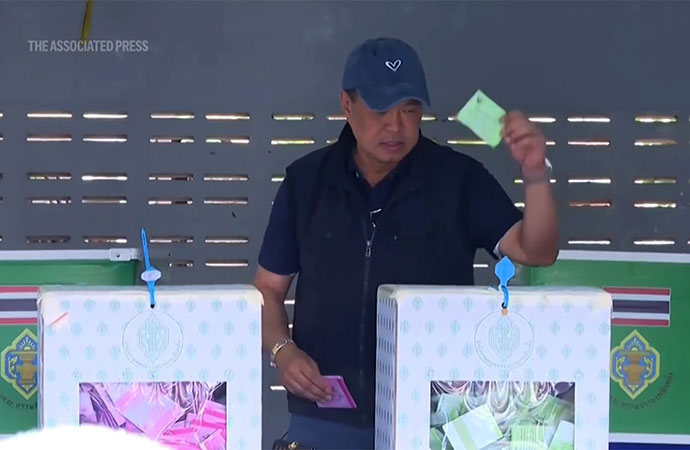
Leaders of Thailand’s major political parties voted Sunday in the general election, which local polls consistently project that no single party will gain a majority, necessitating the formation of a coalition government. Screengrabs from AP
With a rock-solid parliamentary majority, as well as the backing of the military and judiciary, the royalist-conservative Bhumjaithai Party is poised to spend its full four-year term governing in the service of establishment interests. But that does not mean it will all be smooth sailing ahead.
Thailand's old guard is back in power. After 26 years of turmoil - marked by street protests between yellow- and red-clad mobs, two military coups, and multiple judicial interventions - the royalist-conservative Bhumjaithai Party has won a decisive electoral victory over the reformist People's Party. But unless Prime Minister Anutin Charnvirakul finds ways to lift Thailand out of the economic doldrums and close deep social rifts, an anti-establishment backlash remains a distinct possibility.
The royalist establishment has lost to progressive movements before - in particular, the one led by telecommunications billionaire Thaksin Shinawatra. Before Thaksin's rise, Thai political parties were weak, owing to pervasive party-hopping, pork-barrel politics, patronage, and graft. Then came the 2001 general election, in which Thaksin's Thai Rak Thai party won 248 of 500 seats.
Thai Rak Thai achieved this by connecting directly with voters and embracing "populist" solutions, such as universal health care, debt relief, and microcredit schemes. As prime minister, Thaksin also pursued industrial policies that put Thailand on a strong growth path and enhanced its regional status in the wake of the late-1990s Asian Financial Crisis. He completed his first full term in 2005 - no small feat in a country that had faced regular military coups since absolute monarchy was abolished in 1932 - and was re-elected in a landslide, with Thai Rak Thai winning 377 seats in parliament.
Despite Thaksin's popularity, his government was rife with corruption, and palace figures were no fans. Yellow-shirted royalists took to the streets to protest his conflicts of interest, paving the way for his overthrow by the military in 2006. But support for Thaksin proved resilient, and over the next 20 years, his brother-in-law, sister, daughter, and two proxies won elections (his own parties were dissolved twice), only to be ousted either by the military or the judiciary. His red-clad supporters staged regular demonstrations.
Ultimately, however, Thaksin's political brand was hammered into submission: he is currently in prison for corruption and abuse of power, and his current party, Pheu Thai, won just 74 seats in this month's election. But a new progressive force has emerged in his stead. This time, it is not a wealthy leader promising change, but a movement of young people who have spent their lives watching their prospects undermined by protests, coups, and judicial maneuvers. They hope to reclaim their futures by reforming Thailand's monarchy, military, bureaucracy, and oligopolistic economy.
This movement's electoral vehicle, the Future Forward Party, finished third in the 2019 election, only to be dissolved by the Constitutional Court the following year. Future Forward's successor, Move Forward, won the 2023 vote. But, while it managed to forge a coalition with other pro-democracy parties, allies of the monarchy and military blocked it from forming a government. It, too, was then dissolved, and its core leaders were banned from running for office for ten years.
The People's Party - the third incarnation of this movement - has apparently failed to recapture its predecessor's momentum, despite leading in the polls prior to the February 8 vote. While it came in second, it secured only 118 seats, compared to Bhumjaithai's 193 - more than double the number it previously held.
The ruling elite's efforts to divide and weaken young reformist forces - which echo the tactics used to defeat Thaksin's populist and redistributive agenda - undoubtedly contributed to this outcome, not least by contributing to widespread fatigue. Prolonged political volatility, combined with last year's Thai-Cambodian border clashes, set the stage for Anutin to entice Thai voters with promises of stability. Beyond his militaristic and nationalistic messaging, Anutin was perceived to have strong backing from the palace, having been granted regular royal audiences, including on the eve of the vote.
Anutin has also promised to boost growth and curtail graft, with the help of capable technocrats like Commerce Minister Suphajee Suthumpun, Finance Minister Ekniti Nitithanprapas, and Foreign Minister Sihasak Phuangketkeow. But while voters were apparently convinced, the extent to which these figures will be calling the shots remains unclear. Much depends on how many old-style patronage-driven politicians are included in the new cabinet.
Including a representative from the Kla Tham party - a staunch backer of the monarchy and military, led by convicted drug trafficker Thamanat Prompow - would strengthen the Bhumjaithai-led coalition's majority. Even Thaksin's Pheu Thai is likely to join, if only to ensure that his prison term is not extended, that the investigations into his daughter Paetongtarn (also a former prime minister) go nowhere, and that his sister Yingluck (another former prime minister) can return from exile.
With a rock-solid parliamentary majority, as well as the backing of the military and judiciary, Bhumjaithai is poised to spend its full four-year term governing in service of establishment interests. But it will not necessarily all be smooth sailing. Over 65% of Thai voters opted to replace the military-drafted 2017 constitution - a move opposed by many conservatives.
Moreover, the People's Party has hardly been crushed. It won all 33 constituencies in Bangkok and secured 31 of the 100 seats that are allocated on a proportional basis according to nationwide party-list votes, compared to Bhumjaithai's 19. This still-robust opposition will undoubtedly capitalize on any misstep by the Anutin government to recapture support.
For now, Thailand has chosen the status quo. But we may yet see a reckoning, as the old guard, clinging to privileges of the past, clashes with young generations clamoring for a better future.
From Project Syndicate
A Independent Newsweekly
© Copyright 2026 | Designed by ARK Reepon & Developed by Cosmos Group Software Team




Leave a Comment
Recent Posts
Dhaka, Tokyo relationship to c ...
Deputy Chief of Mission of the Embassy of Japan in Bangladesh Yoshida ...
Democracy puts a premium on et ...
And just like that, the deed was done. With a volley of 'Ayes!’( ...
Dhaka still eyeing ‘conducive’ setting for PM’s Delh ..
Gallery Cosmos Artist Residency, 2026
Summit seeks reinstatement of FSRU deal
Hatful of medals for Bangladeshi whiz kids at WMI 20 ..