



Politics
Forbidden Jokes


An Independent Newsweekly






Politics
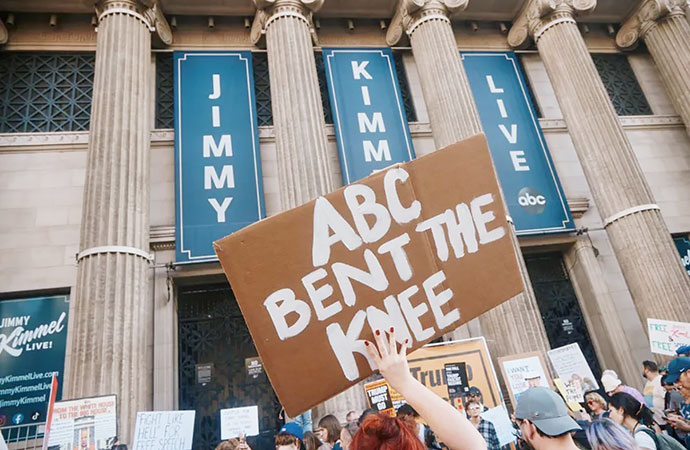
Photo: Collected
Last month, ABC suspended late-night talk show host Jimmy Kimmel – a frequent critic of US President Donald Trump – after pressure from the government. While Kimmel was reinstated, Trump will likely continue to threaten comedians, because nothing is more damaging to a demagogue than being laughed at.
Not all political leaders hate being lampooned by cartoons. Some even proudly display them in their offices. But these tend to be democratic politicians, not authoritarian leaders whose power depends on a cult of personality.
US President Donald Trump, a democratically elected leader with strong authoritarian leanings, can't stand to be ridiculed. It is said that his decision to run for president was the result of then-President Barack Obama making fun of him at the White House Correspondents' Dinner in 2011. There was nothing Trump could do about it back then. But now, as president himself, he can try to silence the mockers.
Last month, Disney's ABC Television network pulled late-night comedian Jimmy Kimmel - a frequent critic of Trump - off the air, after pressure from the chair of the Federal Communications Commission. Trump applauded the move as "Great News for America." This prompted so much protest, with 1.7 million people reportedly canceling their Disney+, Hulu, and ESPN subscriptions, that Kimmel was reinstated a week later. Still, Trump has threatened to revoke the broadcasting licenses of networks that feature comedians who make jokes about him.
Trump is not wrong to recognize the power of humor. The French philosopher Voltaire, one of the all-time great satirists, once said: "I have never made but one prayer to God, a very short one: 'O Lord, make my enemies ridiculous.'" Ridicule punctures hypocrisy, hyperbole, mendacity, and self-importance - the standard tricks of the authoritarian leader's trade.
In the past, monarchs and powerful noblemen understood that mockery could be a necessary corrective to the flattery of courtiers. That was the role of court jesters, who were able to make fun of their bosses with impunity - up to a point. But that was because they could be treated as fools who posed no threat to power.
Since ancient Rome, satirists and comedians have had two main targets. The first is ideas - secular as well as religious articles of faith. This was Voltaire's favored terrain. He loved to mock the Catholic Church, which he saw as a corrupt institution that oppressed people by spreading superstitious beliefs. "Religion," he said, "began when the first scoundrel met the first fool."
Given that satirists, from Voltaire to Kimmel, often ridicule established authority, one might assume that this kind of humor is usually "progressive," or even left-wing. In fact, conservatives have been some of the sharpest satirists. Jonathan Swift, for example, was a staunch defender of the Anglican Church. There is no juicier target for a conservative comic to puncture than the earnest pretensions of idealists, whose zeal for change is often incompatible with a sense of humor. Comedy is more suited to skepticism and doubt than to a passion for great causes.
The other kind of satire is aimed at the personalities of people in power. These are the brave comedians who dare to point out that the emperor has no clothes. As Bob Dylan once wrote: "Even the president of the United States sometimes must have to stand naked."
This kind of ridicule is seldom deadly for ordinary politicians. But the authority of monarchs and authoritarians depends on their aura. People obey them because they believe kings, queens, and dictators are invincible. The grand theater of power is as important to the ruler as the threat of violence to dissenters. When comics poke fun at it and, in the process, reveal these leaders as ridiculous blowhards, they challenge the very source of absolute power.
Hitler was furious about Charlie Chaplin's 1940 comic masterpiece The Great Dictator. Chaplin didn't have to expose the murderous crimes of fascism. All he needed to do was to show Hitler and Mussolini as buffoons. Nothing is more damaging to the demagogue than being laughed at.
In liberal societies, like the US, the United Kingdom, and France, leaders - including kings and queens - have had to put up with a certain amount of mockery. Eighteenth- and nineteenth-century cartoonists were often merciless. Thomas Rowlandson (1756-1827) portrayed the Prince of Wales as a drunken lout. Honoré Daumier (1808-1879) depicted King Louis-Philippe as an obscene glutton.
Like the scandal sheets and yellow press, this type of derision was the price to pay for freedom of expression. This is very much the case in America, where the First Amendment of the US Constitution offers broad protections - more than in any other country - for speech. Public figures can be criticized, parodied, lampooned, and even libeled, unless "actual malice" can be proven.
The late Czech film director Miloš Forman, who immigrated to the US in 1968, made a 1996 film titled The People vs. Larry Flynt. It documented the legal battle between Flynt, the owner of the pornographic magazine Hustler, and Jerry Falwell, the television evangelist who sued Flynt for emotional distress after Hustler published a parody ad in which Falwell reminisced about having sex with his mother. In 1988, the US Supreme Court ruled unanimously that emotional distress was not sufficient reason to deny the First Amendment right to express critical views of public officials and figures.
Forman, who escaped from communist Czechoslovakia, was a grateful admirer of America's First Amendment, which allowed a sleazy pornographer to mock a famous religious leader. If Trump succeeds in silencing the people who laugh at him in public, the country where Forman, who died in 2018, and millions of others once found freedom will cease to exist.
From Project Syndicate
A Independent Newsweekly
© Copyright 2026 | Designed by ARK Reepon & Developed by Cosmos Group Software Team





Leave a Comment
Recent Posts
Is the international community ...
A spate of downgraded economic projections, from Bretton Woods to Mani ...
A Childhood Lesson in Arithmet ...
As children, we learned a simple mathematical rule: if we know the pri ...
Indian authorities launched a major security crackdo ..
Police dispersed garment workers from the Azampur ro ..
Why Saudi Arabia has struggled to defend itself agai ..
Iran-backed Houthis strike Saudi oil company Aramco’ ..