



Featured 2
Atoms for Tomorrow: How Rooppur is Redefining Bangladesh’s Future


An Independent Newsweekly




Featured 2
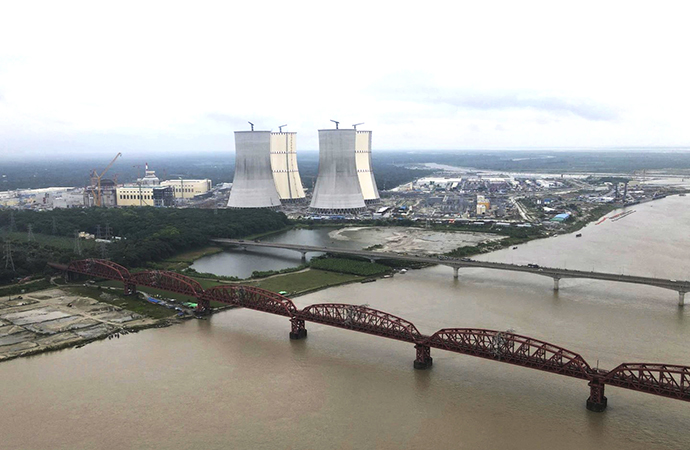
Photo: AP/UNB
For decades, the skyline of Bangladesh has been defined by its lush green fields, winding rivers, and the vibrant, bustling rhythm of a rapidly industrialising economy. From the textile hubs of Gazipur to the bustling commercial districts of Dhaka, the nation's progress has always been tethered to a relentless quest for energy. Yet, energy security in a developing nation has historically walked a tightrope-balancing soaring domestic and industrial demand against the volatile costs of imported fossil fuels, natural gas fluctuations, and environmental imperatives.
Today, that horizon is being redrawn in Ishwardi, Pabna, where the silent, monumental towers of the Rooppur Nuclear Power Plant stand as a testament to a new dawn. With the official commencement of fuel loading and the initiation of controlled nuclear reactions at Unit 1, Bangladesh has crossed a historic threshold. It has formally entered the elite global community of nuclear-powered nations, securing its place as the 33rd country in the world to generate electricity through nuclear fission.
A Monumental Vision Rooted in Global Partnership
The realisation of Bangladesh's nuclear dream is a masterclass in long-term strategic planning, international diplomacy, and engineering resilience. Located about 160 kilometres from the capital, the Rooppur Nuclear Power Plant is being constructed with robust economic and technical assistance from the Russian Federation, under a general contract signed in December 2015 following foundational survey agreements initiated in 2013.
Estimated to cost approximately US$12.65 billion, the massive undertaking comprises two state-of-the-art units, each engineered with a generation capacity of 1,200 megawatts (MW), bringing the combined capacity of the facility to a formidable 2,400 MW. At its core, the project utilizes Generation III+ VVER-1200 reactor technology, widely recognised as one of the safest, most advanced designs in the global nuclear industry. These systems incorporate a sophisticated combination of active and passive safety mechanisms, multiple layers of containment structures, and an innovative "core catcher" designed to contain molten core materials under any hypothetical emergency scenario, ensuring absolute structural and environmental integrity.
The journey toward this milestone has required meticulous execution. Science and Technology Minister Fakir Mahbub Anam, alongside high-ranking dignitaries and international experts-including Alexey Likhachev, head of Russia's state atomic energy corporation Rosatom-has repeatedly emphasised that safety remains the paramount priority of the Bangladeshi government. As IAEA Director General Rafael Mariano Grossi noted in his official congratulatory remarks, stepping into the nuclear arena is a long-term commitment that brings both immense developmental benefits and a profound responsibility to uphold the highest global standards of nuclear safety, security, and safeguards.
Inside the Core: The Science and Precision of Fuel Loading
To understand the magnitude of Rooppur, one must look deep into the heart of the reactor vessel during the fuel-loading phase-widely regarded as one of the most sensitive and technically complex milestones in commissioning a nuclear power station.
Unlike conventional thermal power plants that burn fossil fuels such as coal, gas, or oil, nuclear facilities harness the immense energy locked within atomic nuclei. The fuel used consists of small, highly refined uranium pellets, each weighing a mere 4.5 to 5 grams. Despite their diminutive size, these ceramic pellets pack astonishing power: a single uranium pellet can produce energy equivalent to roughly one tonne of coal, capable of powering an average household for months without emitting a single gram of carbon dioxide or toxic greenhouse gases.
These pellets are hermetically sealed inside zirconium alloy tubes to form individual fuel rods, which are subsequently bundled into complex fuel assemblies. At Unit 1 of the Rooppur plant, a total of 163 such fuel assemblies are systematically installed inside the reactor core using a specialised, automated refuelling machine. Before a single radioactive pellet is handled, the entire insertion mechanism is rigorously tested using dummy assemblies to guarantee flawless operational readiness.
The loading process is conducted under hyper-strict safety protocols. Trained Bangladeshi nuclear operators work side-by-side with veteran specialists from Rosatom, coordinating every movement while the reactor vessel remains flooded with purified water to act as a natural radiation shield. Each assembly is assigned a mathematically predetermined position within the core, as the precise geometric configuration directly governs neutron flux, reactor performance, and safety margins.
Once all assemblies are locked into place and control rods-the mechanical regulators of the nuclear chain reaction-are fully tested, the facility achieves what nuclear physicists call "first criticality." In this phase, the reactor reaches a minimum controlled power level where a self-sustaining, stable chain reaction begins under absolute human control.
From Criticality to Grid: The Path to Commercial Power
Fuel loading is merely the catalyst; transforming that atomic energy into wattage for the national grid involves a carefully calibrated transition through several distinct commissioning phases.
Following successful criticality, the reactor output is ramped up in gradual stages. Initial testing operates the plant at minimal capacity-starting at around 1 percent and scaling upward through 2 percent, 30 percent, and beyond-to verify thermal hydraulics, cooling loops, and turbine responses. Project timelines outlined by technical experts and ministry officials indicate that the first reactor is projected to supply an initial wave of about 300 MW of electricity to the national grid by late July or early August, with output steadily scaling toward full commercial generation.
By the end of the year or early next year, Unit 1 is expected to deliver approximately 1,100 MW of electricity from its 1,200 MW nameplate capacity directly into the national grid. Once both units are fully operational and synchronised, the plant will inject a steady 2,400 MW of baseload power into Bangladesh's energy network.
Significantly, the transfer of operational knowledge is built directly into the bilateral framework. While Russian engineers and technicians are managing initial operations, a dedicated corps of Bangladeshi personnel is working alongside them, acquiring hands-on expertise with the explicit goal of taking over complete leadership and operational control within the first three years of the plant's lifecycle. Once fully handed over, the facility will be operated by the Nuclear Power Plant Company of Bangladesh, designed for a baseline operational lifespan of 60 years, with engineering provisions that could safely extend its service up to a century.
Economic Viability and Industrial Transformation
Beyond the engineering marvel, Rooppur represents a transformative economic pivot for Bangladesh. For an economy that has grappled with the severe financial strains of importing liquefied natural gas (LNG), furnace oil, and diesel-where per-kilowatt generation costs can soar dramatically-nuclear power offers long-term price stability and predictability.
Projections indicate that the generation cost of electricity from the Rooppur Nuclear Power Plant will range between Tk 4 and Tk 4.50 per unit for at least its first two decades of operation. While initial capital expenditure is high, this per-unit cost is substantially lower than oil- and furnace-based thermal generation, providing a crucial buffer for Bangladesh's heavy manufacturing, export-oriented textile industries, and burgeoning digital infrastructure. Furthermore, as capital loans from international partners are amortised and repaid over time, the marginal cost of generation is expected to decrease further, yielding long-term dividends for the national treasury and consumers alike.
The arrival of reliable baseload power directly addresses the chronic energy shortages that have historically stymied industrial expansion in regional hubs outside Dhaka. With uninterrupted power, factories can operate at optimal capacity, supply chains can run without the costly disruptions of diesel-powered backup generators, and the nation can confidently attract foreign and domestic investments in high-tech, energy-intensive sectors.
A Regional Imperative: The Global Shift Toward Nuclear Energy
Bangladesh's entry into the nuclear club does not occur in a vacuum; it mirrors a broader, global recalibration of energy security. Across the globe, nations are increasingly turning to nuclear power as an indispensable pillar of the green transition-a reliable, low-carbon baseline energy source that can complement intermittent renewables like solar and wind.
In South Asia and beyond, neighbouring nations are aggressively expanding their nuclear footprints. India operates numerous nuclear reactors with ambitious long-term expansion goals, while China boasts dozens of operational reactors and continues to scale up its atomic capacity to meet net-zero carbon targets. Even hydrocarbon-rich nations in the Middle East, such as the United Arab Emirates, have successfully integrated multi-unit nuclear power plants into their national grids to diversify their economies and secure sustainable power for the future.
For developing nations, mastering nuclear technology represents more than just megawatts on a spreadsheet; it acts as a catalyst for nationwide educational reform, scientific advancement, and technological maturity. The specialised training required in nuclear physics, radiation safety, advanced materials engineering, and cybersecurity creates a high-value talent pool that cascades benefits across the entire economy.
Building a Resilient Future
As the sunset casts its golden hues over the massive reinforced concrete containment domes in Ishwardi, the Rooppur Nuclear Power Plant stands as a profound symbol of what a determined nation can achieve. It bridges the gap between historical aspirations and modern scientific reality, proving that Bangladesh is no longer just a consumer of global technologies, but an active participant in shaping the frontiers of clean, sustainable energy.
The road ahead will demand unyielding vigilance, rigorous adherence to safety protocols, and a steadfast national commitment to institutional excellence. Yet, as the first atoms split and the first currents of nuclear-generated electricity prepare to pulse through the national grid, one thing is certain: Bangladesh has boldly stepped into a brighter, more secure, and infinitely more powerful future.
A Independent Newsweekly
© Copyright 2026 | Designed by ARK Reepon & Developed by Cosmos Group Software Team







Leave a Comment
Recent Posts
Is the international community ...
A spate of downgraded economic projections, from Bretton Woods to Mani ...
A Childhood Lesson in Arithmet ...
As children, we learned a simple mathematical rule: if we know the pri ...
Indian authorities launched a major security crackdo ..
Police dispersed garment workers from the Azampur ro ..
Why Saudi Arabia has struggled to defend itself agai ..
Iran-backed Houthis strike Saudi oil company Aramco’ ..