



Featured 1
The curse of fatal industrial fires


An Independent Newsweekly







Featured 1
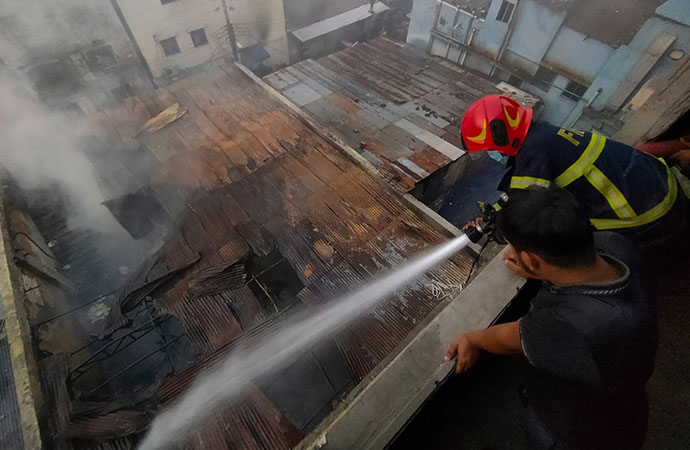
Photo: AP/UNB
A spate of fire incidents in the space of a few weeks has drawn attention once again to the issue of workplace safety. In the latest incident, at least 16 individuals working in a garment factory next to a chemical warehouse in Mirpur in the capital were killed, their bodies burnt beyond recognition, after a fire broke out at the warehouse. Just a few weeks ago, on September 22, four firefighters died after receiving severe burn injuries while extinguishing a blaze at a warehouse in Sahara Market of Tongi, Gazipur.
There seem to be several factors that led to so many deaths in Mirpur. The victims died after inhaling the toxic gas from the chemical explosion. According to Fire Service officials, the rooftop exit was locked with two padlocks, so even if people could go to the top floor, they would not have been able to get to the rooftop. Neither the garment factory unit nor the chemical warehouse had any fire safety licence, fire safety plan, or proper fire protection measures. All routes to escape were blocked. What the incident exposed was sheer negligence and disregard for human lives. The owners of the warehouse and garment washing unit did not install the minimum fire safety measures. As such, they must be held accountable by law.
This isn't the first time that illegally stored chemicals have caused something horrific like this in capital Dhaka. According to the Fire Service and Civil Defence (FSCD) department, there are many chemical warehouses in the city storing explosive chemicals, often illegally and in densely populated areas. The law requires all chemical factories and warehouses to obtain a licence from FSCD, but many of these establishments operate without one. Without accountability, we seem destined to go on encountering such horrors at regular intervals.
It is also unacceptable that a total of four projects to relocate these hazardous industrial units, initiated soon after the June 2010 fire that claimed 126 lives in Nimtoli in Old Dhaka, remain incomplete, even after 15 years, due to red tape and bottlenecks in land acquisition. We may also recall the devastating Churihatta fire in February 2019, that claimed 71 lives. The interim government must take immediate steps to get things moving again on this front, and expedite their completion. They include one to relocate chemical warehouses to a chemical industrial park in Munshiganj. The project, drafted in 2011 and revised later, was scheduled to be complete by June 2022, but the pandemic slowed down its progress, according to the project director. Now it is supposed to be completed by the end of this year, and the government must ensure that happens.
At the same time, the government agencies involved must step up their monitoring of such establishments, and if necessary, shut them down temporarily, till they are able to provide assurances of operating safely. No one should be able to get away with illegal handling and storage of dangerous chemical materials, even more so around residential areas.
A Independent Newsweekly
© Copyright 2026 | Designed by ARK Reepon & Developed by Cosmos Group Software Team






Leave a Comment
Recent Posts
Dhaka, Tokyo relationship to c ...
Deputy Chief of Mission of the Embassy of Japan in Bangladesh Yoshida ...
Democracy puts a premium on et ...
And just like that, the deed was done. With a volley of 'Ayes!’( ...
Dhaka still eyeing ‘conducive’ setting for PM’s Delh ..
Gallery Cosmos Artist Residency, 2026
Summit seeks reinstatement of FSRU deal
Hatful of medals for Bangladeshi whiz kids at WMI 20 ..