



Column
“Shahed Mama and Abul Kashem Fazlu Sir”: Farewell to witnesses of our childhood and youth

An Independent Newsweekly

Column
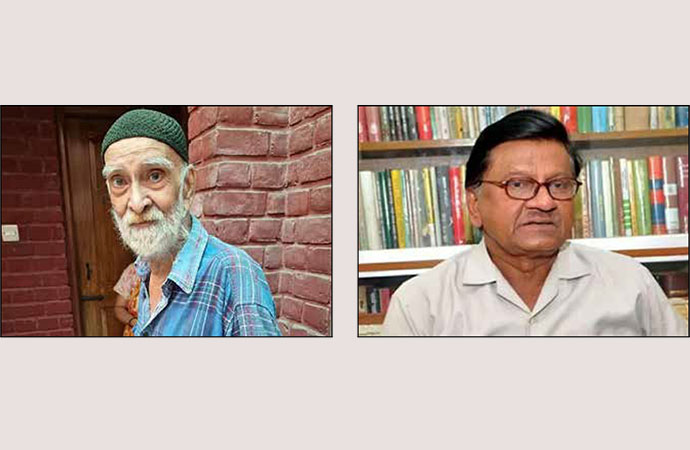
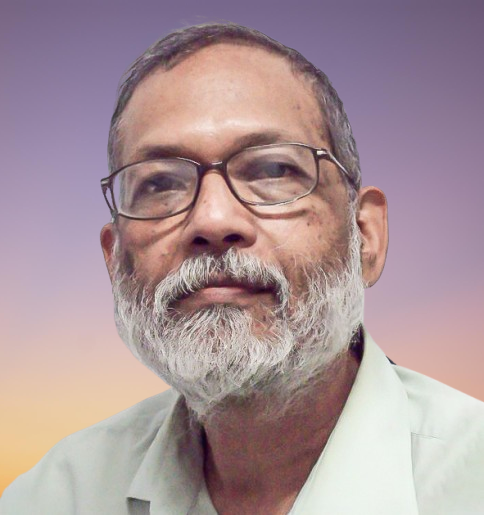
Shahed Kamal And Professor Abul Kashem Fazlul Haque. Photo: Collected
Journalist and teacher Shahed Kamal-our Shamim Mama-is gone. I didn't even know he was so ill and on his deathbed. Read about it on a FB post by Munni Saha and called her immediately. Munni hastily said that he was no longer responding to treatment or anything else. I hung up.
I sat there as if in a daze. In the evening, I learned from a post that Shamim Mama had bidden his final farewell. It felt as though he took a part of me with him. The very next day, news arrived that Professor Abul Kashem Fazlul Haque had also passed away. Suddenly, it feels as if all the elders and witnesses of our growing-up years are waving goodbye.
It is not a matter of just people dying of old age but of the death of a collective past. They passed away at a mature age, but our memories of the past never grow up, they never age-that is why it feels so empty.
One was a witness to Tikatuli, the neighbourhood of my birth. Shamim Mama, or Shahed Kamal was the eldest son of Begum Sufia Kamal, the doyen of the "parah". The other was from the era of our growing up and maturing as youth-a teacher, and in a sense, a fellow traveller. Today, these partners of two of the strongest chapters of our lives are gone.
Tikatuli times
The Tikatuli of my time means the Tikatuli of the 1950s-Abhoy Das Lane. I was born in 1952 in a neighbourhood inhabited by the educated middle class, who played a leading role in shaping the literary and cultural landscape of this country. Mentioning a few names will make it clear. Begum Sufia Kamal lived in that neighbourhood and that is enough. But beyond her involvement with the magazine *Begum*, she was also a political and social activist-not to mention her poetry.
Yet, very few people might know that even though she was not secretly involved in underground political activities, she was a person such radicals deeply trusted. In the mid-1960s, a group called the "Bagmar Group" attempted to establish an independent Bangladesh. In the plan they devised, Begum Sufia Kamal was envisioned as the head of the State. It was a level of a profile not just of politics of that time but her profile and integrity too.
Sikandar Abu Zafar, a pioneering figure in Bangladesh's literary movement and the editor of the literary magazine *Samakal*, was also a resident of that neighbourhood. So was his brother, the artist Syed Jahangir and many others. Almost all of them were Bengali Muslims who had moved from Kolkata and who, in the 1940s, envisioned an "independent state of Bangladesh." They were not traditional "Pakistanis."
Many, including my father, were students of Islamia College and residents of the Baker Hostel of Kolkata where so much of Bengal Muslim league or middle-class politics that led to Bangladesh was born. The political dream they grew up with was not realised, but the dream itself never died. That is probably why, no matter how busy they were with their careers, they supported politics.
The next generation of Tikatuli represents the torchbearers of another continuity. The youth in that neighbourhood during my childhood-unlike my grandparents' or parents' generations who came from Kolkata-also became accomplished individuals in their later lives. Whether it was Shamim Mama, Chotlu Mama (Ali Zaker), Jahan Mama (brother of Shahadat Bhai of the weekly *Bichitra*), or the actor Hasan Imam mama, among others. In other words, two generations were coming together in that neighbourhood, and in later times, it was they who took the helm of society and culture. That is how Tikatuli used to be.
It was a neighborhood where no child could ever get lost because every home belonged to everyone in the neighbourhood. It was this neighbourhood culture that kept Bangladesh resilient through a hundred crises, including 1971. That culture gradually weakened and is now gone. What exists now is for the readers to decide. Shamim Mama-the witness and inheritor of that heritage, a teacher of journalism, and an activist-has departed, taking the testament of that era with him.
The witness of our rebellious youth
The very next day, news came that Fazlu Bhai, or Abul Kashem Sir, had passed away. Professor Abul Kashem Fazlul Haq was one of the primary mentors during our Dhaka University days. He was a teacher in the Bengali Department, while I was a student of the History Department. However, we came together through the left-leaning cultural organisation *Lekhak Shibir*.
Our leader, as well as his, was the head of the Bengali Department and a legendary figure, Professor Ahmad Sharif. Many of our activities revolved around him, whether through those of us who were students or through the active involvement of Professor Abul Kashem and others during a highly challenging time.
We were children of the 1970s, the first batch of Dhaka University after the country became an independent state. We were pro-1971, but at the same time, many of us were not pro-government. Consequently, like-minded people gathered together under various banners. Figures like Ahmed Sofa Bhai and others, who had been active since before 1971, were there, and alongside them comes the name of Professor Abul Kashem Fazlul Haq. Since he was a teacher, his role was within the institutional sphere; since we were students, our boundaries were a bit more scattered.
Professor Sharif could be described as a free-thinking pro-Marxist-meaning he respected leftist ideology, but not in a dogmatic or partisan way that accepted everything blindly. Fazlu Bhai, in that regard, was like Siraj Sir or Serajul Islam Choudhury-a Marxist to most extent. In the various events we organised, it was clear from his speeches that he belonged to that school of thought.
Sir adhered to this candid stance throughout his life. There was no weakness in his intellect. One can read his book *Kaler Jatrar Dhoni* (The Sound of Time's Journey) to understand the framework of his thoughts.
About 5 to 10 years ago, I used to appear frequently on television talk shows. Professor Abul Kashem would also attend. Even there, I would hear the same fearless articulation. He never wavered from the moral stance of his political philosophy. This is what we inherited from mentors like them back in the day. Personal gain always surrendered to their moral fortitude; this was their primary achievement, their legacy.
Those who must leave will eventually depart, that is certain. However, these individuals have left behind something that feels to me like a gift from one generation to another, transcending their individual boundaries. Not everyone possesses the capacity or worthiness to leave such a legacy-they did, and thus they remain immortal not just in memory, but through their deeds.
A Independent Newsweekly
© Copyright 2026 | Designed by ARK Reepon & Developed by Cosmos Group Software Team






Leave a Comment
Recent Posts
The government passes the test ...
One of the cornerstones of the political earthquake Bangladesh witness ...
The government hiked the price ...
The government hiked the price of a 12kg cylinder of liquefied petrole ...
Police in France stand accused of using excessive fo ..
The India-Pakistan Cold War
A week on from DNCC’s eviction drive, Mirpur-10 rema ..
Equal Service, Unequal Pensions: Time for a Fairer S ..