



Column
The story of Saida


An Independent Newsweekly





Column
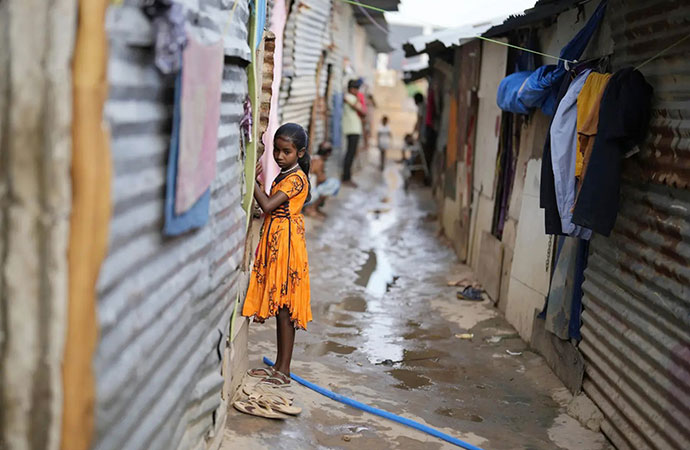
Photo: AP/UNB
People in slums go out to work, particularly in neighbouring households.
Saida came with her grandmother to work in my home in Park Circus, Calcutta, one day. She was 15, an orphan from the nearby slum of Darapara being raised by her grandmother, who was as grizzled and irritable as Matron Time.
I was 13. I would have taken to Saida instinctively as a younger brother but for the confounding fact that she spoke no Bengali nor English (and I no Hindi, her mother tongue from her family's provenance in Bihar, although I could understand the language). Also, she had a terribly musty smell about her, one that carried into my home the unknown and unwelcome fragrance of a girl wearing rarely-washed clothes and sleeping on mats sticking to damp floors.
She was a mysterious figure radiantly dark, mischievously silent, dismissively obedient to my mother's commands, and possessing no perceptible entanglement with the larger world whatsoever. She came in the afternoons to help prepare dinner, mostly with her grandmother in tow. They left with some food for themselves at around 8 pm.
All was normal till Saida ran away one evening. Her grandmother had not come with her that day. My mother had sent her out to a nearby shop to buy one of my favourite sweets. That was at around 4 pm. Half an hour passed, then an hour, and then two. My mother panicked. She blamed me for being so greedy that she had had to send out the wretched girl into the malicious world just for my sweets. The doubts of evening wore into suspicious dusk, which turned into confirming night soon enough.
At 8 pm, Saida returned with herself and my sweets. Upon severe questioning, the kind of interrogation that only women are capable of inflicting on less-powerful women, she confessed to my mother that she had met her boyfriend accidentally on the way to the sweetmeat shop. They had decided on the spot to go on a tour of Calcutta, right up to the Howrah Bridge that rises over the river Hooghly. They had eaten savoury phuchkas along the way, even held hands, quarrelled and made up, and then she had returned content in the knowledge that her boyfriend would love her forever.
My mother was unmoved by this teenage fairytale. "Did you do it along the way?" my mother asked threateningly. "Do what?" Saida asked. "Will you become pregnant?" my mother asked, her question loud enough to be heard wherever pregnancies take place. Saida's silence infuriated my mother, who twisted her left ear so painfully that the poor girl cried out.
Biting into my sweets, I drew my own conclusions. Saida could not have done "it" in the four hours spent on the road; while eating phuchkas (which at their crispy and sour best are better than "it"); on overcrowded trams stuck in traffic jams; or on Howrah Bridge itself (where she and her boyfriend would been run over promptly by hurrying pedestrians or rushing cars).
Public piety and private sinning are perfectly acceptable in a city, but public sinning is quite another matter: The invasive density of a voyeuristic population and the woeful lack of secluded spaces are such that public sinning would have been a very difficult act to pull off. Of course, the two lovers could have checked themselves into a seedy hotel or visited a common friend's home when the parents were out. Possible, yes, but probable?
Perhaps not.
So, unless Saida was feigning innocence after having done "it", the chances of her becoming pregnant, and of my sweet tooth being blamed for it, were negligible. I finished my sweets as my mother's interrogation went on.
It was now 9 pm. Saida should have returned to her home long ago, but she had not. Her grandmother arrived aghast at our door. She was equally angry with Saida and me: Saida for being beautiful, and me for being sweet-loving. The boyfriend was nowhere in sight.
That was the last time that I saw Saida. She did not become pregnant: The grandmother would have rained the avenging skies on my family's heads had she done so. Or perhaps she did become pregnant, and the grandmother decided not to make a public scene, in which case: "Congratulations, Saida, and this time I owe you and your phuchka-treating spouse the sweets."
Saida departed as inscrutable as she had arrived, a female enigma of the Muslim slums.
Muslim life in Bengal never ends. Why should it?
The writer is Principal Research Fellow of the Cosmos Foundation. He may be reached at epaaropaar@gmail.com
A Independent Newsweekly
© Copyright 2026 | Designed by ARK Reepon & Developed by Cosmos Group Software Team






Leave a Comment
Recent Posts
The government passes the test ...
One of the cornerstones of the political earthquake Bangladesh witness ...
The government hiked the price ...
The government hiked the price of a 12kg cylinder of liquefied petrole ...
Police in France stand accused of using excessive fo ..
The India-Pakistan Cold War
A week on from DNCC’s eviction drive, Mirpur-10 rema ..
Equal Service, Unequal Pensions: Time for a Fairer S ..