



Featured 1
An onus on skilled economic management


An Independent Newsweekly




Featured 1

We have now commenced the first full fiscal under the BNP government elected in February, and this is where its economic management must come to the fore and set a new direction for the country. It has passed its first budget, it has had time to make the appointments it wants, and it has had time to settle. Now is the time for results.
The country recorded 4.14 percent growth in its gross domestic product (GDP) in the just-concluded 2025-26, up from 3.49 percent a year earlier, according to provisional data from the Bangladesh Bureau of Statistics (BBS), while the government has set an ambitious growth target of 6.5 percent for the current financial year. Most projections from internationally credible sources indicate growth will struggle to touch 5 percent.
The Asian Development Bank, in its latest outlook, has forecast Bangladesh will grow at 4.5 percent in the 2026-27 fiscal. It also said the economy grew 3.7 percent in 2025-26, lower than the provisional estimate by BBS. Earlier, the Manila-based multilateral lender had projected 4 percent economic growth for FY26 and 4.7 percent growth for FY27.
The ADB said the revised outlook reflects weaker export performance, subdued private investment, high energy prices, persistent inflationary pressures, and a more adverse external environment. High inflation in particular continues to erode real purchasing power and constrain private consumption.
The economy is still described as performing resiliently amid "a difficult global and domestic environment", by both the ADB and others such as Frederic Neumann, chief Asia economist and co-head of global investment research for Asia at HSBC, who spoke at an economic outlook event organised by HSBC at a hotel in Dhaka this week.
Neumann in fact believes that with oil prices easing, the outlook for US tariffs stabilising, and global growth remaining robust, exports can be expected to recover in the next six months. The point was made during the period leading upto the budget, that Bangladesh must seek to first consolidate its macroeconomic recovery following two years of high inflation, pressure on foreign exchange reserves and weaker economic activity, compounded by banking sector vulnerabilities, energy constraints, and weak competitiveness.
In fact, the ADB makes it plain that downside risks to the outlook remain "significant". A further escalation of the Middle East conflict could raise energy and shipping costs, intensify external pressures, weaken growth through higher inflation, and soften remittance inflows. That seems to be already happening, as US President Donald Trump this week declared the ceasefire with Iran as "over".
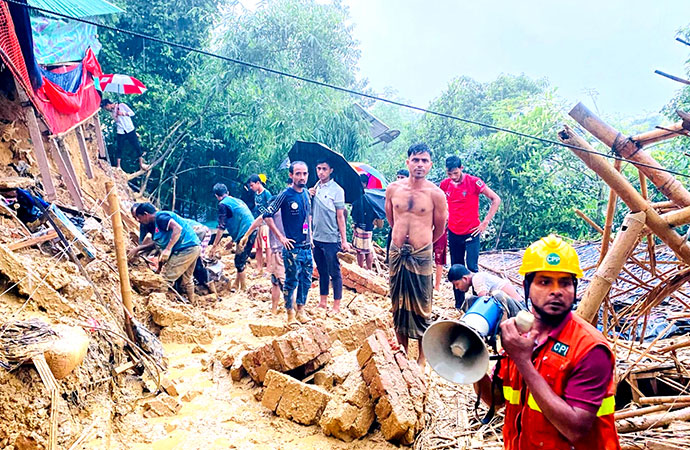
One thing they didn't mention in their report is the risk posed by adverse weather conditions - the onset of the monsoon has served to remind us of the country's vulnerabilities to flash floods and landslides this week, and if they become a factor in the next 12 months, the government's mettle is sure to be tested even more. Let us hope they are up to the challenge.
A Independent Newsweekly
© Copyright 2026 | Designed by ARK Reepon & Developed by Cosmos Group Software Team





Leave a Comment
Recent Posts
The government passes the test ...
One of the cornerstones of the political earthquake Bangladesh witness ...
The government hiked the price ...
The government hiked the price of a 12kg cylinder of liquefied petrole ...
Police in France stand accused of using excessive fo ..
The India-Pakistan Cold War
A week on from DNCC’s eviction drive, Mirpur-10 rema ..
Equal Service, Unequal Pensions: Time for a Fairer S ..