



Column
The Mirror We Avoid

An Independent Newsweekly


Column
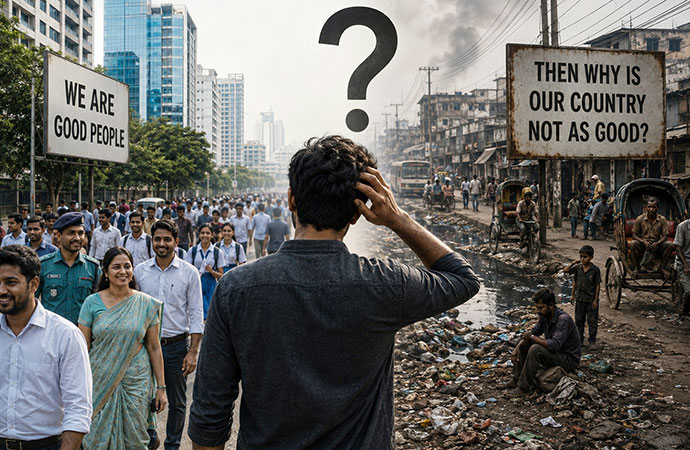
AI Generated Image
If We Are All Good, Why Is Bangladesh Not Yet the Country We Dream Of?
During a recent visit to South Korea, our delegation reflected on how a nation once devastated by war had become one of the world's most advanced economies. As we discussed the reasons-visionary leadership, quality education, sound policies, disciplined citizens and strong institutions-a fellow Project Director, a BUET graduate whose integrity I greatly admired, quietly asked, "If we all claim to be good people, why isn't our country as good as we believe we are?" The bus fell silent. That simple yet profound question has stayed with me ever since because it goes to the heart of Bangladesh's development journey.
Bangladesh has all the reason to be proud
Bangladesh has all the justification to be proud of the progress so far. It has risen from its condition of devastation caused by war and poverty to a US$456 billion economy with a longer lifespan, a near universal access to electricity, and an extremely low rate of poverty. However, the progress of the institutions has lagged behind. Corruption, poor governance, and non-uniform application of law and declining public trust are serious issues. The transformation of the economy in Bangladesh is remarkable; the next challenge is to establish institutions that are as strong and trusted.
The Difference Between Good People and Good Citizens
Maybe there's a difference we don't often draw that we need to make: Good people are not necessarily good citizens. A good person is concerned about family and friends. In addition, a good citizen is a citizen who fulfills the responsibilities of a citizen, including obeying the law, paying taxes in a timely and accurate manner, protecting public property and putting the common good above his or her personal convenience. The tax to GDP ratio in Bangladesh's 2026-27 budget was only 6.8 per cent while total revenue was approximately 8 per cent of GDP; which is well below the required level to deliver quality public services to almost 180 million people. One reality that comes from this is that there are weaknesses in the structures, but another is that development is a shared responsibility. Private virtues aren't the only foundations on which nations are constructed: Everyday civic behaviour is as well.
The Cost of Small Compromises
When the nation is in decline the crisis is generally not its starting point. It grows from the myriad little compromises, such as jumping queues, not obeying traffic laws, putting files on hold, giving special treatment to connections, not paying taxes, and considering laws as a choice. Taken individually these acts are insignificant. Together they create a country's culture. The cost is illustrated in Road Safety. The Bangladesh Road Transport Authority reported 5,490 fatalities in road accidents in 2025, but another group estimated that there were 7,359 deaths and 16,476 injuries, reflecting how serious the issue is and how many accidents go unreported. This is the same elsewhere. A single missed file, a single act of favouritism or one missed regulation may be immaterial, but one and then thousands more make the process less merit-based, less investment friendly and less respectful of the rules of the game.
What International Evidence Tells Us
This is the same result seen internationally. American political scientist Francis Fukuyama defines trust as social capital, while two American political scientists, Douglass North (Nobel laureate) and Robert Putnam, argue that good institutions and civic involvement are vital to sustainable development. This is evident in the rankings in the world. Bangladesh was ranked at 150th position with a score of 24 out of 100 in the Transparency International's 2025 Corruption Perceptions Index among 182 countries and territories, while Denmark, Finland and Singapore were among the top performers. The South Korean experience is a good reminder that success wasn't achieved by the perfection of institutions, but by improving them over time. There are countries that are successful, and they constantly develop the institutions to solve their problems.
Bangladesh's Next Development Challenge
Now the next challenge in Bangladesh is not just to reach higher growth rates but to create institutions that can ensure the rate of growth. In response to this, in June 2025, the World Bank approved US$250 million for the Strengthening Institutions for Transparency and Accountability Project, with the support of the Bangladesh Bureau of Statistics, the National Board of Revenue, the Planning Division, Bangladesh Public Procurement Authority, and the Office of the Comptroller and Auditor General. The message is loud and clear - infrastructure is not enough for sustainable development. What is needed for Bangladesh's next transformation is to have stronger institutions, better governance and higher public trust.
The Mirror Bangladesh Must Face
It is easy to criticise politicians and institutions; the harder task is to examine our own conduct. If we expect transparency, fairness and accountability from others, we must practise those values ourselves. At the same time, responsible citizenship flourishes only when institutions are fair, effective and consistently enforce the law. Lasting trust depends on both.
Five Propositions for a Better Bangladesh
The answer lies not in blame but in action.
First, strengthen civic education so students learn both their rights and responsibilities.
Second, make merit and integrity the foundation of recruitment, promotion and public recognition.
Third, simplify and digitalise public services to improve efficiency, transparency and accountability.
Fourth, measure progress beyond GDP by tracking public trust, service quality, road safety and institutional performance.
Finally, lead by example. National transformation begins when leaders consistently practise the values they expect from others.
Looking into the Mirror
The way is clear before him. Construct institutions that promote merit; establish laws based on justice; train citizens to be good and modernise public services. Governments need to do a better job of governing; institutions need to do a better job of providing services and citizens need to act in a better way. Combined, these three forces will drive the next wave of change in Bangladesh, one that will be not only economic, but also institutional, civic and enduring.
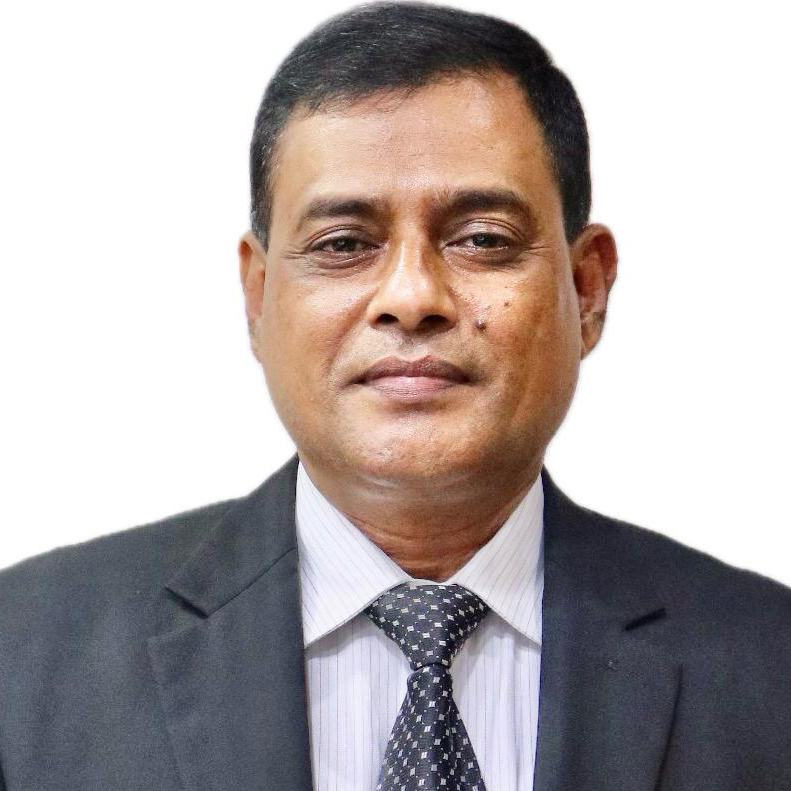
Major General (Retd.) Md. Nazrul Islam is the former Executive Chairman of BEPZA and former Executive Member (Planning) of BEZA. He is a PhD researcher focusing on technology, workforce transformation, and industrial competitiveness, and the writer of the Zi-DoNa Trilogy.
A Independent Newsweekly
© Copyright 2026 | Designed by ARK Reepon & Developed by Cosmos Group Software Team





Leave a Comment
Recent Posts
Is the international community ...
A spate of downgraded economic projections, from Bretton Woods to Mani ...
A Childhood Lesson in Arithmet ...
As children, we learned a simple mathematical rule: if we know the pri ...
Indian authorities launched a major security crackdo ..
Police dispersed garment workers from the Azampur ro ..
Why Saudi Arabia has struggled to defend itself agai ..
Iran-backed Houthis strike Saudi oil company Aramco’ ..