


Column
Snacks of Dhaka: How are they doing?


An Independent Newsweekly
Column
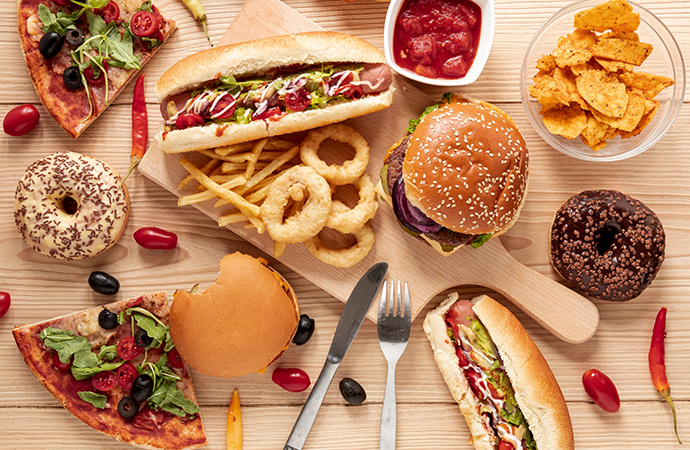
Freepik
There was a time when snacks were not thought to be worth anyone's serious attention. That was some time ago though when Dhaka was barely an urban pimple growing on the face of the new capital city of a new state. But of course snacks were always there and so was the city and they were going through growth, change and finally a transition that was beyond imagination as one stood on the footsteps of the fifties, sixties and seventies.
The old and the new divide
Once, a long time ago, after 1947, the city had two major sections: the hard core old city and the middle class section that lived next to it. The current new city simply didn't exist. The hardcore old Dhaka was the Nawabi zone centered around Sadarghat, Patuatuli, Sankhari Patti or Nawabpur not to mention all the business zones. In fact Nawabpur was close to the rail line beyond which was the Gulistan zone, the harbinger of the things that were coming.
In the seventies, while the old city remained, the new had grown and we had the new middle class zones such as Azimpur, Swamibagh, Moghbazar to name a few. Dhanmandi was more upper though the current supper-upper Gulshan had really not begun to wear the fancy dresses it dons now.
The residential areas that housed the middle class professionals were Wari, Gandaria and other places where the famous sons lived whether commuting to the Dhaka city or Dhaka University via Chankharpul and other areas. The food and lifestyle were also different, one from traditional and the other more attuned to the more cosmopolitan calls of an urban Kolkata led culture.
With 1947, the situation changed as many of the urban elite leadership of Dhaka left for Kolkata and new entrants arrived at the gates of the new city. Thus began the first big change and over time the new city also began to develop a cultural identity of its own.
With 1971 the changes began rapid and radical. New zones sprung but consumption grew at a pace never seen before and with that grew fast food whether on the shops or the street or elsewhere. Few snacks have been lost in time but many new ones have arrived including the all-encompassing burger.
Old city snacks
Some snacks sold in the old city are symbolic of it, like Bakarkhani, the flaky crusty bread usually round in shape and now available in both salty and sweet versions. Another sweet snack is Shuta Kabab, a kebab which has a thread wrapped with it to keep it falling apart. For sweets, all began there whether Maranchand or other chand but balushai hasn't travelled to the newer part of Dhaka and is essentially an old city savoury.
Right now, the most popular snack food, often sold during Ramadan only is 'Boro baper polay khay'. It's actually not one snack item but several and all rolled into one and as the name suggests, you got to be someone special just to even want to try to eat it.
Lots of snack items have now lost old city new city tags and become common to both. But old city is certainly more traditional more Mughal if one wills while the new city is obviously more Western.
Of course there are certain food and snack items that have become universal and nothing fits the description better than the various types of chatptti and fuchka. They are everywhere, at home, in shops and restaurants and on the street of course. Singara, samosa, peanzu are not even considered snack items anymore but part of everyday eating.
One may add the following to the list - hot patties, veggie rolls, pakora, butter bun and all that. They are part of an increasing dominant quick snack cum quick meal where one rushes to put something into the belly when there is no time to have a proper meal, a meal on the run really. But they can also be had at leisure at tea time or when leisure and hunger both call.
New city additions
Old city is more introspective, looking into itself for inspiration while the new city has the whole world in front of it to bring home. And that is reflected in some of the snacks added to the menu including the street vendor menu.
In my street sojourn some new additions are expected. There is the kebab roll, a very popular item, a kind of a local burger but bun-kebab also which is a direct challenge to Hamburger. The unexpected one is of course mo-mo, essentially a Tibetan food now really making its soft self-felt and competing with won ton, the Chinese delicacy usually had with soup.
However, beating everyone hollow and emerging as champion of the world is the great world conquering noodles. It's not only everywhere but in every meal and snacks produced locally as well imported and most don't think of it as a local fast food.
The snacks market is fascinating as it shows how as society and the world changes they are also reflected in the choice of food people make and how delicacies are born with every transition.
A Independent Newsweekly
© Copyright 2026 | Designed by ARK Reepon & Developed by Cosmos Group Software Team





Leave a Comment
Recent Posts
Is the international community ...
A spate of downgraded economic projections, from Bretton Woods to Mani ...
A Childhood Lesson in Arithmet ...
As children, we learned a simple mathematical rule: if we know the pri ...
Indian authorities launched a major security crackdo ..
Police dispersed garment workers from the Azampur ro ..
Why Saudi Arabia has struggled to defend itself agai ..
Iran-backed Houthis strike Saudi oil company Aramco’ ..