



Column
Feeding Bangladesh, but Losing its Farmers: A Food Security Inflection Point


An Independent Newsweekly





Column
Collected
Bangladesh has nearly attained staple food self-sufficiency, but 15-16 million people are still food insecure, and farmers are slowly leaving the sector due to increasing costs and profitability. Among its Asian neighbours, the nation is now at risk of falling behind - not in production, but in productivity, resilience and human resources in agriculture.
Where Bangladesh Stands Today: Progress with Untapped Potential
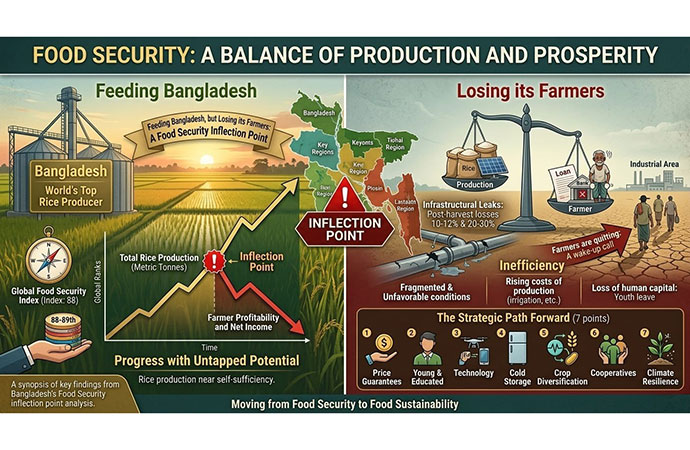
Bangladesh has made great strides in its agriculture. Bangladesh is one of the world's largest rice producers with over 38-40 million tonnes of rice produced per year and has achieved calorie self-sufficiency. But it falls short in global comparisons. Bangladesh is in the 80th-85th position in the Global Food Security Index, behind India (68-70), Indonesia (60-65), Vietnam (50-55) and China (top 40). It's not the yield but the cost, nutrition and resilience. Some 15-16 million people are still food insecure and almost 30% of under-five children are stunted (compared to less than 20% in Vietnam and less than 10% in China). Agriculture accounts for 11-12% of the GDP, but employs more than 35% of the labour force, suggesting low labour productivity. This sumptuous/inefficient/unequal status quo is Bangladesh today.
Farmers are quitting: A wake-up call
Behind these statistics is another reality - the gradual exit of farmers from farming. Increasing costs of production (fertilisers, diesel and labour) have eroded profits. Over the past few years, irrigation costs have soared while, due to urbanisation, labour costs have tightened. However, farm produce prices are volatile and sometimes depressed, due to poor market organisation. Consequently, agriculture is becoming an increasingly risky and unfavourable sector. Farmers are becoming tenant farmers, land is becoming fragmented and smallholders are dying out. Unlike many other developing countries such as Vietnam and China, which have transformed agricultural production with the help of technology and institutions, Bangladesh is losing its production capacity despite short-term food production.
Inefficiencies: Food Security after Harvest
Despite steady production, inefficiencies pose a serious threat to food security. Bangladesh's estimated post-harvest losses for rice are 10-12% and for fruits and vegetables, 20-30% - far greater than in countries with efficient supply chains. India has brought grain losses down to less than 8% via increased storage and China's integrated supply chains have also reduced losses. In Bangladesh, this inefficiency is due to poor storage, lack of cold chains and supply chain integration, leading farmers to sell at a low price during the harvest season and consumers to pay a high price during the off-season. This not only leads to loss in farmer income, but also to an increase in consumer prices.
Missing Link between Technology and Human Capital
The world is rapidly moving towards technology-based farming, but Bangladesh is lagging. China has mechanised most farming activities and Vietnam has adopted digital advisory services, but Bangladesh has only mechanised some farming activities. More significantly, it has an "educated deficit". Data analytics, climate change, financial and supply chain management are knowledge areas needed in modern agriculture. But young people with education tend not to work in agriculture, as they perceive it as a "last resort". Failing to make agriculture a knowledge-based industry will limit improvements in productivity and competitiveness.
Structural Drivers of Food Insecurity
Several factors are still at play in Bangladesh's food security. The country is highly vulnerable to climate change, with floods, cyclones and salinity impacting a large proportion of farmlands each year. Purchasing power has been affected by food inflation, making food unaffordable for many. Rice is the staple food of the country and accounts for more than 70% of the food energy consumed, leading to a lack of diversity and malnutrition. Meanwhile, net sown area is decreasing due to urbanisation. Poor market regulations and coordination between institutions add to the inefficiencies.
What can be done: Securing the System, Retaining the Farmer
To build on production success for sustainable food security, Bangladesh needs to implement a series of strategies:
1. Guarantee Farming is Viable. Set minimum and/or guaranteed prices for major crops, provide crop insurance and low-interest credit to farmers to improve economic stability.
2. Entice Young and Educated into Farming. Provide agri-entrepreneurship training, tax benefits and seed funding, and promote agriculture as a high-tech, high-value-career.
3. Accelerate Technology Adoption. Encourage mechanisation, precision agriculture and digital advice systems, through public-private partnerships, to benefit small and marginal farmers.
4. More Post-Harvest Infrastructure. Develop cold storage, warehouses and rural infrastructure to halve post-harvest losses in next ten years.
5. Diversify Agricultural Production. Promote growing pulses, oilseeds, fruits and vegetables, and protein to boost nutrition and improve farmer's ability to withstand income shocks.
6. Encourage Cluster and Cooperative Farming. Encourage cluster farming and cooperatives to enhance efficiency, allow mechanisation and boost farmers' collective bargaining capacity.
7. Strengthen Climate-Resilient Agriculture. Promote scaling up of salt tolerant, flood and drought resistant varieties and climate-smart agriculture.
8. Enhance Market and Supply Chain Governance. Improve farmers' market monitoring, eliminate middlemen's distortions and build supply chain integration with farmers, consumers and processors.
9. Improve Agricultural Extension and Education. Upgrade agricultural universities, computerise extension services and provide timely advice to farmers in the field.
From Food Security to Food Sustainability
Bangladesh is at a tipping point. Bangladesh has shown it can feed itself, but it's at risk of losing its food security. People are abandoning farming, it is becoming expensive, inefficient, and technology is yet to be embraced. No country can win the battle for food security without retaining farmers and involving its literate population in farming. The challenges of the next stage, therefore, are to secure food through sustainable food security and labour-intensive agriculture through knowledge-intensive agriculture. The next challenge is that Bangladesh needs to secure its farmers - economically, technologically and socially - to secure its food.
Major General (Retd) Md Nazrul Islam is a former executive chairman of BEPZA, a retired Major General of the Bangladesh Army, and a PhD researcher on technology, workforce transformation, and industrial competitiveness.
A Independent Newsweekly
© Copyright 2026 | Designed by ARK Reepon & Developed by Cosmos Group Software Team






Leave a Comment
Recent Posts
Is the international community ...
A spate of downgraded economic projections, from Bretton Woods to Mani ...
A Childhood Lesson in Arithmet ...
As children, we learned a simple mathematical rule: if we know the pri ...
Indian authorities launched a major security crackdo ..
Police dispersed garment workers from the Azampur ro ..
Why Saudi Arabia has struggled to defend itself agai ..
Iran-backed Houthis strike Saudi oil company Aramco’ ..