



Column
A Kolkata Story

An Independent Newsweekly
Column
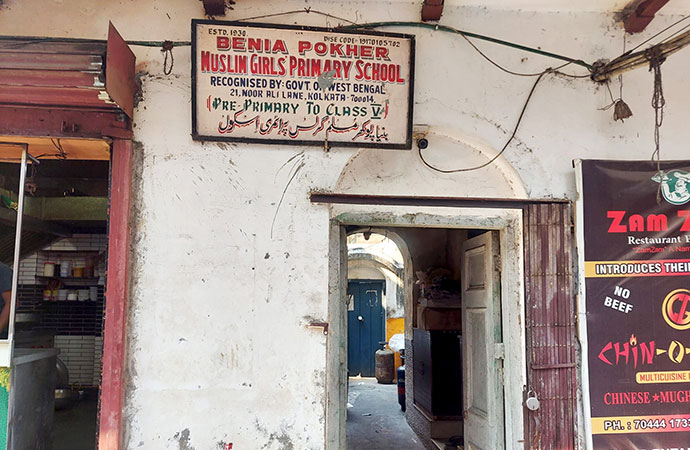
A Benipukur landmark. Notice the colonial spelling of the area. Photo by Asad Latif.
Beniapukur in Kolkata is a largely Muslim area, one of several minority ghettos that have been described as a "territorialised form of hyper visibility and containment". What this means is that such areas stand out in a largely Hindu city as sites of demographic difference that are dramatised by the sheer weight of minority numbers but that are kept in place, so to say, by the invisible cordon of the majority community. I have faint memories of Beniapukur from my childhood and youth spent in the nearby Park Circus area. Park Circus in those years was a cosmopolitan place where religious, linguistic and class identities coexisted in tolerant understanding if not in seamless harmony. Today, it seems to have gone the way of Beniapukur, but that is another story.
I revisited the Beniapukur of my memories in April last year. Immensely congested, it is not only a face-to-face society but is also an in-your-face society. There is no space to be yourself here in such densely-packed space. You are a part of everybody else, and everybody else is a part of you. You are your society. The area is "hyper-visibly" Muslim, with men with beards and caps, and women wearing the burqa, contributing to the visual normalcy of the roads. Also, the lingua franca of the streets, shops and restaurants is Hindi, although some or many or most people might well study Urdu as their mother-tongue language in school. Clearly, residents in Beniapukur in great numbers hail from Bihar or Uttar Pradesh or are descendants of Muslim immigrants from North India. Generations pass but not genetic inheritances of language and habit.
Waiting for naan and mutton masala in a well-known restaurant, something caught my eye in the passing crowd. It was the presence of children in smartly-pressed uniforms on their way to school. Their easy gait spoke of a secular self-confidence in the Indian education system, whose English-medium stream certainly (but not exclusively) allows students access to top careers in medicine, engineering, computing, law, teaching and the civil service - all of which require competence in English along with the mastery of their chosen disciplines. A child's Religious Quotient is not a part of that competitive reckoning. This is not to say that children cannot be Hindu, Muslim, Christian, Sikh, Buddhist, Jain or agnostic or atheist. They can, and they are. But their religious (or non-religious) credentials are far less important than their epistemic capacity to be citizens, that is, to be politically equal stakeholders of the civic sphere.
English-medium schools, to which I think most of the children were headed given their uniforms, inculcate to this day an inclusive sense of English-speaking Indianness that, for all its colonial provenance, is a linguistic legacy that helps to hold diverse India together. Some of the oldest and most illustrious English-medium schools are Christian mission schools as well, but they do not exist to convert Hindus, Muslims, Buddhists, et cetera, to Christianity. As a former student of three Christian institutions - St. Victor School and Don Bosco School (both Catholic and in Park Circus) and Calcutta Boys' School (Methodist in Moulali) - I can attest to the fact that I am still Muslim. I owe my ability to write in these pages today to the teachers who taught me English without ever demanding that I cease or even pause to be Indian (or Muslim). They were Indians themselves. The Frank Anthony Public School in the Beniapukur neighbourhood carries the legacy of the immense Anglo-Indian contribution to national education. I think many of the students passing by the restaurant could have been headed there.
What a prized sight! Most prized of all was that of girls walking step in step with boys, all in matching uniforms. Now, this is unremarkable today, but it was not when I was growing up in Kolkata. Then, many Muslim girls from less-privileged families lived in a kind of interstitial space between male hegemony and female agency. They were allowed to be literate but never to the extent that they challenged the male literati. Perish the thought. Their ambitions consisted of being worthy companions of their husbands' ambitions. Cooking and procreation were their gendered roles, which they accepted with docile inevitability. (This was true of Hindu and Christian girls as well, but more of them escaped the trap than did their Muslim sisters, at least from anecdotal evidence.) The girls of Beniapukur whom I saw last year do not fit into the received grid. Access to an English-language education is transforming their self-expectations. They are not male accessories: They are co-creators of Muslim history within India. English is a good weapon even if it is not the only one. Beniapukur is not Birmingham or Boston, but it is a new Beniapukur. The old Beniapukur is on the way out.
Why do I write all this now, when my visit was in 2025? It is because a new political dispensation has come to power in West Bengal. Relations between Hindus and Muslims will change. There will be a new equation between majority and minority. So be it.
What must continue is the secular self-confidence of Muslim girls and boys in the Beniapukurs of West Bengal. Education will keep their future intact - not retreat into religious isolationism.
True, whether children can attend expensive English-medium schools will depend on their parents' ability to pay their fees. But the economy has a way of moving forward without being tied to any theoretical parameters or promises. That has happened in West Bengal already. It could continue to do so. Should it do so, the Muslim children of West Bengal must be educated to benefit from the best possibilities of the Indian economy, which will reindustrialise a state left behind by years of anti-growth rule.
Those gleaming uniforms must remain well-pressed. That confident gait must continue. It does not matter whether I come again, but the children must grow up to be equal citizens of the same India.
The writer is Principal Research Fellow of the Cosmos Foundation. He may be reached at epaaropaar@gmail.com
A Independent Newsweekly
© Copyright 2026 | Designed by ARK Reepon & Developed by Cosmos Group Software Team




Leave a Comment
Recent Posts
Is the international community ...
A spate of downgraded economic projections, from Bretton Woods to Mani ...
A Childhood Lesson in Arithmet ...
As children, we learned a simple mathematical rule: if we know the pri ...
Indian authorities launched a major security crackdo ..
Police dispersed garment workers from the Azampur ro ..
Why Saudi Arabia has struggled to defend itself agai ..
Iran-backed Houthis strike Saudi oil company Aramco’ ..