



Reportage
Down to The Business End Now


An Independent Newsweekly

Reportage
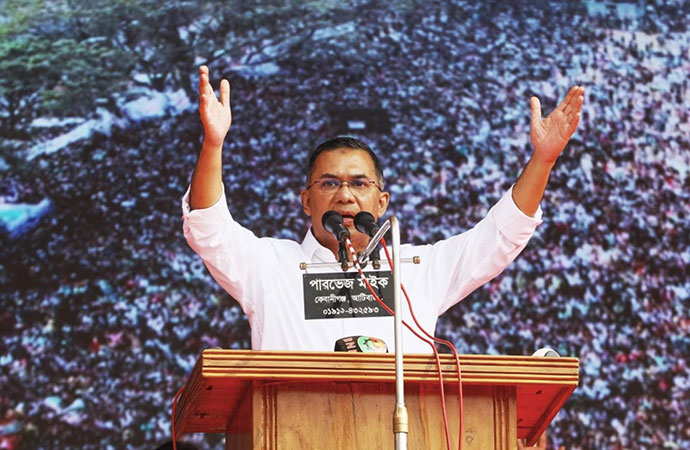
Tarique Rahman, the son of former Prime Minister Khaleda Zia and chairman of the Bangladesh Nationalist Party (BNP), addresses a campaign rally ahead of next month’s national elections, in Sylhet, Bangladesh, Thursday, Jan. 22, 2026. Photo: AP/UNB
The final numbers are in, all the formalities are complete, and we now know a total of 1,981 candidates will be contesting the 13th Jatiya Sangsad (national parliament) elections in 298 of the country's 300 constituencies. This is already the highest number of candidates since 2001, signaling a broad-based buy-in for the idea that the country is ready to finally emerge from the era of electoral dysfunction it had fallen prey to under the Awami League.
The Election Commission (EC) this week released party-wise candidate statistics for the 298 constituencies, after the deadline for withdrawal of nominations, the last hurdle before the races are finalised, passed on January 20. Voting will be held in all 300 parliamentary seats on February 12. The deadline for in Pabna-1 and Pabna-2 was extended till January 24, as a court battle ensued over the delimitation of its boundaries. That has now been disposed of, pushing back the schedule slightly, but the vote is going ahead on schedule.
According to EC data, the Bangladesh Nationalist Party (BNP), one of the two traditionally large parties that has governed the country on multiple occasions in the past, has fielded the highest number of candidates for the election, as well as maintained the broadest presence by naming candidates for the highest number of constituencies. The party's famed sheaf of paddy will be on the ballot in 288 seats this year. Jamaat-e-Islami, which enjoys plenty of momentum thanks to its leading role in the ouster of the last Awami League-led government, will be contesting 224 seats with their balancing scales symbol. Islami Andolan Bangladesh, which was in alliance with Jamaat till things fell apart in a quite spectacular break-up this week, has actually fielded candidates in more seats than Jamaat - 253 in all.
Overcoming a fair amount of adversity in the post-August 5, 2024 period, the Jatiya Party (JP), the AL's partner in crime over many years, is fielding candidates in 192 seats, practically dwarfing some of the newer parties who have been calling for it to be banned, or taken off the ballot - namely the Gono Odhikar Parishad of Nurul Huq Nur, which is on the ballot in 90 seats, and the National Citizen Party (NCP), the children of the revolution as it were, whose candidates will only be running for 32 seats, as part of the Jamaat-led coalition. And now it was down to the hectic campaign.
The BNP's Man with a Plan
For an election that is clearly going to be very keenly contested, the official campaigning period of just 19 days, that commenced on January 22, hardly seems adequate. The BNP's new chairman, Tarique Rahmanm who only returned to Bangladesh on December 25 after 17 years in exile has been forced to keep a whirlwind schedule ever since he set foot back in the country. And on the day that official campaigning commenced, he was set to commence what we understand will be a tour crisscrossing the entire country, starting from Sylhet.
On the same day, over in Dhaka, the party announced five programmes on the first day of the election campaign, stating that they aim to ensure the direct participation of people from all walks of life in the policymaking process for the state.
At a press conference organised at the BNP election office in Gulshan, Mahdi Amin, spokesperson for the party's election steering committee and one of Tarique Rahman's closest advisers, presented the details of these programmes.
Mahdi mentioned that the first programme is the ''Advise Tarique Rahman'' initiative. Under this initiative, a QR code will be distributed nationwide through posters and danglers.
By scanning the QR code, anyone can directly send their opinions, thoughts, and advice to Tarique Rahman. The feedback received through this initiative will be given importance in making necessary decisions for future governance, he stated.
The second programme, ''Letter to Tarique Rahman,'' allows citizens to send their expectations and proposals for the future of Bangladesh via letters, emails, and online. A designated address in Gulshan-2, as well as an email and online platform, have been set up for sending letters.
As the third programme, Mahdi noted the ''Match My Policy'' swipe-based web app.
He mentioned that over 300,000 people have already expressed their opinions on various BNP policies and plans through this simple and user-friendly app. This initiative aims to encourage political participation and policy-based discussions among the youth in the new Bangladesh.
The fourth programme, ''The Plan: Youth Policy Talk with Tarique Rahman,'' involved Tarique Rahman engaging in discussions with local youths, including that very day in Sylhet. Discussions covered various topics, including employment, education, agriculture, health, environment, information technology, and women's empowerment. A total of 127 students from different educational institutions participated in the event. Dr. Zubaida Rahman, and Mirza Fakhrul Islam Alamgir were present at the event.
As the fifth programme, Mahdi mentioned the eight sector-based plans aimed at structural reform of state governance, restoration of democracy, and addressing fundamental crises in people's lives.
Government in Waiting?
The plans were presented earlier in the week by the BNP at a hotel in the capital before diplomats and development partners from various countries. Fakhrul Islam Alamgir attended the event as the chief guest, titled "BNP Policy Dissemination on Priority Social Policies."
According to the BNP, a total of 30 representatives from different embassies participated in the programme. Among them were the Chinese ambassador to Bangladesh Yao Wen, the Malaysian high commissioner, and representatives from the United States, the United Kingdom, India, Pakistan, Russia, the European Union, Iran and Bahrain.
The keynote paper at the event was presented by Ziauddin Haider, an adviser to the BNP chairman. The paper stated that within the framework of the BNP's previously announced 31-point reform agenda for rebuilding the state, the party's "The Plan," under the leadership of Tarique Rahman, has identified these eight social priorities as being directly linked to the lives of ordinary people. The paper described this as a different kind of politics.
Regarding the sector-based plans, the paper said that under a family card programme, each family would receive monthly cash assistance of Tk 2,000 to Tk 2,500 or essential food items. The card would be issued in the name of an adult woman in the household.
Through a proposed farmer card, farmers would be ensured fair prices for fertiliser, seeds and pesticides. The scheme would also include incentives, easy-term loans and insurance coverage. Crop and livestock insurance would be incorporated to address climate risks, disease and market volatility.
In the health sector, the BNP has pledged to recruit 100,000 new health workers, 80 per cent of whom would be women. They would go door to door to assess common health conditions. The party promised to deliver preventive and primary healthcare at citizens' doorsteps in both rural and urban areas.
It also pledged 24-hour free medicines at primary health centres, low-cost treatment for major diseases, expansion of maternity services at upazila-level hospitals, and year-round mosquito control programmes.
In education, the BNP plans to establish multimedia classrooms, introduce a "Learning with Happiness" curriculum from class-VI, and make technical education mandatory.
In the employment sector, the party proposed free internet access in educational institutions and short-term training programmes to develop foreign language proficiency and skills.
In sports, the plans include establishing sports as a profession, making physical education compulsory from class-IV, providing scholarships to talented students aged 12-14 through a "Notun Kuri Sports" initiative, building sports villages with indoor facilities in all 64 districts, appointing upazila-level sports officers, setting up branches of BKSP (Bangladesh Krira Shikkha Protishthan) in every division, expanding playgrounds, and developing a sports equipment industry.
In the environment sector, the BNP proposed dredging or re-dredging of 20,000 kilometres of rivers and canals, implementation of the Teesta and Padma barrage projects, plantation of 2.5 billion trees over five years, integrated waste management nationwide, and production of fuel and organic fertiliser from waste.
For the welfare of religious leaders, the plans include monthly honorariums, festival allowances, skills development training, expansion of mosque-based education programmes, strengthening the Imam-Muazzin Welfare Trust, and similar facilities for the heads of places of worship of other religions.
Speaking as the chief guest, Mirza Fakhrul Islam Alamgir said that today's challenges are multidimensional. He said the BNP has already formulated policies capable of transforming a collapsed economy into a stable one. These policies would pave the way for sustainable development and give low-income people the strength to recover, ushering in a new era of hope.
Mirza Fakhrul also said that the BNP's policies would ensure broader participation of the population in the process of economic development.
He noted that the economy would be inclusive, participatory and expansive. The BNP, he said, is committed to building a society based on democratic values and culture, where parliament will be the centre of all decision-making.
BNP joint secretary general Humayun Kabir delivered the opening remarks at the event. Others present included BNP chairperson's adviser Mahdi Amin, special assistant to the foreign affairs advisory committee Saimum Parvez, international affairs secretary Rashedul Haque, among others.
Praying for Policies
Jamaat-e-Islami has pledged to provide interest-free loans of Tk 10,000 per month to 500,000 unemployed graduates if it comes to power. Young people will be eligible for the support for up to two years between completing their studies and securing employment. The party has also promised interest-free education loans of Tk 10,000 per month for 100,000 students, to be awarded on the basis of merit and need.
These commitments were announced at the party's "Policy Summit 2026", held at a hotel in the capital on Tuesday (Jan. 20). The day-long policy summit featured a series of panel discussions in which Jamaat outlined a range of policies aimed at building a "new Bangladesh".
Diplomats from various countries, along with politicians, academics, researchers, newspaper editors and other prominent figures, were present at the event.
At the summit, Jamaat also pledged to provide interest-free education loans each year to 100 students seeking to study at the world's top universities.
The party further announced that, if elected, it would merge Eden Mohila College, Begum Badrunnesa Government Women's College and Bangladesh Home Economics College, Dhaka to establish what it described as the world's largest women's university. In addition, major colleges under the National University would be upgraded to full-fledged universities.
Jamaat-e-Islami at the summit said that, upon assuming power, it would adopt a "zero tolerance" policy towards corruption. Tax and VAT rates would be gradually reduced from their current levels, with long-term targets of 19 per cent for tax and 10 percent for VAT (currently 15 per cent).
Asked why Jamaat had not nominated female candidates in the upcoming 13th parliamentary elections, the party's nayeb-e-ameer, Syed Abdullah Mohammad Taher, said this would be implemented gradually. The party also promised to introduce a Smart Social Security Card integrating NID, TIN, health and social services into a single card.
The party pledged that gas, electricity and water tariffs for industry would not be increased over the next three years. Other promises included reopening closed factories under public-private partnership (PPP) arrangements, allocating 10 percent ownership of such factories to workers, adopting business-friendly policies, introducing a simplified licensing system, and providing interest-free loans to small and medium farmers.
Jamaat also said that all recruitment would be based strictly on merit. It pledged free healthcare for citizens aged over 60 and for children under five, and promised to establish 64 specialised hospitals-one in each district.
Under its "First 1,000 Days Programme", Jamaat aims to bring maternal and child health and nutrition, from pregnancy to a child's first two years, under the social safety net programme.
For young people, the party's plans include creating a new ministry for skilled manpower development and job placement, providing market-oriented skills training to 10 million youths over five years, establishing "Youth Tech Labs" for graduates in every upazila, and setting up "District Youth Job Banks" in every district to ensure 5 million job placements over five years.
Jamaat also pledged to prioritise women, youth and marginalised groups in creating 500,000 entrepreneurs, to develop 1.5 million freelancers, and to launch skills development programmes tailored to less-educated young people.
In the information and technology sector, Jamaat announced "Vision 2040", which includes targets of creating two million ICT-related jobs and placements by 2030, establishing a national payment gateway for freelancers and digital exports, earning USD 5 billion (500 crores) in ICT export revenue, saving USD 1.5 billion (150 crores) in government expenditure in the ICT sector, and transitioning from a labour-dependent to a knowledge-based economy.
The party also pledged to increase remittance inflows two- to threefold within five to seven years through skilled manpower, and to bring back expatriate Bangladeshi professionals, researchers and academics under what it termed "intellectual remittance".
A party of government?
In his opening address, Jamaat ameer Shafiqur Rahman said that economic growth alone cannot be the sole measure of success. Economic progress, he said, should enable people to plan their lives with confidence, support their families with dignity, and participate meaningfully in society.
At the summit, political scientist professor Dilara Chowdhury questioned how women's participation would be ensured in the highest policymaking forums.
In response, development policy expert Dewan AH Alamgir said that women's participation in the economy and politics could be increased through education, access to opportunities and respect for individual choice.
Asked why Jamaat had not nominated female candidates in the upcoming 13th parliamentary elections, the party's nayeb-e-ameer, Syed Abdullah Mohammad Taher, said this would be implemented gradually.
During the first session, CPD (Centre for Policy Dialogue) distinguished fellow Debapriya Bhattacharya, who spent most of the day seated beside the Jamaat chief, questioned how Jamaat would finance its economic promises and manage expenditure.
While no direct answer was given at the time, it was stated that the issue would be addressed in later sessions.
According to a press release Jamaat issued after the event, ambassadors, high commissioners and diplomats from more than 30 countries-including the United States, the United Kingdom, China, India and Pakistan- and international organisations attended their policy summit.
Black money invades
A total of 891 candidates contesting the upcoming 13th Jatiya Sangsad (national parliament) election are millionaires when assessed on the basis of the current market value of their movable and immovable assets. Among them, 27 candidates possess assets worth over Tk 1 billion.
The information was disclosed in a report titled "Candidate profiles based on election affidavits: 13th national parliamentary election 2026", prepared by Transparency International Bangladesh (TIB), the graft watchdogs.
The report was formally presented at a press conference held at TIB's office in Dhanmondi, Dhaka on Thursday. TIB official Mohammad Touhidul Islam presented the findings at the event where TIB executive director Iftekharuzzaman also addressed.
The anti-corruption organisation also revealed that at least two candidates failed to disclose their dual citizenship status in their affidavits, despite having such information on record.
Both of these candidates are British citizens apparently, but TIB refused to divulge their names.
Executive Director Iftekharuzzaman said that in accordance with the organisation's policy, they are not obliged to disclose such information publicly. He added that although the information has not been made public, TIB does possess it and will inform the relevant authorities.
Regarding the concealment of information in affidavits, TIB further reports that there is information linking one candidate to a house purchased in the United Kingdom in 2013, valued at 1.4 million GBP (approximately Tk 2.1 billion), in the names of the candidate's declared dependants.
This information was not mentioned in the candidate's affidavit. According to reliable sources, a 'shell' company was used in the purchase of the property, with the company's ownership registered in Dubai.
A Independent Newsweekly
© Copyright 2026 | Designed by ARK Reepon & Developed by Cosmos Group Software Team






Leave a Comment
Recent Posts
Energy Security At Stake
For the last ten days, Bangladesh has been grappling with a severe gas ...
The strange disappearance of M ...
The Bangladeshi authorities should immediately comply with a July 12, ...
It’s important to address some irritations in Dhaka- ..
The government is set to import Liquefied Natural Ga ..
The US military struck dozens of targets in Iran
When Politicians Ignore Economic Expertise