



Politics
The Right Lessons From Brazil and the US


An Independent Newsweekly



Politics
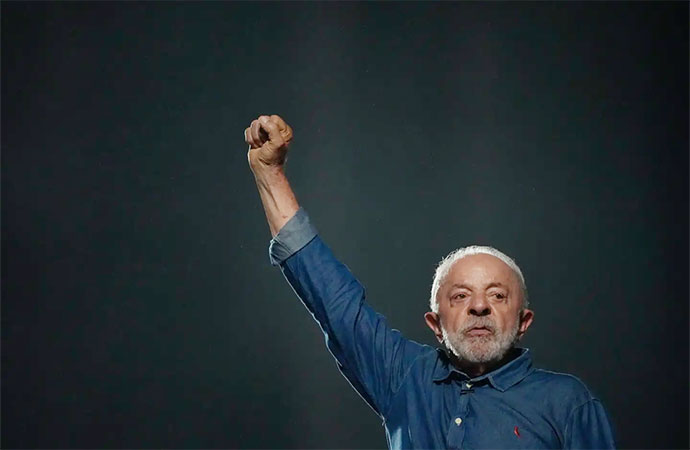
President Luiz Inácio Lula da Silva. Photo: AP/UNB
One lesson progressives in both countries cannot afford to ignore is that recent election results do not amount to a mandate. Neither the Democrats in the US nor President Luiz Inácio Lula da Silva’s Workers' Party in Brazil are offering a vision voters can get excited about.
President Luiz Inácio Lula da Silva defeated the far right's now-fugitive Flávio Bolsonaro in Brazil's recent presidential election. In the United States, President Donald Trump's MAGA minions took a drubbing in the midterm elections. Both results are good news from two very big countries. Democrats everywhere can sleep a little better.
But the good news could be short-lived if the winners learn the wrong lessons. And, to judge from the pronouncements of the establishment commentariat, that is exactly what is happening.
Contrary to what every pundit will tell you, it was not just the economy, stupid. In 2024, Trump won by 1.5 percentage points, when inflation was almost 3%; this time around, with inflation expected to be only slightly higher, around 3.5% in 2026, Democrats won the popular vote (as measured in House of Representatives races) by 13 percentage points. A variable that hardly moved cannot explain an electoral shift of once-in-a-century magnitude (other key US economic indicators-growth, wages, job creation-have been favourable).
The same thing, but in reverse, is true of Brazil: voters did not reward Lula for outstanding economic performance. Inflation and growth are just as mediocre as they have been in recent years (if anything, both seem to be deteriorating in 2026), while interest rates are sky-high. Good luck getting a reasonably-priced mortgage if you are a middle-class Brazilian.
A counterfactual thought experiment confirms that affordability was not the decisive factor in the US midterms. Keep diesel and gasoline prices where they are, but suppose that Trump did not enrich himself and his family in office, did not celebrate the billions oil companies are making, did not allow Immigration and Customs Enforcement (ICE) to shoot and kill innocent Americans, and did not break his promise of no new foreign wars. Would the "blue tsunami" have reached Texas, Alaska, and even Mississippi? Almost certainly not.
The alternative to "It's the economy, stupid" is "It's all about delegation and trust, stupid." Voters have neither the time nor the inclination to leaf through economics textbooks and campaign platforms to decide what the right policy is. Modern democracies run on delegation: we choose other people to figure out policy for us, and we tend to choose people with whom we identify, who seem to share our values and understand our lives.
In 2024, 77 million Americans voted for Trump. Many did so-even though he never won any awards for competence-because he seemed more genuine and less scripted than "elitist" Democrats. In the years since, seeming to care more about his own pocketbook than voters' pocketbooks, Trump betrayed that trust.
Brazil confirms the trust thesis. In the last and crucial televised debate, nepo baby Bolsonaro claimed that Lula "gives with one hand and takes with nine fingers." Lula shot back that he lost a finger in a factory accident because, at 17, if he did not work the night shift he could not eat, while Bolsonaro had not worked a day in his life. After that exchange, with whom were Brazilian voters more likely to identify?
Again, a little counterfactual thinking helps. São Paulo Governor Tarcísio Gomes de Freitas was the presumptive right-wing presidential candidate until the Bolsonaro clan replaced him with Flávio. Freitas got himself re-elected governor by beating the man most often mentioned as Lula's successor by a 26-point margin. Had Freitas been the conservative candidate, would Lula be celebrating his fourth term in office? Probably not.
Here is the other lesson progressives in both countries cannot afford to ignore: the election results do not amount to a mandate. Those results were surprising in all senses but one: as in every election in the modern era, voters were repudiating one person, not endorsing the other. Neither the Democrats in the US nor Lula's Workers' Party in Brazil are yet offering a vision voters can get excited about. In the future, business-as-usual will not do.
Both parties are guilty of thinking that throwing money at problems is the only way to solve them. And both can be accused of having espoused a "woke" agenda that had little to do with the values of a large chunk of the electorate. That can change, of course. In the case of the Democrats, change is already happening. But it takes a while before voters decide they can trust you again with the presidency.
One should never underestimate the ability of the American and Brazilian left to shoot themselves in the foot (or the head). For the Democrats, the biggest risk is that, emboldened by the size of their victory, they will go on to choose in the primary a candidate who could lose to Marco Rubio or to a non-MAGA Republican. Alexandria Ocasio-Cortez is on record as having claimed that if Abdul El-Sayed could win the senatorial seat in Michigan, then anyone could win the presidency.
If "anyone" includes her, I am far from sure the claim is true. Republicans would much rather face AOC than US Senator Jon Ossoff in November 2028.
In Brazil, the biggest risk is that Lula will come to believe that he can get away with doing nothing about the yawning fiscal deficit (near 9% of GDP) and the enormous public debt he has built up. In the recent past, Brazil has avoided a debt crisis because that debt is mostly in domestic currency. But now that interest rates are on the way up, that insulation is looking less safe.
Unless Lula acts soon, even a mild deflation of the AI bubble in the US could trigger a run on Brazilian bonds. The resulting crisis would destroy whatever trust remains in the left's capacity to govern, and guarantee that someone from the right becomes president in four years.
Crises should not go to waste. Nor should victories. May Lula and the Democrats come to understand that.
From Project Syndicate
A Independent Newsweekly
© Copyright 2026 | Designed by ARK Reepon & Developed by Cosmos Group Software Team








Leave a Comment
Recent Posts
BNP on high alert to thwart AL ...
What the month of December holds has been a major topic of discussion ...
Towards a new compact between ...
The continued unrest in the garments sector, even as negotiations for ...
Doa mahfil held for UNB’s Bogura correspondent
Hasina’s extradition: India says travel documents re ..
India desires positive relationship with Bangladesh, ..
US Ambassador meets Indian High Commissioner Trivedi