



Featured 2
Faults in the parliamentary system of Bangladesh


An Independent Newsweekly

Featured 2
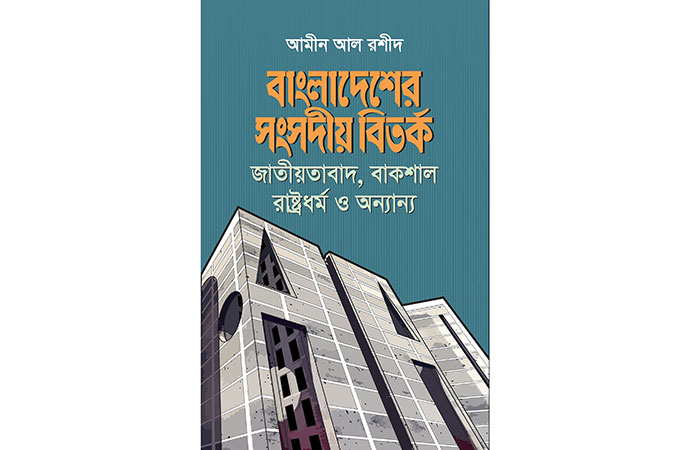
In Bangladesh we have set up a parliamentary system of rule since independence in 1971, but on paper only to tell the truth. The political system has been truly parliamentary for a brief period, the rest is rule by the military, caretaker governments and dysfunctional parliaments and a hotchpotch of others. This hard-to-admit scenario is revealed in Bangladesher Sangsodio Bitorko: Jatiotabad, Bakshal, Rashtrodharmo O Onanyo (Debates in the Parliament in Bangladesh: Nationalism, Bakshal, State Religion and others), a book written by Amin Al Rasheed, a journalist and researcher. Matrivasha Prokash published this book, with cover design by Faridi Numan, in February last year.
In the preface titled 'Why this book,' the author has pointed to the inner truth of this political system in Bangladesh by saying, "The independent Bangladesh started its journey holding the hand of the parliamentary system. But it lost track in a few years turning into a one-party rule. Parliament becomes insignificant. And then the rule of the gun has visited the country several times."
Amin has written in this introductory part: "Though the parliamentary system in Bangladesh is more than 50 years in age, it is fraught with discontinuity. Despite the existence of a parliament, parliamentary practice was not present there. ... Some practice of parliamentary democracy was active only during the 1991-2006 period. Though the BNP was in parliament during 2009 to 2014, their participation was small in number. ... Especially, Jatiya Party's role in the tenth parliament amounted to that of a 'government opposition party' at most."
Here comes the question: How a country starting with the parliamentary rule can discard it in a few years? The country which has seen a truly functional parliamentary system only for fifteen years in its fifty-four years of age is under question with regard to its commitment to people.
Thus the book starts: "None is going to dispute that democracy, despite a number of faults, is the best of all existing options of statecraft in the world. In democracy, parliament (unicameral or bicameral) is an important platform for keeping a government within accountability. Parliament plays an important role in maintaining a balance between different state bodies through a consistent legal structure."
Yet, the questions are: Has our parliament been able to become such a platform? Has it made the governance accountable to people? Has it maintained any balance between power structures of the state? The answer to all these questions is negative in a country which has seen a very few power transitions in a peaceful way. By revealing this this book has become a valuable document of the parliamentary crises in the country. To put the critical parliamentary activities spread across 54 years into a book of only 160 pages is certainly a great task by Amin Al Rasheed.
Both the constitution and the parliament have become centers of long, bitter and unresolved debates since their inception in the independent Bangladesh. The constitution has been made and passed by the Constituent Assembly formed through the 1970 elections for this purpose. The Bhashani NAP was not part of this assembly because of their boycotting of the election and, on the other hand, Jamaat was there despite their collaborator's role during the liberation war.
From the beginning of drafting the constitution, debates surrounded the question of nationality in Article 6 and vacation of a member's seat as per Article 70 if she or he voted against the party which nominated her/him. Some members raised questions against and gave good opinions about accepting Bengali nationalism. Question regarding freedom of members in expressing their opinions in parliament without fear also caused valuable discussions. But these Articles were passed without meaningful attempts to resolve the disputes because of the ultimate majority of the Awami League in the assembly.
It is to be noted that Bangabandhu said in his speech on 4 November in 1972 on the occasion of passing the draft constitution, "We hear about the opposition party. But I have no idea whether such a party exists in this country. It should not be considered our fault if they do not get votes in future elections. Let them say that they are the opposition party by having votes from people in the future."
The above statement came true in the first parliamentary election in which no party outside the Awami League received ten seats who could be called an opposition party in a meaningful way. Yet, even in such a tidal victory, election was not beyond question with regard to fairness.
The Awami League won 293 seats out of 300 in the March 1973 elections. Moudud Ahmed, a senior politician, wrote in his book that the opposition party could get at least 30 seats if the election would have been free and fair. But the Awami League was desperate to win all the seats. No one paid heed to the suggestion by Abul Mansur Ahmad, another senior politician, that the ruling party could be a little liberal to keep at least 50 seats for the opposition.
Abul Mansur Ahmad also wrote, "Establishing a firm foundation for a parliamentary system requires that a considerable number of good politicians from opposition parties become elected." Instead of this, the small number of opposition members and their ineffective roles have weakened the parliamentary system into dysfunctionality. Ridiculously, an opposition party loyal to the government also emerged in our political system. Even these fifteen years were spotted with quarrels, bad words, wasteful praises of leaders and other unseemly matters.
The opposition seats rose from 9 in 1973 to only 11 in 2024 parliamentary elections. These recent 11 eleven seats were won by the Jatiya Party. Latif Siddiqui's fishing hook theory, restriction of free speech by members in parliament, became a hot topic during this time. Yet, our parliamentary house has been a field of unrestrained talks, jokes, jeering, insults etc. In 2023, TIB showed that 20 percent time was spent in praising leaders, 19.4 percent time in highlighting government achievements, 18 percent time speaking ill of other parties and their leaders. Only 0.4 percent time was there for talks about corruption. So, in the end, little time and energy remains left for discussing any constructive issue there.
Many other important topics like the limit of personal property, national emergency, Bakshal, state religion, fifteenth amendment, threat of resignation by the speaker, Justice Sinha's leaving the country, need of an ombudsman, etc. have been discussed here as well. The book has clearly pointed out the faults in our parliamentary political machine, which more often than not have kept our democratic system not in a preferable condition.
But the core message of this book is to face the challenge of making this machine of parliamentary democracy smooth, functional and effective. The solution is not in discarding this machine and running the country without people's mandate for an uncertain time. It is rather in giving people a voice in electing their leaders by themselves and solving developmental and national problems only through the means of long tested parliamentary democracy.
This time now is one of most appropriate for us to read this beautiful and thought-provoking book by Amin and head towards a peaceful, democratic and better Bangladesh by removing the basic faults and repairing the parliamentary system as required.
Alamgir Khan is Editor, NEE (a little mag on ethics and morality)
A Independent Newsweekly
© Copyright 2026 | Designed by ARK Reepon & Developed by Cosmos Group Software Team




Leave a Comment
Recent Posts
An important visit awaits
Sergio Gor, the US Special Envoy for South and Central Asia, is set to ...
Building Young Environmental L ...
Waste is one of the fastest-growing environmental challenges facing Ba ...
WildTeam, Friendship launch community healthcare ini ..
Thousands of young protesters were camped on the str ..
President Mohammed Shahabuddin may resign shortly ci ..
Can We Roar as Loudly for Bangladesh as We Do for Fo ..