



Society
Can Dhaka be South Asia's most beautiful city with political and social responsibility?


An Independent Newsweekly






Society
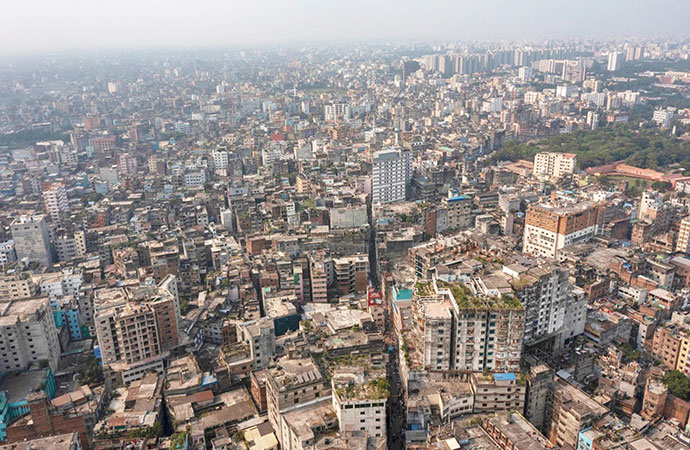
Photo: AP/UNB
Dhaka is frequently mocked as an ugly and congested city. However, this one-sided view does not accurately reflect the whole picture. Dhaka is a wonderful and vibrant city whose residents are creative, hardworking, and deeply connected to the city's rhythm. The thriving markets, historical structures, and rapidly expanding infrastructure have already laid the groundwork for Dhaka to become a modern city.
I've been to Bangladesh several times, and the pace and nature of its development are very clear to me in Dhaka. The metro rail, elevated expressway, and sparkling commercial areas of Motijheel and Gulshan all contribute to a vibrant picture of a moving city. However, it is also true that a city's beauty cannot be measured solely by its brick and stone architecture. This calls for political will and a sense of moral responsibility on the part of the city's residents. A city grows not only by shedding bad habits, but also by instilling positive habits from the start.
One of the simplest and least expensive ways to improve Dhaka's appearance is to remove posters and graffiti from walls throughout the city. The indiscriminate posting of posters on walls, bridges, monuments, and even newly painted metro or expressway pillars is ruining the city's beauty. Although there are signs stating 'Poster ban' in many places, it is clear that the writing is being removed with a post and new posters are being placed on top of it. This alone demonstrates how lax the law is, and how obvious the lack of respect for the law and civic awareness is.
As a result, the effective implementation of the 'Wall Graffiti and Poster Control Act, 2012' is critical. If posters must be posted, they should be limited to specific areas and with the permission of the authorities. However, simply enforcing the law is insufficient; public awareness must also be raised. Clean walls are not only aesthetically pleasing; they also represent civic order.
Another major issue in Dhaka is a lack of adequate parking spaces. Parking cars on roads and sidewalks causes traffic congestion and significantly disrupts pedestrian movement. Uber or Pathao taxis frequently roam the streets or stand on busy roads without taking any passengers, resulting in increased fuel consumption and air pollution.
Along with the expansion of the metro rail, it is critical to create a secure multi-story parking system along the corridor. This will introduce the 'park and ride' system, reducing congestion on major roads. The provision of cycling facilities in designated areas, as well as safe bicycle parking near metro stations, can be extremely beneficial to environmentally friendly travel.
Walking in Dhaka can be dangerous, particularly for women, children, and the elderly. People are forced to walk on busy roads because sidewalks are no longer in use. Creating separate flyovers connecting metro stations, large office buildings, shopping malls, and bus terminals will improve pedestrian safety and comfort.
An example of this can be found in Kathmandu. Placing posters on walls is considered socially unacceptable in many areas. Even during national elections, no posters are displayed on government walls. Despite the fact that there is little law enforcement, people have a high regard for both the government and private businesses. This culture has evolved as a result of ongoing civic initiatives, civic education beginning in primary school, and long-term public awareness campaigns. Clean walls are a symbol of civic pride. Similarly, excessive honking is uncommon there. If there is political will and public cooperation, such a culture can be developed in Dhaka as well.
Dhaka's public transportation system is still undergoing major tests. The buses' exteriors resemble those of wrestlers-crooked, bumpy, and painted in unusual colors. Dirty seats, overcrowding, and irregular bus movement are forcing people to drive their own cars, increasing traffic congestion and pollution.
It is critical to increase the number of clean and regular buses while also strictly adhering to the schedule. It is a long-held hope that the initiative to regulate and organize bus services will be implemented.
Noise pollution is another major issue in Dhaka. The constant misuse of horns and sirens is extremely detrimental to public health and urban order. This issue cannot be resolved without strict monitoring and awareness.
Dhaka's transformation cannot be achieved solely through government efforts. Citizens' day-to-day responsible behavior is also important. These small habits contribute to the character of a city.
When political leadership and civic responsibility work together, Dhaka can truly transform. Then Dhaka will be a modern, clean, and dignified city, a source of pride for its citizens and a role model for other cities.
Kabir Udin, GIS and Remote Sensing Specialist, Bangladesh Country Focal Point, ICIMOD, Nepal
A Independent Newsweekly
© Copyright 2026 | Designed by ARK Reepon & Developed by Cosmos Group Software Team





Leave a Comment
Recent Posts
Dhaka, Tokyo relationship to c ...
Deputy Chief of Mission of the Embassy of Japan in Bangladesh Yoshida ...
Democracy puts a premium on et ...
And just like that, the deed was done. With a volley of 'Ayes!’( ...
Dhaka still eyeing ‘conducive’ setting for PM’s Delh ..
Gallery Cosmos Artist Residency, 2026
Summit seeks reinstatement of FSRU deal
Hatful of medals for Bangladeshi whiz kids at WMI 20 ..