



Society
Building Young Environmental Leaders Through Waste Management Training


An Independent Newsweekly






Society
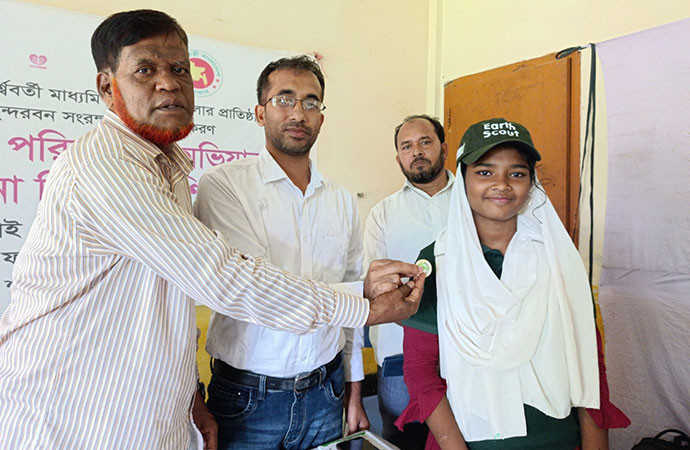
Headmaster & Range Officer presenting the Gold Badge to a student during the award ceremony at Sarankhola range.
Waste is one of the fastest-growing environmental challenges facing Bangladesh. From household garbage and food waste to plastic packaging and hazardous materials, improperly managed waste pollutes rivers, contaminates soil, threatens wildlife, and ultimately finds its way into sensitive ecosystems such as the Sundarbans. As coastal communities continue to expand, effective waste management has become essential not only for public health but also for protecting the world's largest mangrove forest. Recognising that lasting environmental change begins with awareness and action at the community level, WildTeam has been working to equip young people with the knowledge and practical skills needed to become environmental stewards. Through its EarthScout programme, students are encouraged to understand local conservation challenges and take meaningful action within their schools and communities.
As part of this effort, WildTeam organized a day-long Waste Management Training programmes for EarthScouts under the SUNDAR-BAY project, funded by German Cooperation (GIZ) and implemented in collaboration with the Bangladesh Forest Department. The training sessions were held on 20 July in Chandpai Range, 21 July in Sarankhola Range, and 23 July in Satkhira Range, Across the three training sessions, a total of 100 EarthScouts, 15 EarthMentors, and headteachers from 15 partner schools participated.
Representatives from the Bangladesh Forest Department attended each programme as chief guests. Assistant Conservator of Forests Dipon Chandra Das joined the Chandpai session, Station Officer Md. Khalilur Rahman attended the programme in Sarankhola, while officer-in-charge of the Munshiganj Patrol Post Mostafa Jahid Hussain participated in Satkhira. Representatives from the Department of Social Services also attended the training sessions, encouraging students to adopt responsible waste management practices and become role models within their communities.
Addressing the participants, Assistant Conservator of Forests Dipon Chandra Das highlighted the importance of investing in the next generation of conservation leaders.
"The Sundarbans is our national treasure. Protecting it requires raising a new generation of environmentally conscious citizens. Today's training and clean-up activities will play an important role in protecting our environment in the future."
The training was designed to move beyond conventional classroom lectures. Instead, it combined scientific knowledge with practical learning so that students could understand not only why waste management matters but also how to apply those lessons in their everyday lives. Participants learned about the ecological importance of the Sundarbans and the responsibility individuals share in protecting its biodiversity. They were introduced to the four major categories of waste. The sessions also explored one of today's most pressing environmental concerns which is plastic pollution. Students learned how single-use plastics and other non-biodegradable waste travel through canals and rivers before entering the Sundarbans, where they threaten wildlife, aquatic ecosystems, and local livelihoods. To ensure active participation, the programme included group exercises, demonstrations, and hands-on waste segregation activities. Students practiced identifying different types of waste and deciding the most appropriate disposal or recovery method for each. Their knowledge was assessed through pre- and post-training evaluations, allowing facilitators to measure learning outcomes and reinforce key messages throughout the day.
The programme concluded with a badge award ceremony recognising the dedication and achievements of EarthScouts. Students received gold, silver, and bronze badges in recognition of their environmental leadership, participation, and commitment to conservation. Organizers hope these recognitions will encourage students to continue taking active roles in protecting their local environment. The waste management training is only the beginning of a larger initiative. WildTeam plans to establish school-based waste management systems and organize clean-up campaigns across all 15 partner schools in 3 Sundarban ranges. By enabling students to put their newly acquired knowledge into practice, the programme aims to foster long-term behavioral change while reducing waste entering the Sundarbans.
A Independent Newsweekly
© Copyright 2026 | Designed by ARK Reepon & Developed by Cosmos Group Software Team






Leave a Comment
Recent Posts
A commendable intervention by ...
A struggle for local dominance in the Chittagong Hill Tracts, specific ...
How close is the Amazon to a ‘ ...
While Brazil’s presidential candidates have not made policy of t ...
Another shipment of highly radioactive uranium fuel
Harmony: Diplomatic community joins Durga Puja celeb ..
What to know about the Ebola outbreak that has sprea ..
Brazil election: Trump’s ‘Donroe Doctrine’ faces its ..