



Reportage
Unrest for the sake of unrest


An Independent Newsweekly



Reportage
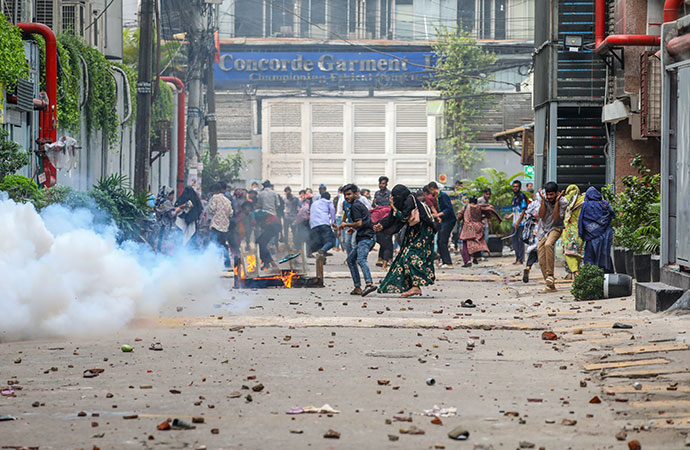
Photo: Rakib
The spectre of unrest in the vital RMG sector, whose revenues contribute close to 80 percent of the country's export earnings, is ominous at the best of times. In the current climate though, a particular set of circumstances (see below) combine to put the country on a powder keg already. And that makes this latest round of agitation, which lasted almost the entire week and may yet continue into next week, very dangerous.
We have also come across disturbing revelations from police and intelligence sources that speak to unsavoury forces attempting to hijack the movement from the very beginning. Indeed, how else do you explain the unrest refusing to die down, even after eliciting the most prompt and sensitive response to their demands we have ever seen, to what is merely the latest iteration of a recurring movement?
Within 24 hours of the movement starting with the first day of unrest witnessed on Saturday (Oct. 31), The government formed a new six-member wage board to increase the wages of garment workers. Representatives of the government, factory owners and workers have been finalised. The Ministry of Labour and Employment issued a notification to this effect on Sunday, after Labour and Employment Minister Ariful Haque Choudhury announced it at an event on Saturday itself.
The minister made the announcement at a press briefing following a meeting with representatives of the Bangladesh Garment Manufacturers and Exporters Association (BGMEA) and the Bangladesh Knitwear Manufacturers and Exporters Association (BKMEA) at the Department of Labour headquarters in Bijoynagar area of the capital. He said there was no reason for workers to continue their protests under the circumstances.
Initially it was announced that the wage board would be headed by Senior District and Sessions Judge Sheikh Ashfaqur Rahman as its chairman. He was later replaced however by District and Sessions Judge Syed Azad Subhani. The owners' representatives on the board are ABM Shamsuddin, director of the Bangladesh Garment Manufacturers and Exporters Association (BGMEA), and Asif Ayub, joint secretary-general of the Bangladesh Employers' Federation.
The workers' representatives are Babul Akhter, general secretary of the Bangladesh Garments and Industrial Workers Federation (BGIWF), and Anwar Hossain, president of the Bangladesh Jatiyatabadi Sramik Dal. Professor Mosleh Uddin Ahmed of the Department of Public Administration at the University of Dhaka has been appointed as the board's independent representative.
The announcement of the board had come in record time, but failed to quell the unrest, which continued the next day. The prime minister, signaling his interest in the matter, called an emergency meeting at the Cabinet Division that evening (Sunday, Nov. 1). In that meeting, Prime Minister Tarique Rahman directed all concerned to remain alert and take necessary measures to ensure the smooth operation of factories and industries and the safety of people's lives and property amid the escalating unrest in the garment sector.
Labour and Employment Minister Ariful Haque Choudhury disclosed the prime minister's instructions while speaking to reporters after the emergency meeting, reported our sister newsagency UNB.
"The prime minister said factories and industries must operate properly and the lives and property of people must remain safe. He asked everyone to stay alert and take appropriate measures in this regard," the minister said.
The strategic assessment meeting took place at the Cabinet Division conference room in the Bangladesh Secretariat. Earlier in the day, garment workers staged intense demonstrations across major industrial hubs, including Mirpur in Dhaka, Kaliakair in Gazipur, Savar, and Ashulia. To prevent further violence and safeguard factory infrastructure, authorities were forced to declare a holiday in over 500 garment units in these zones.
Ariful, also the expatriates' welfare and overseas employment minister, said the meeting also discussed what he described as attempts by vested interests to create instability ahead of December and destabilise the government. Law enforcement agencies confirmed that operatives linked to the banned Awami League and its affiliate organizations actively infiltrated the labour demonstrations to incite violence. In Gazipur's Kaliakair, Sajmul Islam, Organizational Secretary of the Jagannath University unit of Chhatra League, was identified leading a violent march-photographs of which circulated widely on social media. Consequently, security forces arrested 9 individuals linked to Awami League, Sramik League, and Chhatra League in Kaliakair, and 11 others in Mirpur.
Ulterior motives
All parties on Monday (Nov. 2) hoped that a reasonable and fair wage structure for the country's highest export-earning sector would be set by December. There was also consternation surrounding the unrest continuing, despite the obvious sincerity of the government. Protests by apparel workers demanding a minimum monthly wage of Tk 30,000 continued to spread across major manufacturing hubs on Monday. The current minimum monthly wage is Tk 12,500.
By now, all parties were fairly convinced that outsiders, not genuine workers, were behind the violence that has shaken the garment industry for the past several days.
Home Minister Salahuddin Ahmed, after separate meetings with manufacturers and labour leaders, said workers must press their demands through the wage board in an orderly manner while keeping production running. He said a logical, standard new wage structure would be finalised by December.
Around 670 factories had suspended operations as workers blocked roads and clashed with police in several areas. Gazipur, Savar, Ashulia, and Mirpur were hit the hardest as police vehicles were torched and factories vandalised. The home minister said the Labour and Employment Ministry completed forming the wage board in the shortest possible time. It did so after consulting both employers and workers, as part of the board's reconstitution every three years. He said Prime Minister Tarique Rahman had directed that wages be fixed in a pro-worker and pro-industry manner.
How long the new wage board would drag on its activities became a concern. The first meeting of the previous wage board was held 45 days after the notification was issued. The entire process was completed in six to seven months. This time, however, it would not be the same. The government has shown it is sincere about completing the process of determining wages within a short time.
Accordingly, the first meeting of the new Wage Board was held on Wednesday (Nov. 4). After the meeting, Minimum Wage Board Chairman Syed Azad Subhani told journalists, "At the first meeting, we briefed everyone on the process of determining wages. At the board's next meeting next week, the employer and worker representatives will submit their wage proposals in writing."
Worker representative Babul Akhter said the employer representatives had agreed that the new wages would take effect in December so that workers could receive their increased salaries in January. He added, "At the meeting, we requested the neutral member of the wage board to submit a wage proposal. We hope the neutral member will also put forward a proposal."
Babul Akhter said, "Workers have many grievances and complaints, as well as resentment. We will address these issues gradually. We urge the government to implement labour laws."
Addressing workers, he also said that third parties were involved in the ongoing wage movement and urged them to remain neutral and refrain from illegal activities. He demanded the immediate release of workers and labour leaders who had been arrested.
Employer representative ABM Shamsuddin said, "We are committed to completing this process by December so that workers can receive the new wages from January. We have no disagreement on this."
The unrest however, failed to die down. Asked about the situation, BGMEA President Mahmud Hasan Khan told Prothom Alo last night, "There has been no improvement in the protest situation in the industrial areas. The situation today (Wednesday) was much the same as on Tuesday. Production has been disrupted at many factories. The first meeting of the wage board has taken place. We hope the situation will improve from tomorrow (Thursday)."
Meanwhile, two intelligence units of the National Board of Revenue (NBR) have asked banks and financial institutions to freeze the accounts of more than 100 individuals over allegations of links to the ongoing unrest in the garment sector, sources said.
Around 125 companies have also come under scrutiny as the revenue authority investigates whether their financial transactions were linked to efforts to destabilise the sector.
The NBR has asked banks to provide details of the transaction histories of these companies, the sources added. Most of the individuals whose accounts have been targeted are linked to the ousted Awami League government. They include former lawmakers, ministers and influential businesspeople.
Those named include Salman F Rahman, Abdus Salam Murshedy, Tipu Munshi, Shahriar Alam, Nasrul Hamid, Tajul Islam, Tusuka Group's Faizur Rahman, Well Group's Abdus Salam, Nipa Group's Khasru Chowdhury, Standard Group's Mosharraf Hossain and former BGMEA president SM Mannan Kochi.
Demand enjoys support
The fact that the movement has been infiltrated, of course takes nothing away from the fact that its demands are justified. Bangladesh's garment exports continue to grow despite one crisis after another. The sector is ahead of other industries not only in business growth but also in terms of government support.
However, Bangladesh lags behind competing countries in terms of the wages paid to garment workers. Struggling to meet rising living costs amid persistent high inflation, workers have taken to the streets demanding higher wages.
According to data updated last March by Sweden-based H and M Group, one of Bangladesh's leading buyers of readymade garments, garment workers in seven other countries they source from-China, Cambodia, Indonesia, Vietnam, Pakistan, India and Turkey-receive higher minimum wages than workers in Bangladesh. The minimum wages in four other sectors in Bangladesh-tanneries, shipbreaking, sawmills and construction-are also higher than those in the garment industry.
Factory owners however argue that workers' wages are relatively low because of their lower productivity, the low prices of garments and narrow profit margins in garment manufacturing.
The current minimum wage for garment workers is Tk 12,500. The new wage structure came into effect on 1 December 2023. Previously, wage boards were formed every five years. The current BNP government amended the labour law, reducing the interval for wage revisions to three years. Accordingly, the new wage structure must come into effect from December this year.
Taslima Akhter, president of Garment Workers' Solidarity, said that rising prices of essential goods had made workers' lives unbearable. They were being forced to cut food expenses.
Not only that, borrowing to meet household costs has also become more common. Workers had taken to the streets because they had run out of all other options, she said.
Over the past five years, the sector has sustained its exports despite Covid-19, the Russia-Ukraine war, political changes in the country, US reciprocal tariffs and the ongoing Middle East crisis.
Garment exports nearly doubled between 2011 and 2025. Last year, Bangladesh exported garments worth USD 38.82 billion, up 0.88 percent from the previous year, although down from a peak of $42 billion in 2021. According to World Trade Organization (WTO) data published last July, China had the largest share of the global garment export market last year, at 27.5 percent. Bangladesh ranked second, with a 6.76 percent share. Vietnam accounted for 6.53 percent, India 3 percent and Turkey 2.3 percent.
Thanks to its powerful trade body, BGMEA, the garment industry also enjoys various tax benefits. Citing the need to maintain their competitiveness in the global market, factory owners continue to receive tax concessions worth several billions of taka every year.
According to the latest report of the National Board of Revenue (NBR), the garment and textile sectors received corporate tax concessions worth Tk 58.29 billion in fiscal year 2022-23. This is because the garment sector has the lowest corporate tax rate among businesses, at just 12 percent. For environmentally friendly factories, the rate is only 10 percent. Companies in other sectors, however, have to pay corporate tax ranging from 20 to 45 per cent.
Besides income tax concessions, the garment industry also receives cash incentives for exports to various markets. Factory owners also enjoy bonded warehouse facilities.
Under this arrangement, garment manufacturers do not have to pay customs duties or taxes on raw materials such as yarn, fabric and other goods imported from abroad. Only a handful of other sectors, including the leather industry, enjoy bonded warehouse facilities. Other sectors do not receive these benefits.
As long as the owners are receptive to the idea of sharing some of the fabulous wealth the industry bestows on them, raising the minimum wage to somewhere between Tk 18,000-20,000 should pose no issues to the smooth functioning of the garment industry. For the foreseeable future at least.
Living on the edge
The unrest has come at the worst possible time for the government, when it is grappling with all kinds of issues that combine to touch almost every sphere of life in Bangladesh - from the social to the cultural, economic, and of course political. More than two years after the monumental events of the July Uprising, the nation of 180 million, with almost as many opinions and perspectives and sensibilities packed into a tiny, deltaic landscape through which some of the great Himalayan rivers meet the sea, remains in a state of enormous, almost unrelenting flux.
With time it becomes clearer, and more pronounced, that what we witnessed in those 36 days was more than just the end to an entrenched dictatorship in the guise of a secular democracy, that was determined to leave no stone unturned in order to hold on to power. That merely encapsulates the political upheaval that occurred here. Soon we would find ourselves embroiled in toxic culture wars, as a segment grew more and more assertive of its Islamic identity. You heard more and more people bring up the country's 92% Muslim majority. And almost every time it was brought up, it was being used as a cudgel.
The pain in terms of the economy, was more expected. Most Uprisings, wherever they occur in the world, severely disrupt the status quo. They uproot established networks, dismantle existing supply chains. Beneficiaries of the regime may leave behind a tiny sum in haste, but most of their money will leave with them. Most of it is money that could have stayed within the country, and propped up investment. The kind of investment that has remained subdued for over 2 years now.
Almost all the businesses that had it good under the previous regime, are now effectively sitting this one out. Ask them why they have not invested in the economy, or if they plan to anytime soon, and they'll plead 'Instability' or 'Uncertainty'. Private sector credit growth has stayed below 5% for six consecutive months, standing at 4.75% at the end of August 2026, the lowest on record.
The assault we witnessed on the country's banking sector may have crippled it for a long time to come. The sheer amount of bad loans that piled up, as a proportion of total loans, has now reached astronomical levels. As long as the AL regime was in power, they managed to hide most of it. The highest it was allowed to go, or rather show, was 11%. Now it has been revealed to be at least three times that.
Then there is the politics of it all. Stoking unrest during this particular period is nerve-wracking for some observers, considering the anticipation around ousted prime minister Sheikh Hasina's announcement of returning to the country and surrendering next month. The elements of her party still around in Bangladesh, will no doubt try their best to rally around their leader when she arrives back, or at least be prepared to do so. With their activities still under a formal ban, getting back on the streets under the guise of a workers' movement provides a perfect cover to prepare.
None of it augurs well for the social fabric of the country, which at times has felt on the verge of a breaking point over these last two years. The country is still in need of healing from the trauma inflicted on it in not just those last 36 days of the AL regime, but in a more stop-start manner over the preceding 15 years as well. Given all these circumstances, a prolonged period of unrest in the RMG sector, which employs 4 million workers, could just push it over the edge.
A Independent Newsweekly
© Copyright 2026 | Designed by ARK Reepon & Developed by Cosmos Group Software Team



Leave a Comment
Recent Posts
A political earthquake in Amer ...
The American midterm elections have delivered a resounding political r ...
‘A beautifully American story’ ...
Campaigning relentlessly across Michigan, Abdul El-Sayed didn’t ...
Consumers fear paying Tk 2500 for 12-kg LPG cylinder ..
UNB Chief Editor mourns death of Bogura corresponden ..
Enayetullah Khan attends FICAC 2026 North America Re ..
Democrats won control of both chambers of Congress i ..