



Reportage
The Son Also Rises


An Independent Newsweekly

Reportage
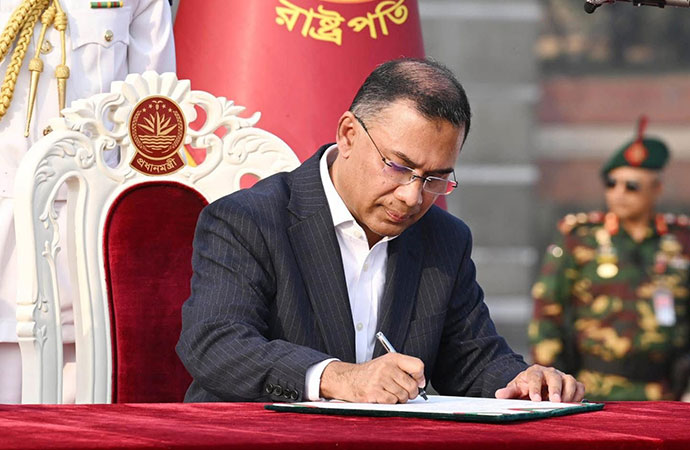
Tarique Rahman, Prime Minister of Bangladesh. Photo: BNP Media Cell
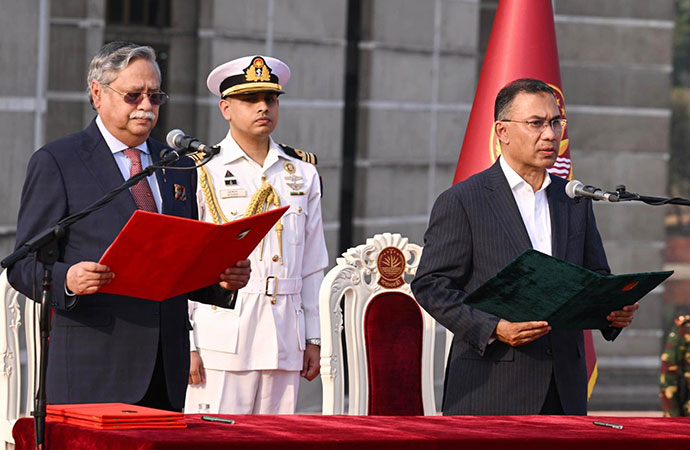
Just two months after returning home from 17 years in exile in London, BNP Chairman Tarique Rahman on Tuesday assumed office as the 11th Prime Minister of Bangladesh following his party's resounding victory in the national election.
President Mohammed Shahabuddin administered the oath at the South Plaza of the Jatiya Sangsad.
Tarique's wife Dr Zubaida Rahman, their daughter Barrister Zaima Rahman and Syeda Shameela Rahman, the wife of his late younger brother Arafat Rahman Koko, were present when he was sworn in as Prime Minister.
Chief Adviser Prof Muhammad Yunus, Advisers, the chiefs of the three services, foreign dignitaries and leaders of different political parties were present.
Earlier, the BNP Parliamentary Party (BPP) unanimously elected party Chairman Tarique Rahman as the Leader of the House after they took over as the members of the 13th parliament.
Tarique Rahman will now lead Bangladesh as the head of the government just as his parents did earlier.
His father Ziaur Rahman was army chief and later president of the county who founded the Bangladesh Nationalist Party (BNP) in 1978, while his mother Khaleda Zia served as Prime Minister for about 10 years across three terms and led the party for more than four decades.
Although many expected BNP to win the 13th parliamentary election and Tarique become Prime Minister, the scenario seemed distant before August 5, 2024.
During the army-backed caretaker government, he was arrested on corruption charges and jailed. After securing bail in 2008, he left the country for medical treatment and began life in exile in London.
That same year BNP lost the ninth parliamentary election to Bangladesh Awami League and the party went through what leaders described as its toughest period in history.
BNP leaders and activists faced police action and arrests, extrajudicial killings, enforced disappearances, party offices were shut and Khaleda Zia was also imprisoned in corruption cases.
During his years of exile in London, Tarique Rahman had to watch everything unfold from afar. For this reason, Thursday's national election marked a momentous turning point for him and a dramatic political transformation in Bangladesh.
He returned home on December 25 last year to a massive reception from supporters but lost his mother five days later. On January 9, he formally assumed leadership of the party and then led it through the election campaign to victory.
At a rally after returning home, echoing the famous 'I have a dream' line of Martin Luther King Jr., he declared: 'I have a plan', which became the central message of his campaign as he toured large parts of the country reorganising grassroots activists.
He also targeted former ally Bangladesh Jamaat-e-Islami by highlighting its 1971 role and policies, seeking to attract undecided voters, a strategy analysts say partly worked as BNP secured a two-thirds majority and returned to power after nearly two decades.
Early life and rise in politics
Tarique was born on November 20, 1968, in Gabtoli, Bogura.
After the assassination of Bangabandhu Sheikh Mujibur Rahman along with most of his family on August 15, 1975, a series of events led to Major General Ziaur Rahman becoming the army chief. On November 29, 1976, he assumed the position of Chief Martial Law Administrator.
Later, on April 21, 1977, he became the country's president. While serving as Chief Martial Law Administrator and army chief, the Bangladesh Nationalist Party (BNP) was formed in 1978 under Ziaur Rahman's patronage from behind the scenes.
Ziaur Rahman remained in state power until he was killed in a military coup on May 30, 1981. Within a year of his death, his wife Khaleda Zia entered politics and was made the party's vice chairperson.
At that time, the BNP chairman was the then president, Justice Abdus Sattar. When army chief HM Ershad seized power in 1982 by ousting the BNP, Khaleda took charge of the party as acting chairperson amid Sattar's illness.
She was later elected BNP chairperson unopposed in 1984 and remained in the position until her death.
Tarique studied at BAF Shaheen School, Dhaka Residential Model College and later enrolled in the International Relations department at the University of Dhaka before leaving studies for business.
According to information on the BNP's website, Tarique Rahman formally entered politics in 1988 by taking primary membership of the party in Gabtali, Bogura.
During the movement against the autocratic rule of HM Ershad, he joined street protests alongside his mother. He also took part in campaign tours across various districts with her during the 1991 election.
Ahead of the 2001 election, Tarique Rahman established an office in Dhaka to conduct research on local-level problems and governance.
A stop-start beginning
Shortly before 10:45 am on Tuesday, February 17, the newly elected BNP MPs of the 13th Jatiya Sangsad took their oaths as MPs in the oath taking room of the national parliament building.
AMM Nasir Uddin, chief election commissioner, administered the oath. However, there was a surprise in the offing, as they did not take oath as members of the so-called constitutional reform commission.
Before the oath-taking ceremony began, Salahuddin Ahmed, a newly elected BNP MP from Cox's Bazar-1 and a member of the party's standing committee, addressed the party MPs present in the oath room and issued a directive.
In his directive, Salahuddin Ahmed stated that they had been elected as MPs in accordance with the constitution. They had not been elected as members of the constitutional reform council.
"We are committed and pledged to implement the July National Charter exactly as it was signed as a document of political consensus."
He made the remarks to journalists today, Tuesday, shortly after 12:30 pm, following the first meeting of BNP's parliamentary party at the Jatiya Sangsad Bhaban. The meeting took place after BNP's newly elected MPs had taken their oath as members of parliament.
The meeting was presided over by BNP Chairman Tarique Rahman. By unanimous decision, Tarique Rahman was elected as the parliamentary party leader and the prime minister.
Salahuddin Ahmed told reporters that during the meeting, Tarique Rahman issued two directives for the party's MPs, no MP should accept duty-free car facilities, and no MP should take government plots.
The BNP leader added, "Change starts from today. Being an MP in this country no longer means they will be more equal than everyone else."
BNP's newly elected MPs did not take the oath as members of the constitutional reform council. On the reason for not taking this oath, Salahuddin Ahmed said that to reflect the people's will as expressed in the referendum, they must first go to the parliament. In parliament, necessary laws and constitutional amendments must be enacted.
Salahuddin Ahmed also remarked that under the existing constitution, the chief election commissioner (CEC) has no authority to administer the oath of the constitutional reform council members. The CEC did not approach them to administer their oath as members of the constitutional reform council, and they did not take the oath, he said.
The BNP standing committee member added, "Everything must be conducted constitutionally. Up to now, we have proceeded according to constitutional procedures, and we will continue to govern this state constitutionally."
Jamaat's nayeb-e-ameer Syed Abdullah Muhammad Taher had told Prothom Alo that the party's newly elected MPs would not take the oath if BNP's MPs refrained from swearing in as members of the constitutional reform council.
He stated that they consider a parliament without reform to be meaningless.
However, he confirmed that the oath-taking was scheduled for 12:00 pm and that Jamaat's MPs would attend the ceremony.
MPs elected from the BNP's allied groups and independent MPs followed the same path. As more than two-thirds of members did not take the oath, the council could not be fully constituted.
People concerned say the outgoing interim government, through the formulation of the July National Charter, initiated efforts to reform various sectors of the state, particularly fundamental constitutional reforms, which were expected to be implemented by the elected government.
But with the council not formed, the reform implementation process has faced complications right at the beginning of the new government's journey. There are concerns that this could trigger political tensions in the future.
Following the victory of the "Yes" vote in the referendum, the July National Charter (Constitutional Reform) Implementation Order stipulates that a Constitutional Reform Council should be formed comprising representatives elected in the 13th parliamentary elections.
The referendum endorsed the order and the 48 constitutional reform proposals contained in the July Charter. The responsibility for implementing these proposals rests with the council.
According to the order, elected representatives are to take oath as council members at the same ceremony after being sworn in as MPs. They would simultaneously serve in both roles.
From the date of its first sitting, the council would have 180 working days to complete constitutional reforms in line with the charter and referendum results.
However, the BNP did not join the council yesterday, leaving the reform implementation process in limbo. After taking oath, BNP Standing Committee member Salahuddin Ahmed told journalists that the party remained committed to upholding the July Charter "to the letter" as a document of political consensus.
In the election held on 12 February, the BNP won 209 of the 297 seats and its allies secured 3. Jamaat-e-Islami won 68 seats, while partners in its 11-party alliance secured 8. Seven independents were elected.
Uncertainty had existed beforehand about whether BNP MPs would take oath as council members. During the oath ceremony yesterday morning, Salahuddin Ahmed instructed party MPs that they had been elected under the Constitution as MPs, not as council members. He said oath-taking could proceed once procedures were set out in the Constitution's Third Schedule following reforms and clarity emerged on who would administer it.
Reform implementation under threat?
Through prolonged discussions between political parties and the former National Consensus Commission, agreement and decisions were reached on a total of 84 reform proposals spanning various sectors. These proposals formed the basis of the July National Charter.
Of these, 48 proposals were related to the constitution. A referendum was subsequently held to implement those constitutional proposals, and the 'Yes' vote prevailed.
The July Charter contains several significant reform proposals, including a partial reduction of the prime minister's authority, an expansion of the president's authority in certain appointments, the introduction of a bicameral legislature, and the incorporation of appointment procedures for constitutional bodies directly into the constitution.
However, the Bangladesh Nationalist Party (BNP) submitted notes of dissent on several key issues, including the method of forming the proposed upper house. The party also incorporated its own constitutional reform proposals in its election manifesto.
The implementation of the constitutional proposals was structured in three stages, two of which have already been completed.
First, to provide a legal basis, the 'July National Charter (constitutional reform) Implementation Order' was issued.
Second, a referendum was held to endorse the implementation of that Order. With the victory of the 'Yes' vote, the process moved towards the third stage.
Under the third stage, the implementation order stipulates the formation of a constitutional reform council comprising MPs to give effect to the constitutional proposals contained in the July Charter.
Under the existing constitution, amendments may be enacted with the support of two-thirds of the MPs. However, the July Charter Implementation Order provides that, rather than the regular parliament, a dedicated constitutional reform council would undertake the task of constitutional reform on this occasion.
During discussions with political parties, the proposal to establish such a council was raised. In particular, Jamaat-e-Islami and the NCP argued that the constitutional proposals contained in the July Charter would, if implemented, introduce substantial changes to the fundamental structure of the constitution.
They contended that there could be legal questions as to whether a regular parliament is empowered to alter the constitution's basic structure. If amendments were adopted through the ordinary parliamentary process, they might subsequently be challenged before the courts. By contrast, granting the incoming parliament a specific and extraordinary mandate to carry out constitutional reform would preclude such legal challenges.
The BNP, however, expressed the view during those discussions that the formation of a separate council was unnecessary, maintaining that the existing constitutional amendment procedure was sufficient.
Furthermore, Jamaat-e-Islami, the NCP and several other parties proposed that the charter should be implemented through the issuance of a special order rather than by ordinance. The BNP opposed this approach, arguing that there is no constitutional provision for such an order and that the president may only promulgate an ordinance under the constitution.
The National Consensus Commission subsequently sought expert opinions on these matters. Ultimately, on 13 November last year, the president promulgated the 'July Charter (Constitutional Reform) Order', which included provisions for the establishment of a constitutional reform council.
Nevertheless, uncertainty remains as to the extent to which this order will be effective in practice and whether it will withstand legal scrutiny in the future.
Additional Reporting by UNB
A Independent Newsweekly
© Copyright 2026 | Designed by ARK Reepon & Developed by Cosmos Group Software Team




Leave a Comment
Recent Posts
Dhaka, Tokyo relationship to c ...
Deputy Chief of Mission of the Embassy of Japan in Bangladesh Yoshida ...
Democracy puts a premium on et ...
And just like that, the deed was done. With a volley of 'Ayes!’( ...
Dhaka still eyeing ‘conducive’ setting for PM’s Delh ..
Gallery Cosmos Artist Residency, 2026
Summit seeks reinstatement of FSRU deal
Hatful of medals for Bangladeshi whiz kids at WMI 20 ..