



Reportage
The Past and Future of Bangladesh-India Connectivity


An Independent Newsweekly


Reportage
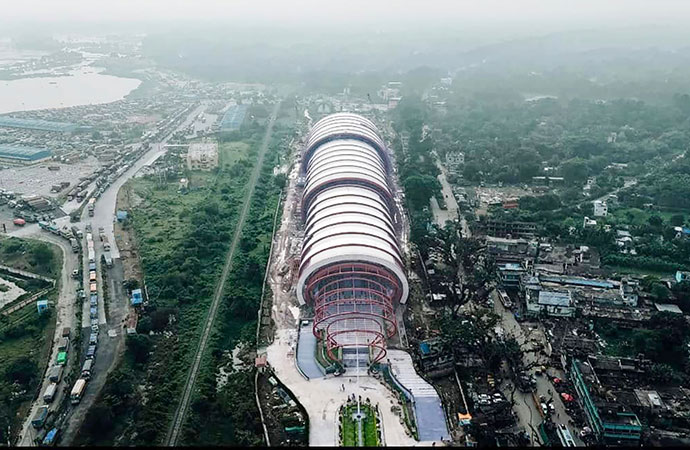
The Petrapole Passenger Terminal in Bongaon, West Bengal, on the Indian side of the Petrapole-Benapole land border crossing
With elections and a new, democratically elected government on the horizon in Dhaka, there is finally a window of opportunity for Bangladesh and India to rekindle their economic dialogue in line with their respective national and developmental interests. Despite the difficult political times - and much public, extremist animosity - there are also important indications of private outreach and engagements behind the scenes. Indian External Affairs Minister S. Jaishankar's visit in December marked one small but significant step towards normalization in bilateral ties.
Trade, transit, investments and infrastructure or water and energy connectivity will all play a central role in shaping the terms of Delhi-Dhaka re-engagement in line with their respective developmental agendas. There is no alternative to more regional interdependence if political leaders on both sides are to deliver on job creation and economic growth in the next 5-10 years amidst global uncertainty, protectionism and conflict.
But to move forward on bilateral economic relations, we also need to appreciate past progress. This will be particularly difficult for Bangladesh. Recognising pre-2024 achievements will be politically uncomfortable because popular perception is that the bilateral connectivity agenda was ineffective or even harmful to Bangladesh's economic development. The narrative I heard from multiple stakeholders in Dhaka during my recent visit is unambiguous: under the previous dispensation, Bangladesh sold out to India on all things economy and connectivity.
This view is not complete nor accurate: for the first time in 50 years, the Dhaka-Delhi connectivity partnership since the 2000s (starting under the late Prime Minister Khaleda Zia) transformed the India-Bangladesh borderlands from a political and security periphery into nodes of economic growth, reviving past rail, road, and river linkages to drive a record boom in bilateral and sub-regional trade. There is a rich literature documenting this progress since the 2000s and the tangible developmental benefits it has brought to Bangladesh, however limited or unsatisfactory.
Anchored in their 2009 and 2011 framework agreements, India and Bangladesh implemented an ambitious agenda marked by both historic achievements and some failures. For the first time since 1971, both New Delhi and Dhaka were able to shift realities on the ground, focusing on restoring connectivity in transportation and energy infrastructure, as well as trade and transit, severed since the 1960s.
Bilateral connectivity was not a mere economic or infrastructure agenda driven by bureaucrats and technical cost-benefit calculations: it was driven by political leadership on both sides, including through articulation with diverse trade, industry, and electoral stakeholders. Bilateral connectivity initiatives were also underpinned by the foreign policy vision of a more interdependent Bangladesh-Bhutan-Nepal-India (BBIN) and Bay of Bengal regions linked to global supply chains with East and Southeast Asia. Initiatives such as Japan's Bay of Bengal Industrial Growth Belt (BIG-B) or Dhaka's offer to host the Secretariat for the Bay of Bengal Initiative for Multi-Sectoral Technical and Economic Cooperation (BIMSTEC) further reflected this vision of Bangladesh as a regional power, linking South and Southeast Asia, enabled by stronger economic relations with India.
It is against this broader context that one must evaluate past agreements, successes and failures. In the Daily Star's November 27 edition of last year, S M Abir Hossain and Jahid Hossain offer a critical assessment of what they describe as an asymmetric transit arrangement between Bangladesh and India ("Rethinking Bangladesh-India transit relations: The question of reciprocity").
The two authors of the Dacca Institute of Research and Analytics denounce India's April 2025 decision to withdraw transhipment privileges for Bangladeshi exports and identify an "opportunity to engage India in renewed dialogue that reflects the interests of both countries, while remaining aligned with Bangladesh's own national priorities."
The article makes an important contribution by rekindling Bangladeshi attention to the unavoidable and irreversible trend of greater economic engagement with India. But Abir and Jahid Hossein's assessment of the bilateral transit arrangement is also a good example of how focusing on a few failures can come at the expense of recognizing broader achievements for Bangladesh. In suggesting that there were connectivity gains and advantages "only for India", they ignore significant benefits for Bangladesh and underplay Dhaka's agency to realise national interests.
First, they ask, "Why has Bangladesh not been able to sell more to India?" This critical question has preoccupied many Bangladeshi decision-makers and scholars in recent years. Numerous studies suggest different answers, mostly in line with Bangladesh's path-dependent focus on textiles, clothing, and ready-made garments (RMG) exports to Western markets. Yet the authors zoom in on India's non-tariff barriers as the primary explanation for low exports, highlighting "sanitary requirements, encompassing port delays, state-level taxation, and administrative red tape." All these may well play a factor, but it is difficult to argue that there is any specific or political measure targeting Bangladesh compared to any other exporters to India.
More importantly, a significant part of the answer might lie in Bangladesh itself, as illustrated by the sorry state of its transportation infrastructure, which is critical to cross-border land-based trade. In October 2024, India's Home Minister inaugurated the country's most advanced land port at Petrapole. However, this has a limited impact until Bangladesh finally upgrades the mirror infrastructure on its side, in Benapole. Despite being the country's largest land port, it continues to be afflicted by multiple infrastructure bottlenecks and delays that increase the costs of Bangladeshi exports. Without addressing these gaps, Bangladesh will find it difficult to reap the benefits of the large Indian market next door.
Second, Abir and Jahid Hossain seem to exaggerate the political factor in explaining the India-Bangladesh connectivity agenda since 2009 and, conversely, neglect the role of the Bangladeshi bureaucracy and industry in negotiating terms of engagement for trade and transit. They contend that "issues such as transit, security cooperation, power imports, and water diplomacy were rarely managed through balanced, formal mechanisms."
Negotiation capacity is undoubtedly an essential factor shaping economic agreements, and the world's fifth-largest economy will naturally have more heft than the 34th. It seems, however, harsh to dismiss Bangladesh's position until 2024 as one of systematically caving in to India, with Dhaka allegedly neglecting the country's economic and developmental interests in favour of Delhi's. There are certainly limitations to the 2015 trade agreement and the 2018 transit deal for Chattogram and Mongla ports - but beyond the role of political leadership, one should not underestimate the work of Bangladeshi diplomats and sectoral bureaucrats, supported by a strong framework of policy experts and economists, that pursued and achieved significant national interests.
The political reading - all so popular these days - is that the previous regime in Bangladesh voluntarily surrendered its sovereignty and sold its economic future to India for narrow geopolitical or personal and political gains. There is significant evidence in some cases, which is why, in August 2024, I argued for India to distance itself from the former prime minister immediately. To what extent that corresponds to the truth in specific cases merits careful, technical scrutiny. This is an assessment for Bangladeshis to undertake as they embrace a new political chapter and - as the authors rightly argue - need to develop adequate institutional capacity to pursue a positive, pragmatic agenda to re-engage India as an economic and connectivity partner.
Yet one should beware of throwing the economic baby out with the political bathwater: the last fifteen years saw significant bilateral progress, including in sectors often forgotten, which brought tremendous gains to Bangladesh's journey towards LDC graduation in 2026. After decades of delays, Nepal now exports electricity to Bangladesh through Indian transmission lines. The Bhutan-Bangladesh preferential trade agreement, signed in 2020, has led to exponential growth in trade via Indian roads, rivers, and railways. While still well below potential, Bangladesh's exports to India have risen to over $1.5 billion, compared with exports to China, which have stagnated at one-third that level.
Third and finally, to build on these successes, governments and policy-makers must depoliticise the connectivity agenda and emphasise that greater economic interdependence promotes mutual, win-win development ambitions. Political leadership has a special responsibility to articulate the language of interdependence as an opportunity, rather than a threat. Scholars and analysts also have a role to play: it does not help when the authors of the Daily Star article make the vague claim that Indian transit cargo has "security costs" or that a "dedicated Transit and Trade Commission" should also comprise "geopolitical analysts."
India and Bangladesh have a special responsibility to show that South Asia, the Bay of Bengal, and the Indian Ocean regions can only flourish through the logic of economic connectivity. In these times of geopolitical flux, identitarian conservatism and economic protectionism, the decision-making time horizons for political leaders are shrinking to deliver fast, tangible development to unprecedentedly young, ambitious and restless electorates.
For both Dhaka and New Delhi, it is therefore crucial to find new ways to explain why better transportation and energy linkages, as well as bilateral trade, transit or technology partnerships, are critical to sustain economic growth and achieve developmental objectives. The future of Bangladesh-India bilateral and sub-regional connectivity will hinge on the ability to build on and improve past successes.
There are important signals that players on both sides are working towards a pragmatic relationship based on economic complementarities that work around political differences. Prime Minister Modi's letter to BNP acting chairman Tarique Rahman was full of symbolism, referring to his late mother's "vision and legacy" and expressing trust in his "able leadership" of the party toward a "new beginning" for India-Bangladesh relations.
Constantino Xavier is a Senior Fellow at the Centre for Social and Economic Progress, New Delhi. Views are personal.
A Independent Newsweekly
© Copyright 2026 | Designed by ARK Reepon & Developed by Cosmos Group Software Team





Leave a Comment
Recent Posts
The right time for an apology
The publication of the posthumous memoirs of lawyer Abdur Razzaq, who ...
Human rights experts commissio ...
Human rights experts commissioned by the UN’s top human rights b ...
Teesta erosion leaves several hundred families homel ..
Housing Without Houses: The Hidden Cost of Banglades ..
The Election Commission will review the timeframe
The story behind the Arafat brothers' ‘Kolpona’