



Reportage
Tarique Rahman’s Return and a Vision of Reconciliation


An Independent Newsweekly


Reportage
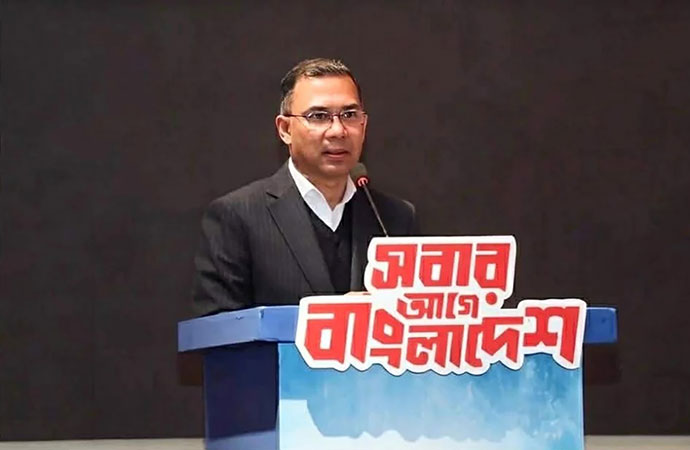
BNP Chairman Tarique Rahman exchanges greetings with editors and journalists at a city hotel on January 10, 2026. Photo: Collected
After more than 17 years in exile, Tarique Rahman returned to Bangladesh on 25 December, stepping back into the centre of national politics with a message that seeks to redefine the country's political culture.
At an interaction with editors, journalists and media owners in Dhaka on 10 January, the Acting Chairman of the Bangladesh Nationalist Party (BNP) articulated a vision grounded in reconciliation, justice and long-term development, while outlining policy priorities ranging from social security and healthcare to employment, technology and water security.
Held at a city hotel, the interaction brought together senior figures from print, television and digital media. At the outset, Tarique Rahman moved around the hall, exchanging greetings with many in attendance, shaking hands and engaging in brief conversations. The informal gestures set the tone for an event that was both symbolic and substantive, marking his formal re-entry into public life after years abroad.
Addressing the gathering, Tarique emphasised what he described as a policy of "no vengeance, but reconciliation", underscoring the need to move Bangladesh beyond decades of political confrontation. Justice, he said, must prevail, but without perpetuating cycles of retaliation. According to him, the democratic process must be protected at all costs if the country is to avoid returning to instability.
He said the BNP plans to reach out to the public with its programme from 22 January, ahead of the 13th national parliamentary election scheduled for 12 February. "We will welcome discussion and criticism from you all, so that they can be used to address the problems faced by the country's people," he told the audience, stressing the role of the media in shaping accountable governance.
Reflecting on the country's history, Tarique referred to the 1971 Liberation War, the mass uprising of 1990 and the events of 2024. "If we work for the country keeping the spirits of these movements in mind and for the cause of independence, it will be possible to reach the right destination," he said, framing his political outlook within Bangladesh's defining moments of struggle and transformation.
Universal social security and the family card
One of the central policy ideas outlined at the event was the introduction of universal social security programmes, particularly through a family card system aimed at empowering women in rural areas. Tarique said the initiative is being conceptualised to benefit farmers, imams, teachers and ordinary citizens in a similar manner, ensuring inclusivity across professions and social groups.
Implemented in phases, he argued, such programmes could gradually reduce corruption. Bangladesh, he said, has an estimated 40 million families, with an average of five members per household, and the proposed system is being designed with this demographic structure in mind.
Under the initiative, the family card would be issued in the name of a woman in each household. However, it would not be a lifetime entitlement. Homemakers would receive the card for a limited period of five to seven years. Assistance under the scheme could be provided either as a fixed financial allocation or through essential food items, depending on assessed needs.
"Our objective is to make educated women economically self-reliant," Tarique said. "The family card initiative I mentioned earlier is designed precisely with this goal in mind - to empower women across society."
Explaining why support would be channelled directly to women, he cited past experience showing that women tend to prioritise healthcare for the family, children's education and savings or small-scale investments. "When women begin investing - even modestly - the local economy strengthens naturally, starting from the village and spreading to the upazila and district levels," he said, adding that healthier and better-educated families generate wider community progress.
Economy, remittances and exports
Turning to foreign currency earnings, Tarique identified the garments sector and remittances from migrant workers as the two main drivers of the economy. He noted that around one million Bangladeshis go abroad for work each year, with 600,000 to 700,000 heading to the Middle East.
With proper language training and basic skills development, he said, migrant workers could perform better and earn more, thereby increasing remittance inflows. He also said entrepreneurs exporting 100 per cent of their products would be given bonded facility benefits to help expand employment opportunities.
While garments and remittances remain the economy's pillars, he stressed the need to develop new export sectors to ensure sustainable growth and resilience in the face of global economic changes.
Dialogue over division
A recurring theme of Tarique Rahman's address was the need to prevent political disagreement from turning into conflict. "We must ensure that differences of opinion do not turn into divisions. Even if there are disagreements, they should be resolved through dialogue," he said.
Referring to the political upheavals of recent years, he added, "We do not want to return to the situation that existed before 5 August 2024." According to him, putting aside differences and working collectively is essential to keep democracy alive and protect the country's independence and sovereignty.
Rethinking IT parks and digital livelihoods
On technology and youth employment, Tarique proposed a different approach to IT parks. Where such parks already exist, he suggested bringing young IT professionals together and providing free Wi-Fi and small office spaces.
"This would allow them to operate more effectively, expand their businesses, create jobs and eventually build larger companies," he said, describing the model as both realistic and achievable.
He also highlighted the growing number of young content creators on platforms such as Facebook and TikTok. To support them, he said government policies must be streamlined so that their incomes can grow and they can access international markets. Discussions have already been held on simplifying payment systems for digital creators, he added, and such measures could be implemented quickly if the BNP comes to power.
A preventive healthcare model
Drawing on his experiences in London, where he lived for the past 17 years, Tarique spoke at length about healthcare. Even developed countries, he said, are struggling to sustain expensive, hospital-based systems and are increasingly shifting towards disease prevention.
Treating serious illnesses requires huge expenditure on medicines, doctors, hospital beds and infrastructure, whereas prevention significantly reduces costs. He cited studies showing that awareness-based preventive measures lower overall state healthcare spending.
"If people are made aware of which foods to avoid to prevent kidney disease, heart conditions and diabetes, overall public health improves," he said.
Based on this approach, the BNP plans to design a healthcare system centred on prevention, with basic training for health workers to enable them to raise awareness at the community level. Improving ambulance services would also be a priority.
"In the United Kingdom, even the response time of an ambulance is a subject of political debate," he said. "In contrast, if Dhaka continues on its current path, a severe crisis could emerge within the next 10 to 15 years."
"Our goal is to ensure healthcare for the country's 20 crore people. This is not limited to hospitals alone; emphasis must also be placed on public awareness, nutritious food, hygiene and preventive healthcare."
Youths, water and women's safety
After formally becoming the BNP chief on 9 January, Tarique said his visits to places such as Savar left him with the impression that the younger generation is seeking guidance and hope. Addressing unemployment among youths, he reiterated the need for vocational, technical and language training to expand overseas employment and increase remittances.
He also warned of a looming water crisis, noting that while Dhaka's rivers remain heavily polluted, access to safe drinking water is under threat. The Buriganga River, he said, is fully polluted, the Shitalakshya nearly half polluted, and pressure on the Meghna River is increasing.
On women's safety, he said both women and men have the right to security and described harassment of women on social media as a growing concern. Combating this trend, he said, would be a top priority for the BNP.
"There must be accountability," he said, adding that Bangladesh cannot return to the situation that existed before 5 August 2024. Differences of opinion may persist, he acknowledged, but the democratic process must be kept alive.
Attendees
Those present at the session included UNB Editor-in-Chief Enayetullah Khan; BBC Bangla Editor Mir Sabbir; senior journalist Qadir Kallol; Bangladesh Pratidin Editor Abu Taher; Prothom Alo Executive Editor Sajjad Sharif; Samakal Editor Shahed Muhammad Ali; Dainik Bhorer Kagoj Editor Dewan Hanif Mahmud; Protidiner Bangladesh Editor Maruf Kamal Khan; Desh Rupantor Editor Kamal Uddin Sabuj; Daily Sun Editor Md Rezaul Karim; Kalbela's Santosh Sharma; Ajker Patrika's Kamrul Hasan; BSS Chairman Anwar Al Din; Al Jazeera's Tanvir Chowdhury; Reuters' Ruma Pal; AFP's Shesh Sabeeha Alam; Bangladesh Television Director General Mahbub Alam; Bangladesh Betar Director General Z M Zahedur Rahman; Somoy TV's Jubayer Ahmed; Channel i's Shaikh Siraj; Bangla Vision's Abdul Hai Siddiqui; NTV's Fakhrul Alam Kanchan; Jamuna TV's Fahim Ahmed; DBC's Loton Ekram; Ekattor TV's Shafik Ahmed; and ATN's Hasan Ahmed Chowdhury Kiran.
Among BNP leaders present were Standing Committee members Mirza Abbas, Amir Khasru Mahmud Chowdhury, Salahuddin Ahmed and Hafiz Uddin Ahmed; Vice-Chairman Asaduzzaman Ripon; Chairperson's Advisory Council member Abdus Salam; Chairperson's Adviser Mahdi Amin; and Media Cell members Atikur Rahman Rumon, Shammi Akhtar and Shairul Kabir Khans.
The programme was conducted by Media Cell Convener Maudud Hossain Alamgir Pavel and the Chairperson's Press Secretary Saleh Shibly.
A Independent Newsweekly
© Copyright 2026 | Designed by ARK Reepon & Developed by Cosmos Group Software Team




Leave a Comment
Recent Posts
Another stress-test for the wo ...
And just like that, the world economy has been thrown into turmoil onc ...
Turkish President Recep Tayyip ...
Turkish President Recep Tayyip Erdogan offered to mediate for a new ce ...
Bangladesh flags economic risks of prolonged Middle ..
Bangladesh seeks enhanced cooperation with Argentina
US trade deal discussed with BNP, Jamaat before sign ..
Road Transport and Bridges, Shipping, and Railways M ..