



Reportage
Ganges Waters: The quest for a more equitable treaty


An Independent Newsweekly



Reportage
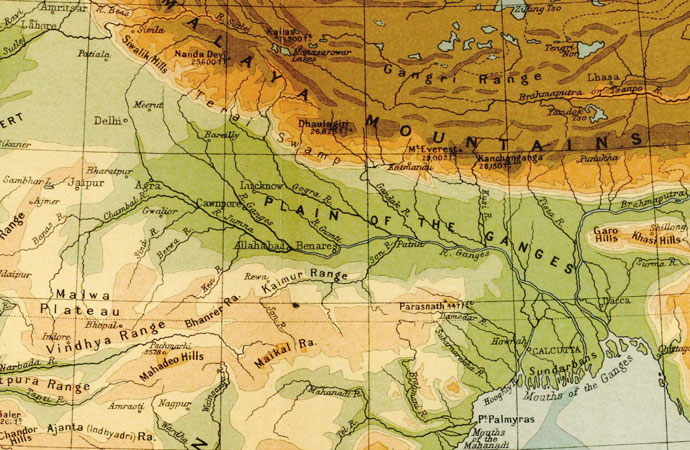
The Ganges river valley and plain as shown in a portion of the map. Image: wikimedia.org
Securing its fair share of the transboundary rivers' waters is likely to become a major issue for Bangladesh in the coming days, making effective water diplomacy, international cooperation and constructive engagement with India increasingly important, officials and experts have said.
The urgency is underscored by the Ganges Water Sharing Treaty, signed on December 12, 1996, which is due to expire on the same date this year. The government in Dhaka has been increasingly vocal in recent weeks, communicating a vision that Bangladesh will be seeking a new or revised agreement that safeguards its interests, particularly its share of dry-season flows, with the inclusion of a guarantee clause.
"Water could emerge as one of the major challenges for the entire world, including Bangladesh, in the future," Local Government, Rural Development and Co-operatives Minister Dr Abdul Moyeen Khan said last week, stressing the need to integrate proper water management into national development planning.
Bangladesh and India share 54 transboundary rivers, but the Ganges remains the only one covered by a bilateral water-sharing agreement between the two countries.
Guarantee clause a key priority
Water Resources Minister Shahiduddin Chowdhury Anee said Bangladesh wants a new or revised Ganges agreement rather than simply renewing the existing treaty, with provisions guaranteeing its required share of water during the dry season.
"Our main priority will be to bring back the guarantee clause that was included in the 1977 agreement," he said on October 8.
The agreement was negotiated during the administrations of President Ziaur Rahman in Bangladesh and Prime Minister Morarji Desai in India, and signed in Dhaka on November 5, 1977. It took effect on the same day and remained in force for five years. It contained a specific safeguard: if the available flow fell sufficiently low, Bangladesh was guaranteed at least 80 per cent of its scheduled share during a 10-day period. This offered a degree of protection to Bangladesh when the available flow was insufficient to meet the countries' scheduled allocations.
After the agreement's formal five-year term ran until November 5, 1982, there followed a period of interim arrangements till the 1996 deal was signed. None of the arrangements from 1982 onwards (two MoUs in 1982 and 1985, and a low-flow arrangement in 1983) contained the guarantee clause. After the expiry of the temporary arrangements, the two countries lacked a comprehensive, long-term water-sharing agreement. The 1996 treaty finally established a 30-year framework, giving Bangladesh a formal allocation formula and institutional arrangements for monitoring and addressing disputes.
It is reasonable to interpret the agreement as a negotiated compromise: Bangladesh secured a long-term framework for sharing Ganges water, while India did not accept the broad, unconditional minimum-flow obligation that Bangladesh had previously enjoyed under the 1977 arrangement.
An official also referred to Article III of the 1977 agreement, which stated that "The waters released to Bangladesh at Farakka under Article I shall not be reduced below Farakka except for reasonable uses of waters, not exceeding 200 cusecs, by India between Farakka and the point on the Ganga where both its banks are in Bangladesh."
In plain language, this meant that India could not withdraw or divert the water released to Bangladesh at Farakka as it flowed downstream, except for reasonable uses of up to 200 cusecs in the specified stretch of the river before it entered Bangladesh.
A 2019 review published in Water Policy, a peer-reviewed scholarly journal published by the International Water Association, highlights another significant difference between the two agreements: the 1977 agreement specified a joint investigative process, a three-year deadline and a commitment to consider and implement augmentation schemes. The 1996 treaty recognised the need for cooperation on augmentation but did not prescribe comparable terms of reference or a timetable for a joint study.
In other words, the 1977 agreement sought to address both sides of the problem: how to share the water available at Farakka and how to increase the amount available during the dry season. Of course, the augmentation programme was never successfully implemented. That left the underlying scarcity unresolved, even as the two countries subsequently negotiated new arrangements for sharing the water.
Perhaps the most telling assessment came from the Asian Development Bank's Law and Policy Reform Programme, which said:
"The Ganges-Brahmaputra-Meghna mega-basin is the second largest hydraulic region in the world, and one of the most densely populated regions. Within this basin, 54 rivers cross the border between upstream India and downstream Bangladesh. Only one, however, is subject to a bilateral agreement between the two countries: the Ganges River.
"The Ganges Treaty between India and Bangladesh is an agreement to share surface waters at the Farakka Barrage near their mutual border. But the treaty, which was signed in 1996, divides water flow without sharing the value and uses of the river between the two countries. It does not even take into consideration the uppermost riparian, Nepal, meaning that it takes neither a whole-of-basin approach to river management, nor does it factor in the effects of upstream use of the Ganges on water availability at the Farakka Barrage.
"The Ganges Treaty illustrates that a legally binding agreement is not the same as meaningful cooperation between the parties. The treaty favours the hydro-hegemonic state (India) and solidifies the status quo. It does not create a community of interest in the shared management of the river and has left Bangladesh with numerous concerns and unresolved issues."
A new outlook on water diplomacy?
As the minister for water resources, Shahiduddin Chowdhury Anee has been very much at the forefront of setting out Bangladesh's stall on the matter, even as negotiations are said to continue at the Joint Rivers Commission level between the two countries.
The minister was the chief guest at a seminar in August, organised by the Bangladesh Institute of Law and International Affairs (BILIA), titled "Ganges Water Treaty: Issues for Renegotiation," where experts called for strengthening Bangladesh's negotiating capacity and using international law before signing a new treaty with India.
Former interim government law adviser and Professor of Law at the University of Dhaka, Asif Nazrul presented the keynote paper at the seminar.
In his paper, titled "Ganges Treaty: A need for new thinking", he said around 70 per cent of the Ganges basin lies in India's Uttar Pradesh, Bihar and West Bengal, leaving Bangladesh structurally as a lower-basin country, according to reporting by Prothom Alo.
The expansion of extensive irrigation projects upstream in India has caused extreme variations in water flow during the dry season. Asif Nazrul identified the absence of a guarantee for a minimum water flow in the 1996 treaty, compared with the guarantee clause in the 1977 treaty, as a fundamental structural weakness.
Citing statistics, he showed that Bangladesh's share had fallen by around 6.52 percent under the 1996 treaty. He noted that during 27 critical periods between 2008 and 2016, Bangladesh failed to receive the minimum water flow on 15 occasions.
He also pointed out that the existing treaty contains no specific mechanism for the right to information or environmental protection, while the dispute resolution mechanism it established was plainly inadequate.
In his address as chief guest, the water resources minister criticised the previous Awami League government's handling of relations with India.
"Our relationship with the neighbouring country is friendly. However, our friends need to provide greater cooperation in safeguarding Bangladesh's interests and rights. We must take the relationship forward while respecting the feelings of the people of Bangladesh and the interests of the country," he said.
He said Dhaka was also willing to seek legal recourse at the international level if necessary to safeguard the country's interests in a coordinated manner.
The water resources minister further said, "The first treaty, signed in 1977, protected our interests. It included a guarantee clause. But memorandums of understanding were signed in 1982, 1983, 1984 and 1985, and none of them contained a guarantee clause. The 1996 treaty subsequently dropped the guarantee clause."
He said Bangladesh had been deprived because the guarantee clause was absent.
Delivering the concluding remarks at the seminar, BILIA chairman and professor of law at the University of Dhaka, Borhan Uddin Khan said, "In the new treaty, we want a guarantee clause, a dispute settlement clause and the right to information."
There was one other thing Anee mentioned at that seminar. Referring to Prime Minister Tarique Rahman's then-upcoming participation at the United Nations General Assembly, the water resources minister had said: "I hope the prime minister will present a strong position on the treaty (Ganges water-sharing treaty) in favour of Bangladesh when he visits the United Nations next month. He must firmly present our rights and interests there."
This however was plainly not the case in the prime minister's eventual speech at UNGA81. Although the PM reaffirmed Bangladesh's dedication to international water cooperation by highlighting the country's 2025 accession to the 1992 UN Water Convention, there was no specific mention of the Ganges Treaty.
In his speech last week (Oct. 8), which was delivered at a seminar titled "Rethinking Water Futures: Youth Leadership, Justice and Cooperation" at the Bangladesh Institute of International and Strategic Studies (BIISS), Anee also struck a less hardline tone. He said water diplomacy should focus on cooperation and mutual benefits rather than competition, stressing the need for sustained dialogue, scientific cooperation, data sharing and inclusive water governance.
"Cooperation should create mutual benefits rather than being framed explicitly as a competition over water," he said.
He described water as closely linked to Bangladesh's geography, economy, agriculture, culture, foreign policy and national security.
"We are a delta country shaped by rivers. Yet, we are also a riparian country dependent on water flows originating beyond our borders," he said.
Anee called for stronger engagement through the Joint Rivers Committee and multilateral water governance mechanisms, alongside greater international cooperation and scientific collaboration.
"We need cooperation instead of confrontation, evidence instead of assumptions, participation instead of execution, and long-term planning instead of short-term responses," he said. "Our goal should not simply be to manage water crises when they occur; our goal should be to build a just, decent, and cooperative water future."
But is the other side listening?
Sreeradha Datta, professor of international affairs at the OP Jindal Global University and one of India's most seasoned Bangladesh-watchers, is of the view that Bangladesh's stated position may get short shrift within the present atmosphere prevailing in relations between the two countries.
Talking to Dhaka Courier, she said apart from affected states like Bihar and West Bengal, the issue is currently not top of the tray in Indian policymakers' minds, especially in light of recent domestic developments there. Yet she also makes clear that the two August statements of the Ministry of Foreign Affairs in Dhaka, linking a possible summit between the two prime ministers to the extradition of Sheikh Hasina, have left their mark on how far India is willing to go to accommodate Bangladesh's post-July sentiments.
"Given all that is weighing on the relationship right now, I am not very upbeat that a new agreement can be negotiated. I see a greater possibility of more interim arrangements in the near future," she said.
As such, she views Dhaka's stated aims regarding a new agreement more as a shot across the bows, rather than "a serious negotiating position."
"I think it is very important for Bangladesh and India to renew the Ganges Treaty. But it has to be revised. The very simple reason is that the treaty was done almost three decades ago," international affairs expert Dr Shahab Enam Khan told our sister newsagency UNB recently.
Dr Khan, who is the Executive Director of the Bangladesh Centre for Indo-Pacific Affairs, and a former chair of the international relations department at Jahangirnagar University, strongly suggested that this should also come with arrangements such as revitalising the JRC and including a much more transparent and accountable data-sharing system, which will definitely build much more confidence over 'hydro-diplomacy' and water management and water sharing, most importantly, between the two countries.
"This is very important that we should also go into the diplomatic negotiations not only from the diplomatic perspective, but also from engineering, science, and definitely economic perspectives," he said.
Foreign Minister Dr Khalilur, while attending the ninth Indian Ocean Conference in Mauritius, said they would like to see that there is an arrangement and a new treaty, or a revised treaty, ensuring the essential needs of both peoples.
"These are common rivers, and we have common legacies here, common interests and, as I said, there's no other alternative but to seek a solution that is durable and will win public trust. And this will also be very important to lay the basis for the relationship over the next 25 to 50 years," he told NDTV on the sidelines of the conference.
The foreign minister said they have done 55 years (of bilateral relations) already. "So, I don't think we should look at five years or ten years. We have to look at the very long term. So, mutual climate resilience as a priority in our foreign policies, our people policy, I should say, will actually be a key driver of the future."
Stonewalling?
The Indian government, through its Ministry of External Affairs spokesperson Randhir Jaiswal, has continued to say that issues concerning the Ganges treaty and other shared rivers would be discussed through the Joint Rivers Commission.
"On the Ganga Water Treaty, as also other rivers that we share between Bangladesh and India, we have a Joint Rivers Commission. All matters relating to rivers, river-related matters, will be discussed as part of this Joint Rivers Commission," he said recently, adding that technical-level meetings on the Ganges treaty had continued.
Given the legacy of the July Uprising of 2024, it is understandable that the government elected in its aftermath would seek a more equitable footing in relations with India. But a fundamental change to the status quo, particularly in a dispute in which India enjoys natural advantages as the upper riparian, will require more than a declaration of intent. It will depend on whether Bangladesh can translate its demands into a credible negotiating position and whether India recognises that the rules of engagement between the two neighbours have shifted.
Without that shift, the BNP government's more muscular insistence on restoring elements of the 1977 agreement may fall on deaf ears. Negotiations could instead become another casualty of the paralysis or even deterioration that marked relations with India during the last two BNP-led governments.
Additional reporting by AKM Moinuddin
A Independent Newsweekly
© Copyright 2026 | Designed by ARK Reepon & Developed by Cosmos Group Software Team





Leave a Comment
Recent Posts
Is the international community ...
A spate of downgraded economic projections, from Bretton Woods to Mani ...
A Childhood Lesson in Arithmet ...
As children, we learned a simple mathematical rule: if we know the pri ...
Indian authorities launched a major security crackdo ..
Police dispersed garment workers from the Azampur ro ..
Why Saudi Arabia has struggled to defend itself agai ..
Iran-backed Houthis strike Saudi oil company Aramco’ ..