



Reportage
From largest donor to ‘growing together’: Why BIG-B matters


An Independent Newsweekly



Reportage
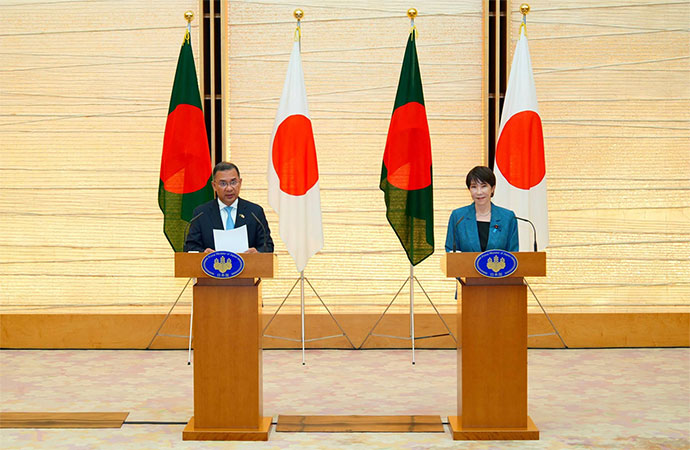
Prime Minister Tarique Rahman and Japanese Prime Minister Sanae Takaichi. Photo: Facebook
The vision for a Bay of Bengal Industrial Growth Belt (BIG-B) was first unveiled in 2014, during then-Japanese prime minister, the late Shinzo Abe's whirlwind visit to Bangladesh. Abe had risen to the Japanese premiership two years earlier, as possibly the most inspirational leader Japan had seen in decades.
Having grown into one of the world's most advanced economies in the second half of the 20th century, Japan in the 1990s had seemingly exhausted its ambition and appetite for innovation, and fallen into a state of torpor, typified by years of stagflation. Abe came along determined to shake the Japanese economy into life again. And BIG-B was his proposed "centrepiece" for Japanese cooperation in Bangladesh, for which he sought the support of businessmen from both nations.
At a Bangladesh-Japan Business Forum event at the Pan Pacific Sonargaon Hotel where he was staying, he said he would "promote" trade and investment in Bangladesh. He even said the country was also important for implementing his "Abenomics", the set of economic policies he championed to breathe new life into the long-stagnant Japanese economy.
"I am promoting Abenomics in Japan to lead Japan's economic recovery. To me Bangladesh is very important to enhance trade and investment of Japan, and I am promoting Abenomics to lead Japanese economic growth."
BIG-B was also prescribed as part of Japan's grand design of combining two oceanic regions - Pacific Ocean and Indian Ocean - for more geopolitical space to boost its economy. The Bay of Bengal forms the north-eastern part of the Indian Ocean, and is known to be the largest of its kind in the world.
Abe during that visit also mentioned the three dimensions he envisioned to the BIG-B concept. One was to promote infrastructure improvement for industrial development; second was to create a better environment for investments and last to promote improved "solidarity and unity" in the region including Bangladesh.
Specifically, he said improvement of transportation and infrastructure, stable supply of power and energy, urban development including special economic zone improvement, and also public sector development including improved market access to the financial markets, were key to the BIG-B concept.
He expressed his hope that in those areas Japanese technology would be "fully leveraged and used in Bangladesh," before adding that doing so would bring mutual benefit and prosperity for both countries.
He also highlighted the Matarbari power generation project near the Port City of Chittagong, as one of the "flagship" projects within the cooperation between the two countries.
In Abe's footsteps
In light of the rapidly changing global situation, a more prevalent supply chain risk, rapid technological innovation and mounting social issues, Bangladesh and Japan will upgrade BIG-B into "BIG-B for Shared Prosperity" as an initiative of "strategic cooperation" in the exclusive partnership between the two countries.
This is aimed at enhancing the resilience and preserving each country's freedom of decision, said the Japanese government.
Meanwhile, Bangladesh and Japan signed a number of Memoranda of Cooperation and other documents between the two countries, said the Japanese side.
The two countries signed five cooperation documents covering economic relations and the business environment, agriculture, fisheries and livestock, and environmental protection.
These include a memorandum of cooperation between Japan's Ministry of Economy, Trade and Industry and Bangladesh's Economic Relations Division; separate memoranda between Japan's Ministry of Agriculture, Forestry and Fisheries and Bangladesh's Ministry of Agriculture and Ministry of Fisheries and Livestock; a memorandum of cooperation on the environment between Japan's Ministry of the Environment and Bangladesh's Ministry of Environment, Forest and Climate Change; and a letter of intent between Japan's Global Environment Bureau and Bangladesh's Department of Environment under the Ministry of Environment, Forest and Climate Change.
Towards Shared Prosperity
BIG-B (the Bay of Bengal Industrial Growth Belt) is an economic development initiative with three pillars: (1) economic infrastructure development, (2) improvement of investment environment, (3) strengthening connectivity.
It has served as the flagship initiative of Japan-Bangladesh cooperation, and can be said to have supported Bangladesh's economic growth for over a decade already.
The "BIG-B for Shared Prosperity" positions Bangladesh as a hub to promote common prosperity and to contribute to mutual growth, according to the Japanese Ministry of Foreign Affairs.
Japan and Bangladesh have agreed to strengthen cooperation in connectivity, energy security, disaster resilience, trade, investment and defence to promote economic growth and regional peace and stability.
Under the proposed cooperation framework, the two countries will promote integrated economic infrastructure development centred on Matarbari Deep-Sea Port, including power and energy facilities, airports, roads, railways, inland waterways and special economic zones, to strengthen supply chains and develop Bangladesh into a logistics and industrial hub.
They will also work to improve the investment climate, develop human resources, expand public-private partnerships and establish transparent and predictable rules to attract investment.
Both sides will seek to expand trade and investment under the Japan-Bangladesh Economic Partnership Agreement (EPA), improve market access and promote industrial upgrading and export diversification. Their cooperation will also focus on building resilient supply chains in manufacturing, logistics, food and agriculture, information and communication technology, pharmaceuticals and other sectors.
To strengthen energy security, the two countries will promote initiatives under Japan's "POWERR Asia" framework for a stable and economically viable energy supply and explore opportunities for energy infrastructure development in the Matarbari region.
They will also enhance cooperation to address natural disasters and climate change, including strengthening emergency response capabilities and developing sustainable disaster-prevention infrastructure.
In the security sector, Japan will support Bangladesh's capacity-building efforts and promote bilateral security and defence cooperation, with a focus on maritime security, maritime domain awareness, coastal patrols and port security.
The framework includes providing patrol boats to Bangladesh under Japan's first Official Security Assistance (OSA) project, exploring a second OSA project and providing patrol vessels through official development assistance (ODA) to strengthen coastal security capabilities.
Both countries will also work to improve their ability to respond to emerging technological challenges, including cybersecurity, as part of broader efforts to enhance resilience against geopolitical uncertainties and promote peace and stability.
Prime Minister Takaichi and her Bangladeshi counterpart reaffirmed their commitment to further strengthen bilateral relations under the two countries' Strategic Partnership, with a focus on regional peace, prosperity and stability.
At their summit meeting in Tokyo, Takaichi congratulated Tarique Rahman on assuming office as prime minister and described Bangladesh as a friend that shares the 'values of democracy'. Amid growing international instability, she said Japan strongly supports Bangladesh's ability to make its own decisions freely and strengthen its resilience under Japan's updated "Free and Open Indo-Pacific" (FOIP) vision.
Takaichi also expressed her intention to work with Tarique Rahman to promote peace and prosperity in the region.
In response, Tarique Rahman said Japan, as a peace-loving nation, was among the first countries to recognise Bangladesh's independence and holds a special place in the hearts of the Bangladeshi people.
He said the two countries had built longstanding friendly relations and expressed his commitment to working with Takaichi to take bilateral ties to new heights.
The two leaders' summit meeting took place on the morning of October 27, the second day of Prime Minister Rahman's visit. It was followed by a joint press event and luncheon, according to the Japanese Ministry of Foreign Affairs.
Takaichi vows to "grow together"
Japanese Prime Minister Sanae Takaichi on Tuesday pledged strong support for Prime Minister Tarique Rahman's nation-building efforts, saying Japan will work closely with Bangladesh to strengthen their strategic partnership and promote shared prosperity.
In a post on her official X account after their bilateral summit in Tokyo, Takaichi said she was pleased to personally congratulate Tarique on taking office, describing Bangladesh as a friend that shares the values of democracy and the rule of law.
"Japan will strongly support the nation-building efforts of the Rahman administration, which came to power following a democratic general election," she said.
Takaichi said the two countries discussed bilateral cooperation in light of their shared values and Bangladesh's importance to the realisation of a Free and Open Indo-Pacific.
She said they agreed to advance the Bay of Bengal Industrial Growth Belt, a key framework for bilateral cooperation, into a new strategic initiative called "BIG-B for Shared Prosperity."
The Japanese Prime Minister said Tarique recalled Japan's role as a peace-loving nation and its early recognition of Bangladesh's independence. She said her Bangladeshi counterpart also described Japan as a country that holds a special place in the hearts of the Bangladeshi people and expressed gratitude for the wide-ranging support and cooperation from the Japanese government and people.
Highlighting Bangladesh's economic potential, Takaichi said the country is important to Japan's economy because of its strategic position connecting South Asia and Southeast Asia and its large, young market of 170 million people.
Referring to the joint statement issued after their summit, she said the two countries will work together through government and private-sector initiatives under their strategic partnership.
"Together, we will grow stronger and more prosperous," Takaichi said, pledging to work closely with Tarique to promote peace and prosperity across the Indo-Pacific region.
Finance Minister stays back
The finance ministers of Bangladesh and Japan emphasised strengthening their economic relations and expanding cooperation in alternative financing beyond traditional foreign direct investment (FDI).
The emphasis came at a bilateral meeting between Bangladesh Finance Minister Amir Khosru Mahmud Chowdhury and Japanese Finance Minister Satsuki Katayama at the Japanese Finance Minister's office in Tokyo on Friday. Japanese Assistant Finance Minister Mimura Atsushi also attended the meeting.
According to a press release from the Finance Minister's Office, the discussions covered ways to deepen bilateral economic and development cooperation and take the longstanding partnership between the two countries to a new height.
Both sides discussed Bangladesh's infrastructure development, expansion of bilateral trade and opportunities to increase economic cooperation through alternative financing mechanisms beyond conventional foreign direct investment.
They also agreed on the need for effective initiatives to make existing economic ties more dynamic and explore opportunities for cooperation in new sectors. Two of the Prime Minister's Special Assistants, Tanvir Gani and Shakirul Islam Khan, attended the meeting, along with other senior officials from both countries.
Japan is one of Bangladesh's major development partners. Japanese financing has supported several large infrastructure and social development projects in Bangladesh over the years, while important projects are currently being implemented and new agreements are being pursued.
The meeting of finance ministers was expected to provide further impetus to bilateral efforts to expand economic cooperation and explore alternative sources of financing for Bangladesh's development needs.
"No third country in BIG-B"
Determined to allay any apprehension that a bilateral agreement between Dhaka and its largest, most important benefactor could at all be used as an instrument by any third country to regain lost ground (in a geo-economic sense), State Minister for Foreign Affairs Humaiun Kobir on Friday moved quickly to dispel any such view from gaining succour. Bangladesh and Japan discussed the Bay of Bengal Industrial Growth Belt concept exclusively in the context of their bilateral economic partnership, ruling out any discussion involving a third country.
"There is no reference to any third country in the joint statement. There is no reference to the Bay of Bengal here. We will not discuss any third country in our discussions with Japan. That's clear. And we did not do that," he said, referring to the joint statement issued following Prime Minister Tarique Rahman's four-day official visit to Japan.
Speaking at a media briefing at the Ministry of Foreign Affairs, Kobir said Bangladesh had made it clear to Japan that the discussions would focus on bilateral relations, particularly economic ties.
"We made it very clear in our discussions with the government of Japan that we came here to discuss bilateral relations between Bangladesh and Japan, economic relations in particular," he said while responding to a question about whether BIG-B could be expanded into a regional industrial supply chain centred around the Matarbari deep seaport, involving Nepal, Bhutan and India's Seven Sisters.
Accompanying Kobir at the briefing were Salahuddin Noman Chowdhury, who is set to become the next Foreign Secretary, and Additional Foreign Secretary (Public Diplomacy and Other Priority Matters) AKM Shahidul Karim.
Kobir said Bangladesh understands its responsibilities when it comes to engaging other countries in regional initiatives.
"If we have to discuss anything else, then the respective representatives of those countries must be at the table, and we must be sitting across the table with them as well," he said.
The State Minister also clarified that Prime Minister Tarique Rahman's visit to an LNG terminal in Japan was not aimed at importing liquefied natural gas (LNG) from the country.
The Prime Minister visited the facility to see how an LNG terminal is designed, developed and operated, as Bangladesh is also considering setting up such a terminal, he said.
"Japan has done it, and it is a proven example. So the purpose of that field visit was to see how it looks, how they have done it and how it is working, to get an idea for ourselves," Kobir said.
Regarding the proposed Japanese economic mission to Bangladesh, he said it would be sent soon following joint ministerial-level meetings between the two countries.
"They will send an economic mission soon. So, at a time of mutual convenience, that mission will be sent," the State Minister said.
On the Rohingya issue, Kobir said Bangladesh would continue to raise the matter at international forums, both bilaterally and multilaterally, describing it as an important national security concern and a key foreign policy priority.
"Wherever we go internationally, be it bilateral or multilateral, this is an important national security matter for us, an important foreign policy priority for us. So we will discuss this," he said.
The State Minister said Bangladesh was building a respectful bilateral economic partnership with Japan, describing it as an investment-driven partnership.
A Independent Newsweekly
© Copyright 2026 | Designed by ARK Reepon & Developed by Cosmos Group Software Team







Leave a Comment
Recent Posts
Resting in Peace in Pirojpur
I never had the privilege of meeting freedom fighter Manik Pashari, wh ...
An impending disaster in the h ...
There has been a fresh spike in both dengue and measles cases, hospita ...
‘Stories bring us together’: Laetitia Troussel-Luber ..
A high-speed train slammed into another that had sto ..
Bangladesh and Malaysia concluded the first round of ..
CPC's international department head Liu Haixing to v ..