



Reportage
Finishing what we started


An Independent Newsweekly

Reportage
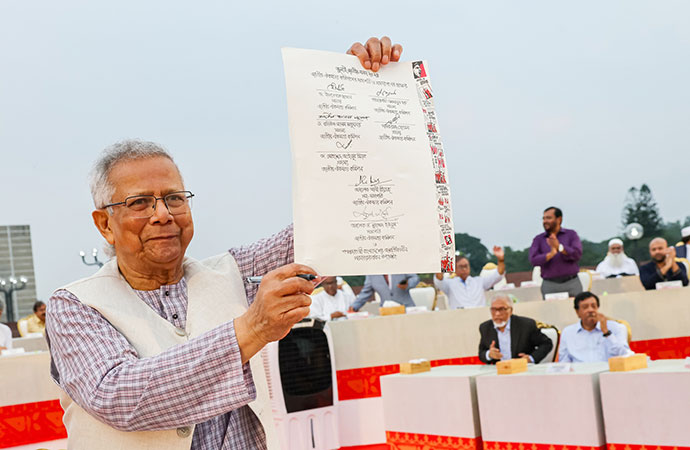
Chief Adviser Muhammad Yunus
Finally putting all the speculation to rest, Chief Adviser Muhammad Yunus on Thursday (November 13) revealed that the election to the 13th Parliament and the referendum on the July Charter, the set of proposed reforms worked out in discussions between the various political parties under the guidance of the interim government that came to office in the wake of last year's July Uprising, will be held on the same day in the first half of February next year.
"The referendum will take place in the first half of February simultaneously with the general election. This will not in any way hinder the goals of reform; rather, it will make the election more festive and cost-effective," he said in a televised address to the nation.
"Appropriate law will be formulated in due time to facilitate the holding of the referendum. We are taking all-out preparations to hold the election in a festive atmosphere," the Chief Adviser added.
To implement the July Charter, the government has adopted several key provisions in a constitutional order that was gazetted shortly after the speech.
"These include holding a referendum on the charter's proposed constitutional reforms and subsequently forming a Constitutional Reform Council," he said.
Dr Yunus said the interim government, in a meeting of the Council of Advisers, approved the July National Charter (Constitutional Reform) Implementation Order, 2025. "After the completion of necessary signings, it has reached the stage of issuing a gazette. It's great news," he added.
He also revealed the question to be presented on the referendum ballot, which will ask for the public's consent (or otherwise) in four key areas:
a) The caretaker government, Election Commission, and other constitutional bodies will be formed in accordance with the procedures outlined in the July Charter.
b) The next parliament will be bicameral. Based on the proportion of votes received in the national election, a 100-member upper house will be formed, and any constitutional amendment will require the approval of a majority in the upper house.
c) The political parties that win the next election will be obligated to implement the 30 reform proposals agreed upon in the July National Charter, including increased female representation in parliament, election of the deputy speaker and parliamentary committee chairs from the opposition, limitation of the prime minister's tenure, enhancement of presidential powers, expansion of fundamental rights, independence of the judiciary, and strengthening of local government.
d) Other reforms outlined in the July Charter will be implemented as per the commitments of the political parties.
"On the day of the referendum, you will express your opinion on these four issues by casting a single vote - either 'yes' or 'no,'" said Prof Yunus.
If a majority votes "yes," a Constitutional Reform Council will be formed, comprising the representatives elected in the upcoming parliamentary election. These representatives will also serve as members of the national parliament. The council will complete the constitutional reform process within 180 working days from the date of its first session, he added.
Within 30 working days after the reform is completed, an upper house will be constituted based on the proportion of votes received in the parliamentary election, and its term will continue until the final working day of the lower house, he said.
In accordance with the pledge to implement the July Charter, provisions will be made to incorporate the July National Charter into the Constitution, he added. "This inclusion has also been specified in today's approved order."
BNP's stinging reaction
BNP Standing Committee member Salahuddin Ahmed, in his immediate reaction said the Chief Adviser has violated the July National Charter through his outlines on the implementation of the charter in his speech to the nation.
"The Chief Adviser himself signed the July Charter. In his speech, he violated the charter by including matters beyond the signed charter and adding new elements that were not mentioned in it," he told our sister newsagency UNB giving his initial reaction to Prof Yunus' address to the nation.
"If we analyse his speech alongside the signed charter, we will see that he has grossly breached it. That is all I want to say for now," the BNP leader added.
Meanwhile, an urgent meeting of the BNP Standing Committee has been called for Thursday evening.
The meeting, convened by BNP Acting Chairman Tarique Rahman, will begin at 7pm at the Chairperson's office in Gulshan.
Earlier in the day, Chief Adviser Prof Muhammad Yunus announced that the national election and the referendum on the July Charter will take place on the same day.
In a televised address to the nation, he said a meeting of the Council of Advisers had approved the July National Charter (Constitution Amendment) Implementation Order, 2025.
"To implement the July Charter, this order includes several important provisions. These include holding a referendum on the constitutional amendment proposals of the charter and, subsequently, the formation of a Constitution Reform Council," he said.
A senior BNP leader said that while the party welcomes the announcement of the election and the referendum on the same day, it has reservations about the implementation order and the nature of the referendum.
He added that the meeting of the BNP Standing Committee, the party's highest policymaking body, will discuss these issues in detail and decide on the party's next course of action.
Jamaat: Happier than they look?
Bangladesh Jamaat-e-Islami Secretary General Mia Golam Parwar on Thursday evening said the nation's expectations regarding the proposed referendum were not fulfilled in the Chief Adviser's address.
Speaking at a briefing at the party's Moghbazar central office, Parwar said the Chief Adviser's remarks lacked clarity on how the referendum would be conducted alongside the national election.
"If the national election and the referendum are held on the same day and balloting is suspended in any area due to unrest, what will happen to the 'Yes' or 'No' votes in the referendum?" he questioned.
He said the Chief Adviser's speech did not clearly explain the mechanism of managing both national and referendum ballots on the same day.
The party is also refusing to let go of its demand to have the referendum precede the election. Yet from all that is known of the Bangladeshi electorate circa 2025, there can be no doubting that they stand as the party that would most benefit out of what is emerging as the central issue in the referendum.
A line under the Uprising?
The framing of this endgame to the July Charter has basically boiled it down to the issue of 'PR Upper House', as the issue came to be known during the IG-led deliberations. It was the starkest contrast in the two visions that eventually collided - BNP's of an honours system modelled on Westminster (Tarique Rahman has long talked admiringly of the system he witnessed in the UK, and was moved to include it in the party's much-vaunted 31 points) versus a house that could act as a control on the levers of power, as exercised by the executive. Coming out of a period of authoritarianism, that would be the logical direction. Not towards Westminster, where the long term future of the unelected House of Lords, at least in Labour's plans, is in the dustbin of history. And the IG has nudged them in that direction - but now the people can have their say.
The way the question has been framed, everybody would have to agree on A - the caretaker's return is of paramount importance, and that would be enough to carry the rest. C contains the ones everybody already agreed on. And D is mostly a prop. The only real battle-line, is down B. In a sense, the IG has bet the farm on a 'Senate' elected on the basis of vote share in the election - proportional representation. And that is bound to somewhat dilute the dominance it is expected to enjoy through the First-Past-The-Post lower house. But in post-Uprising Bangladesh, that is not a dilution BNP should regret too much - if at all it has to in the end.
Chief Adviser's full address
In the name of Allah, the Most Gracious, the Most Merciful
Dear countrymen - children, adolescents, young men and women, students, men and women of all ages - I extend my greetings to you all.
Assalamu Alaikum.
In August of last year, under the power of the July prising, we formed the interim government. Since then, during our tenure, we have reached a very crucial juncture.
Our government was entrusted with three main responsibilities:
1. To bring to justice those responsible for the genocide,
2. To undertake necessary reforms for a transparent and effective democratic system, and
3. To transfer power to an elected government through a free and fair election.
We are moving forward with the trials of the genocide carried out under the orders of the then fascist regime during the July Uprising. The International Crimes Tribunal established for this purpose is soon to deliver its first verdict, while several other cases are nearing conclusion. Regular criminal courts have also initiated proceedings related to the July killings. For the first time in the country's history, we have also begun judicial proceedings on the heinous crime of enforced disappearances.
I am pleased to inform you that we have also made remarkable progress in the field of reforms. The interim government, either on its own initiative or based on recommendations from reform commissions, has implemented several significant reforms. Some proposed reforms are still ongoing. Through ordinances or amendments to existing laws, we have carried out reforms to strengthen judicial independence, judicial administration, financial transparency, institutional capacity, digitalization, and anti-corruption efforts.
We believe these reforms will play a major role in ensuring good governance in the future. We hope that the next elected government will adopt these reforms through discussions in parliament.
Another of our great responsibilities is to conduct a free and fair election. I have already announced that the national parliamentary election will be held in the first half of February. We are taking all necessary preparations to ensure that the election is festive, participatory, and fair. We are working tirelessly to fulfill our entrusted duty properly.
Dear countrymen,
The National Consensus Commission, formed to draft proposals for state restructuring, has been working tirelessly for nearly nine months. During this time, the commission has held discussions with representatives of the political parties that participated in the July Uprising. In a cordial atmosphere, with patience and mutual respect, these political parties have debated and presented their arguments on various reform proposals. Where differences existed, they tried to narrow them. In many cases, consensus was reached. The people of the country were able to witness the entire process live. This was an unprecedented event - not only in Bangladesh's political history but also by global standards. It is a hopeful sign for our future politics.
I extend my sincere thanks to the members of the Consensus Commission and to the leaders of the political parties for making this extraordinary democratic exercise a success.
Through the July Charter, consensus has been achieved among political parties on 30 significant constitutional reform proposals. This is a historic achievement. Some proposals have minor differences, while a few appear to have larger gaps - but even those are not deeply divisive upon closer examination. The disagreements are mainly over whether certain reforms should be enshrined in the constitution or enacted through legislation - not over their necessity or guiding principles. Thus, while public statements by parties may seem contradictory, a careful analysis of the July Charter shows far less difference in substance.
This is our unique achievement and a source of national courage.
Considering all this, and recognizing the July Charter signed by the political parties as the primary document, the interim government has approved the July National Charter (Constitutional Reform) Implementation Order, 2025 in today's meeting of the Council of Advisors. It is now in the process of being officially gazetted.
In order to implement the July Charter, the order includes important provisions such as a referendum on the Charter's constitutional reform proposals and the formation of a Constitutional Reform Council thereafter.
We have decided that the referendum will be held on the same day as the national election - that is, in the first half of February. This will not hinder the reform goals and will make the process more festive and cost-effective. Necessary legislation will be enacted in due course for holding the referendum.
The question to be presented on the referendum ballot is as follows:
"Do you approve the July National Charter (Constitutional Reform) Implementation Order, 2025 and the following constitutional reform proposals contained within the July National Charter?"
The key proposals include:
a) During the election period, the caretaker government, Election Commission, and other constitutional bodies will be formed in accordance with the procedures described in the July Charter.
b) The next parliament will be bicameral - consisting of an upper house of 100 members elected proportionally based on national votes, and any constitutional amendment will require the approval of a majority in the upper house.
c) The reforms agreed upon by political parties in the July Charter - including increased representation of women in parliament, election of a Deputy Speaker and committee chairpersons from the opposition, term limits for the Prime Minister, expanded powers of the President, protection of fundamental rights, judicial independence, and stronger local government - will be binding on the parties that win the next election.
d) Other reforms described in the July Charter will be implemented in line with the commitments of the political parties.
Voters will cast a single "Yes" or "No" vote to express their opinion on all four points.
If the majority votes "Yes," a Constitutional Reform Council will be formed, comprising members of the newly elected parliament. These members will simultaneously serve as Members of Parliament. The council will complete the constitutional reforms within 180 working days of its first session, and within 30 working days thereafter, an upper house will be established proportionally based on the election results. Its tenure will last until the end of the lower house's term.
The July Charter will also be formally incorporated into the Constitution, as stated in the newly approved order.
Dear countrymen,
After taking charge following the Uprising, rescuing the economy from deep crisis was a huge challenge. Over the past 15 months, we have successfully overcome it. In all key indicators - exports, foreign investment, and reserves - the economy has returned to a positive trajectory. The looted banking sector has recovered, and public confidence has returned. Comprehensive measures are underway to further strengthen the banking system.
Despite global declines in foreign investment after the Uprising, Bangladesh's foreign direct investment (FDI) increased by 19.13% in the first year - a remarkable achievement contrary to global trends.
Next week, APM Terminals B.V., owned by Denmark-based Maersk Group, will sign a 30-year concession agreement for the Laldia Container Terminal Project. Under this agreement, the European company will invest USD 550 million, marking the largest-ever single European investment in Bangladesh. Laldia will become the country's first world-class green port.
Dear countrymen,
For nearly a decade and a half, our people were deprived of their voting rights. Now, they are eager to exercise that right in the upcoming election. It is absolutely essential that the political parties supporting the Uprising remain united in ensuring a fair election in February. Otherwise, the nation will face grave peril - a concern I have expressed repeatedly.
The unity of our people against fascism in July 2024 was forged by those who stood tall in the face of death. Let us not dishonor their sacrifice by engaging in petty disputes. No one today is being asked to sacrifice more than what those martyrs gave - their lives and limbs. The people simply ask that we honor their memory through tolerance, unity, and commitment to the nation's collective aspirations above all else.
Therefore, I sincerely hope that the political parties will accept our decisions in the broader national interest and move forward toward a festive national election. Through this, we shall enter a new Bangladesh.
From the Chief Adviser's Official Page.
A Independent Newsweekly
© Copyright 2026 | Designed by ARK Reepon & Developed by Cosmos Group Software Team





Leave a Comment
Recent Posts
Bangladesh to purchase additio ...
Ruling out any US pressure behind Bangladesh’s decision to purch ...
Hormuz Strait’s reopening does ...
State Minister for Foreign Affairs Humaiun Kobir has said keeping the ...
Climate change has won - now it’s climate catastroph ..
Runa Khan’s Bangladesh
The United States struck targets in Iran
After 14 years, a lead finally emerged in the 2012 m ..