



Reportage
Ceiling and Wall Cracks after an Earthquake: When to Worry


An Independent Newsweekly







Reportage
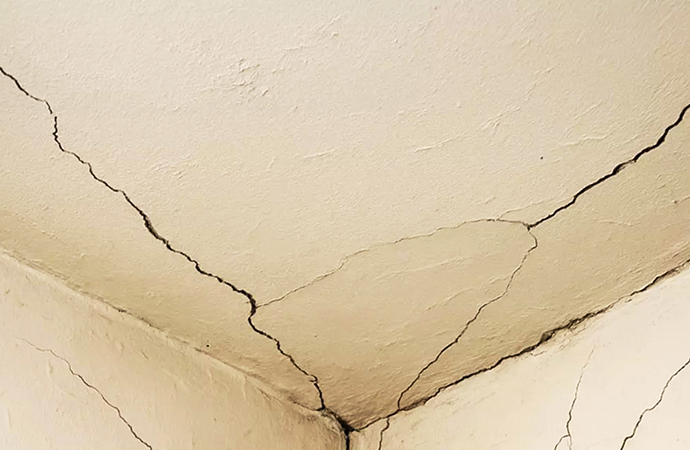
Representational image
Assessing post-earthquake damage in buildings
Dealing with cracks on ceilings or walls after earthquakes is a long-standing issue for common people. Depending on the magnitude of the tremors, damage can range from tiny clefts to extensive spaces across walls and ceilings. Even after the tremors stop, there is a risk of bigger accidents from the cracks that have formed. In most cases, victims are unsure which of those could actually be deadlier. Let's discuss the different types of post-earthquake structural damages and cracks to clear up confusion and take the right action with caution.
Earthquake Cracks That Don't Mean Trouble
Be it in living or workplaces, seismic damage to property and furniture can come in many forms. But not all of these are severe enough to cause bigger accidents. Here are some signs you want to look for.
Hairline Cracks
These are very thin, pen- or spiderweb-like lines that appear on plaster or paint. These surface spots are formed when the plaster on the surface becomes flexible due to shaking. They are not harmful and can be easily repaired.
Moreover, apart from seismic activity, these are also caused by normal house settlement, temperature change, and humidity fluctuations.
Splits in Structural Joints
Weak spots emerge after a long time where the ceiling is directly connected to the wall. In most cases, this situation does not arise due to structural reasons.
Interior Wall Stress Marks
These walls typically don't bear any load, acting as partitions. Unlike pillars, these walls do not support the building.
Cracks After An Earthquake You Should Take Seriously
Seismic consequences are so severe in some cases that they can actually indicate serious structural damage to the building. Let's explore them and determine which ones are worth paying more attention to.
Fractures Over Wider Areas
Surface fractures larger than 3 mm, about the size of a coin edge, are the most severe. These cracks, which appear immediately after the earthquake, can indicate transverse stress on the building.
Diagonal Cracks
These cracks, which form at an angle, often extend from the corner of a window or door to the surrounding area. At first glance, it may seem that the entire frame was bent.
However, besides seismic reasons, these can also be the result of different foundation settlements, like water intrusion.
Stair-like Shear Cracks
Brick houses often come with cracks in the form of a staircase pattern on the walls. These buildings are very vulnerable and move unevenly during seismic shocks.
Cracks That Go Through Walls
These are quite dangerous because they do not appear on the surface or plaster but deep inside the wall. This can be at risk of a full structural collapse.
Stress Lines in Door or Window Frames
If doors or windows are not closed properly as soon as possible after the earthquake, their frames will slide from where they were originally set. No cracks may even be visible in this case.
Post-earthquake Damages That Need Professional Inspections
Some earthquake impacts are so critical that they require professional intervention. Such action is a must when-
- The crack is wider than 3 to 5 mm.
- There is no symptom of the crack closing, but rather it is getting wider little by little every day.
- The wall is swelling outwards.
- Significant fractures are visible between the wall and the ceiling/floor.
- After the earthquake, the floor is no longer as level as it was before.
Final Words
The likelihood of structural collapses or related accidents from cracks after an earthquake depends on the type of cracks. Small, shallow ruptures should not be a cause for concern. Plus, they can distract attention from more urgent damage. The prompt response will be worthy when ruptures that are deep, diagonal, or larger than 3 mm get priority. Furthermore, it is wise to seek professional help for expanding defects on ceilings/walls, deformed floors, and swollen walls after earthquakes.
A Independent Newsweekly
© Copyright 2026 | Designed by ARK Reepon & Developed by Cosmos Group Software Team






Leave a Comment
Recent Posts
Is the international community ...
A spate of downgraded economic projections, from Bretton Woods to Mani ...
A Childhood Lesson in Arithmet ...
As children, we learned a simple mathematical rule: if we know the pri ...
Indian authorities launched a major security crackdo ..
Police dispersed garment workers from the Azampur ro ..
Why Saudi Arabia has struggled to defend itself agai ..
Iran-backed Houthis strike Saudi oil company Aramco’ ..