



Reportage
An amendment antithetical to the spirit


An Independent Newsweekly






Reportage
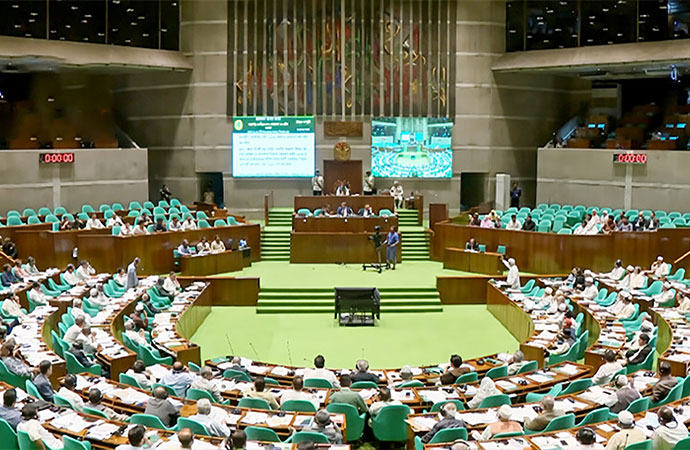
Photo: Collected
As the 13th Parliament sat through marathon sessions to either adopt, repeal, amend or allow to lapse the 133 ordinances that were issued by the President during the tenure of the interim government (August 2024 to February 2026) last week, a last-minute amendment to the 'Bank Resolution Act' by the treasury benches, without taking the opposition into confidence, exploded a firestorm of controversy this week not just in the House, but also far and wide outside it.
Indeed, it wasn't just any old amendment that we saw. Rather, its only possible interpretation would suggest it is in fact antithetical to the spirit of the law itself. Before we get to the amendment, it would probably be instructive to get a grasp of the law itself, what it aims to achieve, and the gaps it claims to have filled.
A bank resolution occurs when authorities determine that a failing bank cannot go through normal insolvency proceedings without harming public interest and causing financial instability.
To manage the bank's failure in an orderly manner, authorities use resolution tools that ensure continuity of the bank's critical functions, maintain financial stability and restore the viability of parts or all of the bank.
The Bank Resolution Act, 2026 (based on the 2025 Ordinance) empowers Bangladesh Bank, as the country's banking regulator, to step in to stabilise, merge, or restructure distressed banks. Indeed, the recent merger of five weak banks-Exim, Social Islami, First Security Islami, Union, and Global Islami-into the newly formed 'Sammilito Islamic Bank', was largely implemented in accordance with the text of what was earlier the ordinance (Bank Resolution Ordinance 2025).
Four of these banks were previously under the influence of the S. Alam Group, whose owners have been fugitives from the law for nearly two years now. The other was controlled by Nazrul Islam Majumdar, owner of the Nassa Group and a very controversial figure himself, who is also a fugitive since August 2024.
The centre of the storm is Section 18(A), a clause reportedly added on the night of April 9, just before the bill was tabled in Parliament. Financial experts describe this move as creating a "staircase for return" for individuals and groups involved in large-scale loan irregularities and mismanagement, said officials of Bangladesh Bank.
Under this newly incorporated section, former shareholders of weak banks that have undergone merger or resolution can apply to reclaim their shares, assets, and liabilities. Former owners can initiate the transfer of control by depositing only 7.5 percent of the total funds previously injected by the government or Bangladesh Bank to save the institution.
The remaining 92.5 percent of the state-provided funds can be repaid over two years at a 10 percent simple interest rate.
"If the government spends Tk 20,000 crore to bail out a bank, the former owners can effectively take it back by paying just Tk 1,500 crore initially," noted a banking analyst.
"For those who have siphoned off thousands of crores, this is a negligible amount. It's like returning a bank for a nominal down payment," said a former governor of Bangladesh Bank, preferring anonymity.
Sources within the Bangladesh Bank revealed that the central bank was largely bypassed regarding this specific amendment. A committee formed on April 1 had initially proposed a streamlined version of the law, reducing it from 98 to 74 sections, but Section 18(A) was not part of the final draft submitted by the technical committee.
"We requested the Finance Ministry to exclude this controversial clause the moment we learned of it," a senior central bank official said on condition of anonymity. "Allowing those who destroyed these banks a path back to ownership undermines the entire purpose of the resolution process."
Central bank officials had recommended that if such a provision were included, it should carry much stricter conditions-such as a permanent ban on owners whose negligence led to the crisis and a requirement for full repayment of all debts and depositor funds before any transfer of ownership. Instead, the law now only requires an "undertaking" or promise to pay.
Critics and analysts warn that the new provision could pave the way for disgraced former owners-those responsible for plunging banks into crisis-to reclaim control of their institutions for a nominal down payment.
Economists and banking sector insiders have warned that at the domestic and international level, it would be a bad signal in banks and financial sector reforms activities, which is expected by the IMF and World Bank.
Aside from the disputed Section 18(A), the rest of the bill maintains the original framework of the ordinance. It empowers Bangladesh Bank to appoint administrators to troubled banks, transfer assets and liabilities to third parties, form temporary bridge banks, establish a dedicated Resolution Fund, and identify and take legal action against individuals responsible for a bank's downfall.
However, analysts believe the inclusion of the "return clause" threatens to overshadow these reformative measures, potentially leaving the backbone of the economy vulnerable to the same forces that necessitated the bailout in the first place.
Reform credentials questioned
The International Monetary Fund (IMF) has emphasised that Bangladesh requires extensive reforms across three critical sectors, including financial, fiscal, and foreign exchange. According to the global lender, significant work remains to be done in each of these areas to ensure economic stability.
Krishna Srinivasan, Director of the IMF's Asia and Pacific Department, made these remarks on Thursday while responding to questions from Bangladeshi journalists at a press conference in Washington, DC. The briefing was attended by media representatives from India, Nepal, Sri Lanka, and South Korea, among other nations.
The briefing took place on the sidelines of the World Bank-IMF Spring Meetings, which commenced on April 13 and are scheduled to conclude on April 18. A 14-member Bangladeshi delegation, led by Finance and Planning Minister Amir Khosru Mahmud Chowdhury and Bangladesh Bank Governor Md. Mostaqur Rahman, is currently attending the meetings.
Reflecting on his visit to Bangladesh on March 24, where he met with Prime Minister Tarique Rahman and the Finance Minister, Srinivasan shared his impressions of the new government's capacity for reform.
"I visited Bangladesh and held meetings with the Prime Minister and other high-level officials. We discussed the challenges ahead," Srinivasan stated. "I noted that a government with a strong majority has the opportunity to undertake ambitious reform agendas. They have listened to our suggestions; now we must wait and see how they respond."
The IMF Director expressed concern over Bangladesh's revenue collection performance. "In terms of revenue mobilization, Bangladesh has not performed well. It remains at a low level and has seen further deterioration over the last three years," he noted.
Regarding the release of the next loan tranche, he mentioned that discussions are ongoing, and updates would be provided in due course.
Highlighting the situation in Sri Lanka, Srinivasan pointed out that under its IMF-supported program, the country has made significant strides in increasing its tax-to-GDP ratio over the last three years, gradually building financial buffers. He noted that Sri Lanka is now in a relatively better position to support citizens affected by energy price shocks.
Srinivasan warned that because Bangladesh has a small revenue base, the government faces greater pressure when trying to provide social safety nets. "The people of Bangladesh are suffering. Therefore, it is crucial that whatever resources Bangladesh possesses are utilized with maximum target-based efficiency," he urged.
He advised Bangladesh to focus on increasing revenue collection while addressing other barriers in the financial sector to boost both short-term and long-term growth. Like other Asian nations, Bangladesh has been impacted by global energy shocks, and Srinivasan concluded that policy support and program discussions are active, with the outcome depending on how effectively these dialogues progress.
A crisis of governance
Bangladesh's banking sector, which should operate as the backbone of the economy, is struggling to regain even its previous footing, which wasn't all that much to write home about itself, due to a profound lack of good governance and deepening financial instability. The indicators are all there.
According to the latest review by Bangladesh Bank, 17 banks failed to generate any net profit in 2024, while 11 banks gave up spending under Corporate Social Responsibility (CSR) altogether in 2025. Experts view these as a clear sign of the dire state of the industry, fueled by skyrocketing non-performing loans (NPLs), weak boards, and political interference.
Masrur Reaz, Chairman of Policy Exchange Bangladesh and former senior economist at the World Bank, told our sister newsagency UNB that the financial health of some banks has revealed the worsening situation of the sector.
He pointed out that these banks will take several years to return to a good financial position. At the same time, strict policy regulations and skilled management are also required for these banks.
Towfiqul Islam Khan, an economist and the Additional Research Director at the Centre for Policy Dialogue (CPD), said that the scenario was a reflection of the economy of Bangladesh. The banking sector is like the blood circulation in the financial sector; while banks are in trouble, the overall economy will not be vibrant, he said.
All is not well
A recent central bank report on CSR activities revealed that 11 banks made no contributions to social welfare in 2025. These institutions include: Janata Bank, Agrani Bank, BASIC Bank, Bangladesh Krishi Bank, Rajshahi Krishi Unnayan Bank, Bangladesh Commerce Bank, National Bank, Global Islami Bank, Padma Bank, Union Bank, and National Bank of Pakistan.
While CSR funds are typically allocated to sectors like education, health, and climate change, the zero expenditure by these banks suggests they are too preoccupied with internal financial and administrative crises to fulfill their social obligations.
In 2025, the total CSR expenditure by the banking sector stood at Tk 345.05 crore, with Tk 98.44 crore going to education and Tk 85.64 crore to health. However, the fact that only a few strong banks carry the bulk of this expenditure highlights a massive disparity in financial health across the sector.
Meanwhile, the central bank's performance report for 2024 identifies 17 banks that failed to earn a net profit. The list comprises several state-owned and struggling private lenders:
Janata Bank, Agrani Bank, BASIC Bank, Bangladesh Krishi Bank, Rajshahi Krishi Unnayan Bank, AB Bank, Bangladesh Commerce Bank, First Security Islami Bank, ICB Islamic Bank, IFIC Bank, National Bank, NRB Commercial Bank, Global Islami Bank, Padma Bank, Social Islami Bank, Union Bank, and National Bank of Pakistan.
Analysts cite high NPLs, unearned interest income, rising operating costs, and irregularities in loan disbursement as the primary drivers of this unprofitability. Many of these banks are now facing such severe capital shortfalls that they struggle to maintain regular business operations.
Interestingly, the report noted that six banks managed to contribute to CSR in 2025 despite recording no profits in 2024, likely by utilizing previous reserves-a move experts warn may challenge long-term stability.
The crisis points toward systemic issues that have plagued the sector for years. The main challenges identified include:
i) A significant portion of total loans is stuck with large borrowers who continue to enjoy new facilities without repayment.
ii) Political and influential interference in boardrooms often overrides commercial logic.
iii) Lack of profits has led to a sharp decline in Capital Adequacy Ratios (CAR).
iv) Also, reliance on manual systems and outdated software increases operational risks.
A drag on the economy
The fragility of the banking sector is casting a long shadow over the national economy. A weak banking system leads to reduced credit flow to industries, hindered investment, and slowed GDP growth. The economists and industry insiders are calling for immediate intervention to stabilize the sector. Key recommendations include:
1. Strict Loan Recovery: Legal action against willful defaulters.
2. Board Accountability: Ensuring transparency and independence in bank management.
3. Digitalisation: Modernising risk management and banking software.
4. Policy Oversight: Strengthening CSR monitoring to ensure it remains a merit-based, profit-driven obligation.
Without swift reformative steps, this deep-seated governance crisis and financial weakness pose a significant risk to the overall economic stability of Bangladesh.
TIB's scathing reaction
Soon after it came to light, Transparency International Bangladesh (TIB) expressed grave concern over the 'Bank Resolution Act, 2026,' bluntly claiming that the new provision will facilitate corruption and allow "identified looters" to regain control of the banking sector.
The anti-graft watchdog stated that the inclusion of Section 18(a) in the Act guarantees impunity instead of ensuring justice for those responsible for the collapse of weak banks.
In a statement, TIB Executive Director Dr. Iftekharuzzaman described the move as "self-defeating," noting that it effectively rewards individuals who plundered the sector.
The TIB chief pointed out that the "Bank Resolution Ordinance, 2025"-issued during the interim government-had barred individuals responsible for a bank's collapse from returning to ownership even if funds were repaid. However, the new 2026 Act reverses this stance.
"Whatever justification the government may offer, this decision facilitates and shields corruption. It does not ensure legal accountability; instead, it signals a shift in policy capture, leaving room for the re-emergence of kleptocratic practices," Dr. Zaman said.
TIB questioned the logic behind allowing former owners to re-acquire shares by depositing only 7.5 percent of a government-determined amount, with the remaining 92.5 percent payable over two years at a 10 percent interest rate.
"By what magic have the former owners, who pioneered the plundering of this sector, suddenly attained such purity?" Dr. Zaman asked, questioning how these individuals would suddenly be capable of covering capital shortfalls and repaying all depositors.
The organization expressed skepticism over the central bank's ability to monitor these conditions, fearing that Bangladesh Bank remains "plagued by conflicts of interest."
The statement further noted that passing such a law by majority vote in Parliament contradicts the ruling party's electoral manifesto regarding financial sector reforms.
TIB warned that without a proper legal process to ensure accountability, no qualitative improvement will occur in the banking sector. The organization urged the government to reconsider the provisions to prevent the burden of deeper insolvency from falling on the general public.
Additional reporting by Anisul Islam
A Independent Newsweekly
© Copyright 2026 | Designed by ARK Reepon & Developed by Cosmos Group Software Team





Leave a Comment
Recent Posts
Is the international community ...
A spate of downgraded economic projections, from Bretton Woods to Mani ...
A Childhood Lesson in Arithmet ...
As children, we learned a simple mathematical rule: if we know the pri ...
Indian authorities launched a major security crackdo ..
Police dispersed garment workers from the Azampur ro ..
Why Saudi Arabia has struggled to defend itself agai ..
Iran-backed Houthis strike Saudi oil company Aramco’ ..