



Reportage
A Life of Power, Duty and Defiance


An Independent Newsweekly
Reportage
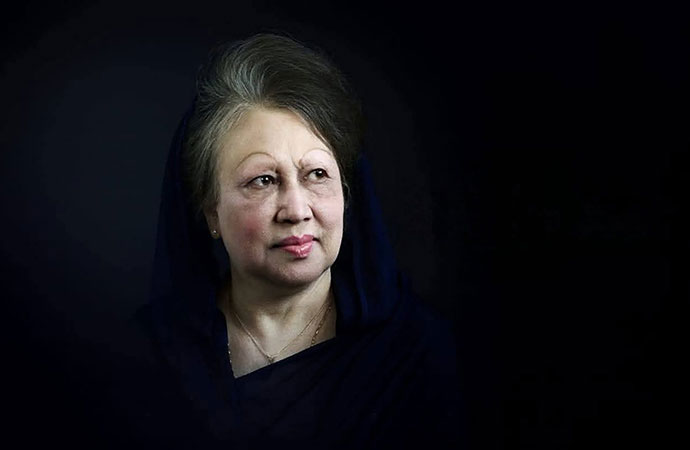
Begum Khaleda Zia
She held on, just long enough to pass the baton. Or perhaps just to feel the loving embrace of a son coming home one last time. Either way, history will show that five days after Tarique Rahman returned home from the UK after 17 years in exile, his mother Begum Khaleda Zia, thrice-former prime minister of Bangladesh, the chairperson of the BNP, the widow of a heroic former president and the uncompromising, unbowed matriarch of the country's democracy, passed away on the morning of December 30, 2025.
Her long and turbulent political journey came to a solemn end just after the Fajr prayer, around 6am, last Tuesday at Evercare Hospital, where she had been receiving treatment for 37 days.
"The BNP Chairperson breathed her last at 6:00am," AKM Wahiduzzaman, the party's ICT Affairs Secretary, said shortly afterwards. Her death was later confirmed by the medical board and senior party leaders.
"It is with a heavy heart that we announce the passing of our esteemed Chairperson," said BNP Secretary General Mirza Fakhrul, his voice choked with emotion.
She is survived by her eldest son Tarique Rahman, three granddaughters, and millions of supporters and admirers. Her long political career has left a lasting mark on Bangladesh's political landscape and inspired generations.
Widow of slain President and BNP founder Ziaur Rahman, who of course was also a heroic freedom fighter, Khaleda Zia had long been woven into the fabric of Bangladesh's political drama - its rises, ruptures, hopes, and hostilities. Her final days were marked by an unrelenting battle against pneumonia, chronic lung infections and persistent cardiac complications.
News of her death spread quickly through the city in the early hours, cutting through the cold winter morning and heavy fog. People across the country were stunned. Silence fell, while scenes of grief unfolded inside and outside the hospital.
A deep sense of grief swept across Bangladesh with condolence messages pouring in from leaders at home and abroad.
The BNP announced seven days of mourning over the death of its long-time leader. The government declared three days of national mourning, including a general holiday on Wednesday, the day of her janaza, which was supposed to be held at the South Plaza of the National Parliament and Manik Mia Avenue in the capital. In the end, it took an entire swathe of Dhaka defined by Shyamoli to Kawran Bazar on one diagonal and Kalabagan to Mohakhali on another.
She was later buried with full state honours at Chandrima Udyan beside the grave of Ziaur Rahman.
Power and Resistance
Khaleda Zia led the BNP for 41 years and earned the title of the 'uncompromising leader' during the pro-democracy movement of the 1980s. She served as a Member of Parliament five times -- Prime Minister three times and Leader of the Opposition twice.
Starting her political journey as a homemaker, Khaleda spent much of her over four-decade political life on the streets, leading movements and facing arrests and imprisonment, but refusing to be beaten. She was the true icon of the pro-democracy movement of the 1980s, remaining uncompromising throughout, and that is why the people rewarded her and her party in 1991 - although nobody saw it coming, and it is still talked about as a huge shock.
Her status as a symbol of uncompromising defiance against authoritarianism became sealed during her years in opposition to the last Awami League regime. One of the most notable aspects of last year's Uprising that overthrew the AL government was that it allowed Khaleda Zia to be restored to her rightful place in the nation's story.
She was even slated to run in three seats initially by the BNP in the upcoming election. Later as her health deteriorated, they reduced it to one. Now they will need to find a replacement for her in that seat as well. She finished with a perfect 23-0 electoral record - never having lost an election she contested.
The BNP chief had been suffering from multiple chronic illnesses, including liver and kidney complications, heart disease, high blood pressure, diabetes, arthritis and infections.
She was admitted to Evercare Hospital on November 23. As her condition worsened, her elder son, BNP Acting Chairman Tarique Rahman, and other family members rushed to the hospital late Monday night.
Shortly after 2am, Begum Zia's personal physician, AZM Zahid Hossain, told reporters that she was passing through an 'extremely critical time' and requested the nation to pray for her recovery. A few hours later, doctors declared her dead.
Family members, including Tarique Rahman, his wife Zubaida Rahman, their daughter Zaima Rahman, the family of her late son Arafat Rahman Koko, her siblings, and BNP Secretary General Mirza Fakhrul Islam Alamgir, were present at the hospital at the time.
Doctors, nurses and hospital staff were seen in tears as the news broke. The news spread rapidly on social media, with people from all walks of life expressing grief. BNP leaders, activists and supporters gathered outside the hospital in large numbers.
At around 9am, the head of the medical board Prof Shahabuddin Talukder said with a choked voice that the medical team tried their best for more than a month, but Khaleda Zia was declared clinically dead at 6am.
Fakhrul Islam Alamgir said the loss was 'irreparable' and something the nation would never be able to overcome.
Leading the Tributes
Fakhrul said Chief Adviser Muhammad Yunus had called him to express condolences. BNP Senior Joint Secretary General Ruhul Kabir Rizvi announced a seven-day mourning programme following the death of Khaleda.
As part of the programme, black flags have been hoisted at all party offices across the country for a week starting Tuesday, while party leaders and activists have been sporting black badges and Quran khatam and prayers will be held nationwide during the period.
Condolence books were opened at BNP's central office, Chairperson's Gulshan office and other party offices across the country.
An emergency meeting of the Advisory Council was held on Tuesday afternoon, where Mirza Fakhrul attended as a special guest. The meeting began with a minute's silence, and decisions were taken regarding state mourning and funeral arrangements.
Law Adviser Asif Nazrul said Khaleda Zia's contribution to the country would remain unforgettable.
The BNP Standing Committee also held an emergency meeting chaired by Tarique Rahman. BNP offices at Naya Paltan, Gulshan and elsewhere witnessed emotional scenes as leaders and supporters broke down in tears.
Cutting a picture of grief but remaining resolute throughout, Tarique Rahman paid an emotional tribute to Khaleda, remembering her as a tender and loving mother who was also a steadfast guardian for her family and the nation.
"My mother, BNP Chairperson Begum Khaleda Zia, has responded to the call of Almighty Allah and left us today. Inna lillahi wa inna ilayhi raji'un (Indeed, we belong to Allah, and to Him we shall return)," he wrote in an emotional post on his verified Facebook page.
To many, he said, she was the leader of the nation, an uncompromising leader, the 'Mother of Democracy', the 'Mother of Bangladesh'.
"To me, Khaleda Zia was a tender and loving mother who devoted her entire life to the country and its people. Throughout her life, she stood firm against autocracy, fascism, and hegemony, leading the struggle for freedom, sovereignty, and the restoration of democracy," he said.
Though her life was illuminated by sacrifice and struggle, Tarique said at home Khaleda was their truest guardian, a mother whose infinite love gave them strength in their darkest moments.
He said Khaleda endured repeated arrests, denial of medical care, and relentless persecution. "Yet even in pain, confinement, and uncertainty, she never stopped sheltering her family with courage and compassion. Her resilience was not loud, but it was unbreakable."
For the country, Tarique said she lost her husband and lost her child. "In that loss, this nation and its people became her family, her purpose, her very soul. She leaves behind an unforgettable legacy of patriotism, sacrifice, and resistance, a legacy that will live on in the democratic conscience of Bangladesh."
Life and Legacy
Khaleda Zia leaves behind a legacy as a steadfast leader, a symbol of resilience and patriotism, and one of the most influential states persons in Bangladesh's history. Her life was a testament to resilience, determination and leadership, marked by an unwavering commitment to democracy and deep patriotism.
Starting as a homemaker, she entered politics seven months after the assassination of her husband, late President and BNP founder Ziaur Rahman and rose to become Bangladesh's first female Prime Minister in less than a decade.
To keep the party united amid internal divisions and political uncertainty following Ziaur Rahman's death and the military takeover by General Hussain Muhammad Ershad, senior BNP leaders persuaded Khaleda Zia to join politics in January 1982.
According to the BNP website, Khaleda Zia became a primary member of the party on January 3, 1982. She was made Senior Vice Chairperson in March 1983 and was appointed Acting Chairperson on January 12, 1984.
On May 10, the same year, she was elected BNP Chairperson unopposed. She completed 41 years in that position in May 2025, shaping not only her own remarkable political journey but also the course of the nation's politics.
Under her leadership, BNP came to power thrice, although one of those lasted mere weeks, and played a central role in Bangladesh's political history. She became Prime Minister by leading her party to victory in the fifth, sixth, and eighth parliamentary elections in 1991, 1996, and 2001
Over a political career spanning nearly 43 years, she faced personal tragedies, imprisonment and political turbulence, yet remained an unbowed leader and a unifying symbol of democracy in Bangladesh. She spent her last days as the country's elder statesman, always insisting on the people remaining united and shunning the path of revenge. By the end, she was the tallest among all the leaders of Bangladesh.
Analysts describe her as a charismatic and uncompromising leader. She led a long struggle against military rule under HM Ershad, forming a seven-party alliance that played a key role in his fall.
Her political journey was not without hardships. She endured imprisonment, family tragedies-including the deaths of her husband and younger son, Arafat Rahman Koko-and repeated political harassment.
Khaleda Zia's leadership faced its most difficult period during the Awami League regime, when she was convicted in two cases and jailed, although most people agreed in private that the charges against her were trumped up, to say the least. She remained in prison for more than two years before being released in March 2020 through an executive order during the Covid-19 pandemic, following a deal struck with the family that she would be kept out of politics. The suspension was later extended periodically.
Even when the army-backed government in 2007 offered her opportunities to go into exile abroad, she firmly refused, saying that Bangladesh was her only home and the place where she wished to live until her death. Through this stance, she emerged as a symbol of resilience, integrity and loyalty to the nation.
Khaleda Zia was also known for her pragmatic approach. She supported dialogue and compromise when necessary, including the introduction of a neutral caretaker government system into the constitution, even when initially opposed within her party.
She skillfully led BNP through multiple alliances, protests and elections, balancing strategic decisions with her principles. By all accounts, her style of leadership was delegatory and non-intrusive - pick the best person for the job and give him or her the space to implement their vision. That is how she managed to hold on to a brilliant core group that her husband had put together at the BNP's birth.
Despite criticism from some quarters that she rose to power through political inheritance, observers note that she established her leadership in a male-dominated political landscape through determination and political skill.
Late political analyst and author Mahfuz Ullah wrote a book on her life, in which he noted that Khaleda Zia carved out her own political space through merit and leadership at a time when few women led major political parties.
Among other things, under her leadership, the BNP was accused of hobnobbing with the Jamaat e Islami, the theological party that had opposed independence in 1971. The BNP formed an alliance with them that lasted close to two decades, and took them into government in 2001, although they can always point to the fact that the people voted them in.
That term from 2001-6 also saw the advent of jihadist militancy in the country, which was at the core of the BNP losing favour for a number of years afterwards, paving the way for the subsequently authoritarian regime of AL.
Aposh-heen Netri to Unifying Figure
Born on August 15, 1946 as Khaleda Khanam and nicknamed 'Putul' by her family, she married Ziaur Rahman in 1960 and became a widow at 36, raising her two sons, Tarique Rahman and Arafat Rahman, while gradually emerging as a decisive political leader.
Throughout her leadership of BNP, Khaleda Zia earned respect not only from her followers but also across political parties. Analysts describe her as a unifying figure, a champion of democracy, and a symbol of perseverance who transformed Bangladesh's political landscape, paving the way for women to lead at the highest level.
Her status as the country's tallest leader at the time of her death became sealed by the unprecedented turnout at her janaza. Till now, the most historic janaza held in Bangladesh that people still talk about today, had been that of President Zia in 1981. Few would have thought that one day, his wife's would surpass it.
People from across the country thronged Manik Mia Avenue, Khamar Bari, Bijoy Sarani, Asad Gate, Karwan Bazar and surrounding areas. They stood on rooftops, staircases, on the expressway, beneath flyovers, and even inside Metro stations, finding any patch of ground they could.
Around 11:50 am, a freezer-van draped in the red-and-green national flag, carrying Khaleda Zia's body, arrived at the avenue from the Gulshan Avenue residence of her elder son, Tarique Rahman.
A multi-layered security arrangement was in place around Manik Mia Avenue to maintain law and order as mourners gathered in untold numbers, despite the biting winter weather. Members of the army, police, RAB, BGB, and other law enforcement agencies remained deployed throughout the event.
Witnesses said many cried, calling Khaleda Zia their "mother" as they arrived at the venue. Some traveled overnight from rural areas to join the prayers. In neighbourhoods miles away from the main venue, crowds spilled onto the streets as a sea of people raised their hands and prayed.
Dignitaries from India, Pakistan, Sri Lanka and Nepal also arrived in Dhaka. Foreign envoys and representatives from 32 countries attended the funeral ceremony. India's External Affairs Minister S. Jaishankar after his arrival met Zia's elder son Tarique Rahman and handed over a personal letter from Indian Prime Minister Narendra Modi. Pakistan's National Assembly Speaker Sardar Ayaz Sadiq, Nepal's Foreign Minister Bala Nanda Sharma and Bhutan's Minister for Foreign Affairs and External Trade Lyonpo D. N. Dhungyel also arrived in Dhaka to show their respect.
Jaishankar's attendance was seen as particularly significant, signaling a willingness and opportunity for rapprochement between the BNP and Delhi, which has been accused of being too invested in the Awami League as far as its policy towards Bangladesh is concerned.
Overall, the number of people who attended would have been impossible to count, though estimates ranged from 30 lakh to a crore. Suffice it to say, it was the largest funeral in the country's history, and one of history's largest, worldwide. And not a single person in attendance would have said she didn't deserve it.
A Independent Newsweekly
© Copyright 2026 | Designed by ARK Reepon & Developed by Cosmos Group Software Team






Leave a Comment
Recent Posts
Dhaka, Tokyo relationship to c ...
Deputy Chief of Mission of the Embassy of Japan in Bangladesh Yoshida ...
Democracy puts a premium on et ...
And just like that, the deed was done. With a volley of 'Ayes!’( ...
Dhaka still eyeing ‘conducive’ setting for PM’s Delh ..
Gallery Cosmos Artist Residency, 2026
Summit seeks reinstatement of FSRU deal
Hatful of medals for Bangladeshi whiz kids at WMI 20 ..