



Reportage
A Grand Celebration of Diversity


An Independent Newsweekly



Reportage
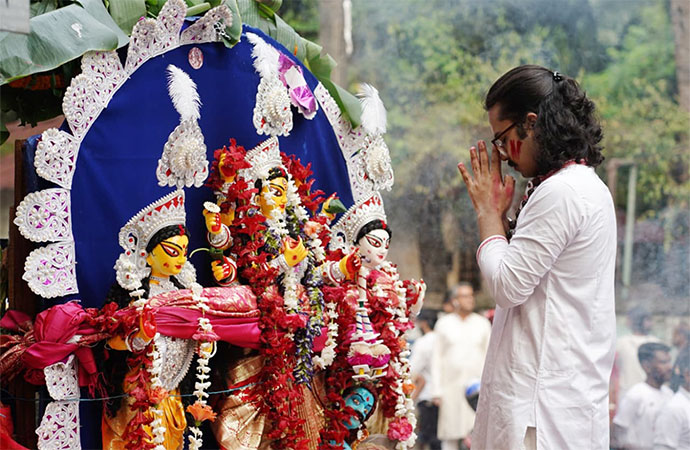
Photo: Rakib/ UNB
Many people and observers called the 2026 Durga Puja one of the best and most remarkable celebrations in recent years due to a notable absence of major disorder, vandalism, and smooth, peaceful conduct across the country. The peaceful celebrations have drawn praise, with people highlighting the smooth conduct of the festival across the country.
Durga Puja's roots in Bengal reach back to the 16th century. Kansa Narayan, the feudal king of Tahirpur in Rajshahi, spent nearly eight to nine lakh rupees - a staggering sum for the time - beginning the tradition of Durga Puja in Bengal, though at first, it remained a festival only for the wealthy.
For ordinary people, puja brought rare moments of joy in otherwise monotonous rural lives. Beyond worship, it was a carnival: feasts, jatras (folk plays), kirtans (a genre of religious performance arts, connoting a musical form of narration), kavigan (poet songs), and even elephant processions.
The excitement was so overwhelming that newspapers would shut down. In 1902, Dhaka's influential Bengali paper 'Dhaka Prakash' announced: "Dhaka Prakash will be closed for four weeks on the occasion of Sharadiya Puja. We extend our greetings to our patrons and wish that Mother Sarvamangala blesses all with good fortune."
Yet, despite its growth, Durga Puja wasn't always Dhaka's biggest festival. Civil Surgeon James Taylor, writing in around 1839, listed Muharram, Bera, and Vaishnava celebrations as the city's main festivals, with no mention of Durga Puja. Economist Bhabatosh Datta later recalled in his memoir 'Aat Dasak' that Jhulan and Janmashtami, not Durga Puja, were the most anticipated events in Dhaka. Still, the puja existed in certain places - such as the grand mansions of Sutrapur, or at the Ramakrishna Mission in Tikatuli.
After the Partition in 1947, many wealthy Hindu families migrated from East Bengal, and with the end of the zamindari system, the private grandeur of Durga Puja declined. It transformed into a community celebration, funded by public donations.
A new vote bank?
In the first Durga Puja since he took over the reins of Bangladesh in February this year, Prime Minister Tarique Rahman appears to have pleased the country's Hindu community and earned praise even from detractors.
He himself joined the celebrations as well on Maha Nabami, which fell on October 20, returning to Dhaka after midnight after a whirlwind day visiting Durga Puja mandaps in Rangpur, Rajshahi and Chattogram and exchanging greetings with members of the Hindu community as part of his daylong tour marking Sharadiya Durga Puja.
He arrived at Hazrat Shahjalal International Airport here by a military aircraft at 1:10am (Wednesday) after completing his visits to the three divisional cities. The Prime Minister left Dhaka at 9am on Tuesday (20 October) and first visited the historic Radha Gobinda Dharmasabha Temple in Rangpur, where he exchanged greetings with devotees.
He later visited the Dharmasabha Temple in Rajshahi, where he handed over a cheque for Tk10 lakh to the temple authorities and held an interaction with members of the Hindu community.
In Rajshahi, community members requested him to consider establishing a fund for celebrating puja and setting up temples. They also expressed satisfaction with the government's increased grants and support for this year's Durga Puja celebrations.
Later in the evening, Tarique Rahman visited the JM Sen Hall Puja mandap in Rahmatganj, Chattogram, where he exchanged greetings with members of the Hindu community and joined a view exchange meeting.
During the visit, devotees welcomed the Prime Minister with greetings and cultural programmes, while party leaders, activists and supporters lined roadsides in different areas to greet him.
The Prime Minister was accompanied on his return to Dhaka by BNP Acting Secretary General Ruhul Kabir Rizvi, Home Minister Salahuddin Ahmed, Cultural Affairs Minister Nitai Roy Chowdhury, BNP Standing Committee Member Gayeshwar Chandra Roy, Chittagong Hill Tracts Affairs State Minister Mir Mohammed Helal Uddin, Prime Minister's Special Assistant Bijon Kanti Sarkar, lawmaker Nipun Roy Chowdhury and BNP Joint Organising Secretary Jayanta Kumar Kundu, among others.
According to the Bangladesh Puja Celebration Council, Durga Puja was celebrated this year at 33,851 venues or mandaps nationwide, up from 33,355 in 2025 and 31,461 in 2024. The number of venues where Durga Puja was celebrated in the capital Dhaka was 258. The government deserves thanks for administering such a peaceful celebration of Durga Puja, said to be the most peaceful in recent history. All this shows that if the government wants, there can be no disruption in, vandalism of or attacks on Durga Puja celebrations. The same should be true of the festivals of other religious minorities. The government is reported to have deployed more than 210,000 law enforcement personnel alongside setting up base camps of the Border Guard Bangladesh and conducting police oversight across all regions.
To prevent untoward incidents during the festival, members of various law enforcement agencies were deployed at Puja pandals across Bangladesh. The Dhaka Tribune reported that 212,118 members of the auxiliary paramilitary force, the Bangladesh Ansar and Village Defence Party, were deployed for security.
Eight members were assigned to each high-risk mandap and six to each of the other mandaps. Another 104 striking teams remained on standby to respond quickly in case of trouble. The Border Guard Bangladesh also set up 18 base camps and strengthened patrols to secure around 1,800 Puja mandaps located within eight kilometres of the country's borders.
The Tarique Rahman government declared a three-day holiday for Durga Puja, from October 20-22. With October 23-24 falling on Friday and Saturday, the regular weekly holidays, the break effectively extended to five days. Such a long break over puja was previously unheard of in Bangladesh.
BNP Acting Secretary General Ruhul Kabir Rizvi on Thursday said this year's Durga Puja was celebrated across the country in a peaceful and festive atmosphere due to the government's vigilance, sincerity and dedication.
"Durga Puja was celebrated in a peaceful and festive atmosphere across the country this year. The Hindu community was able to celebrate the festival peacefully because of the government's vigilance, sincerity and dedication," he said.
Rizvi made the remarks while speaking to reporters after distributing leaflets as part of Dhaka South City Corporation's dengue prevention awareness campaign in Shantinagar in the capital.
He said many people from a neighbouring country had also come to Bangladesh to participate in Puja celebrations and praised the safe and peaceful environment.
Rizvi said the BNP had contacted every Puja mandap and held discussions with the relevant committees. Party leaders and activists had worked day and night to ensure security, he added.
Rizvi alleged that the Awami League and an underground political party were involved in propaganda surrounding this year's Durga Puja. He said similarities could be seen in their conduct and statements in various incidents.
The BNP leader said a people-friendly and responsible government could overcome any conspiracy and work for public welfare. The peaceful and festive celebration of Durga Puja this year was an example of that, he added.
Praise across the board
The peaceful Durga Puja celebrations this year have also drawn praise from writers, activists and cultural figures, who credited the BNP government and law enforcement agencies with ensuring the Hindu community could observe its biggest religious festival without major disruption.
Writer and activist Sadikur Rahman Khan, filmmaker Mostofa Sarwar Farooki and writer Faham Abdus Salam welcomed the celebrations, describing them as a significant departure from the atmosphere of fear and uncertainty they said had surrounded the festival in previous years.
In a Facebook post, Sadikur said nearly 4,000 Hindus had responded to a question posed by Indian media outlet Prothom Kolkata about the first Durga Puja under Bangladesh's new government.
According to Sadikur, many respondents said they had not witnessed such a beautiful celebration since independence.
"The most peaceful Durga Puja in a Bangladesh without the Awami League has demonstrated who the real enemies of Hindus were," he wrote.
Sadikur accused the former ruling party of exploiting communal tensions to portray itself as the Hindu community's only protector.
He acknowledged that religious hatred had not disappeared, particularly online.
"Derogatory comments about Goddess Durga continue to appear online. Nor can we say that online hatred surrounding Puja has disappeared," he wrote.
"But the fact that nobody dared to take that online hatred into the streets is a credit to the government."
Sadikur said the peaceful celebrations represented a collective achievement extending beyond religious identities.
"This joy belongs to Muslims. It belongs to Hindus. It belongs to Christians and Buddhists alike," he wrote.
Farooki also praised the authorities for maintaining security throughout the festival.
"Bangladesh has just celebrated a wonderfully joyous Durga Puja!" he wrote on Facebook.
He thanked law enforcement agencies, the Home Ministry and government officials at every level for ensuring a safe celebration.
"May every year be like this," he wrote, invoking what he described as the central spirit of the July mass uprising: "A Bangladesh that includes everyone and belongs to everyone."
Farooki also criticised those he believed were politically uncomfortable with the peaceful celebrations.
"Those who gain politically when our Hindu brothers and sisters suffer are bound to be unhappy," he wrote.
Meanwhile, Faham congratulated the BNP government for overseeing the celebrations.
"Congratulations and thanks to the BNP government!" he wrote.
He said Durga Puja during the Awami League's rule had often been accompanied by fears of communal disturbances.
"Ordinary Muslims in Bangladesh have never been so communal that they would prevent Hindus from celebrating Puja," Faham wrote.
He accused the Awami League of exploiting such fears for political advantage.
Addressing the Hindu community, Faham argued that religious minorities should not regard any single political party as their exclusive protector.
"I hope you will realise that the Awami League did not protect your interests. It used you," he wrote.
He expressed hope that Bangladesh was entering a period of greater religious tolerance, while acknowledging that the country had not yet overcome its communal divisions.
A Independent Newsweekly
© Copyright 2026 | Designed by ARK Reepon & Developed by Cosmos Group Software Team








Leave a Comment
Recent Posts
A commendable intervention by ...
A struggle for local dominance in the Chittagong Hill Tracts, specific ...
How close is the Amazon to a ‘ ...
While Brazil’s presidential candidates have not made policy of t ...
Another shipment of highly radioactive uranium fuel
Harmony: Diplomatic community joins Durga Puja celeb ..
What to know about the Ebola outbreak that has sprea ..
Brazil election: Trump’s ‘Donroe Doctrine’ faces its ..