



Politics
Israel’s Buffer-Zone Fallacy


An Independent Newsweekly







Politics
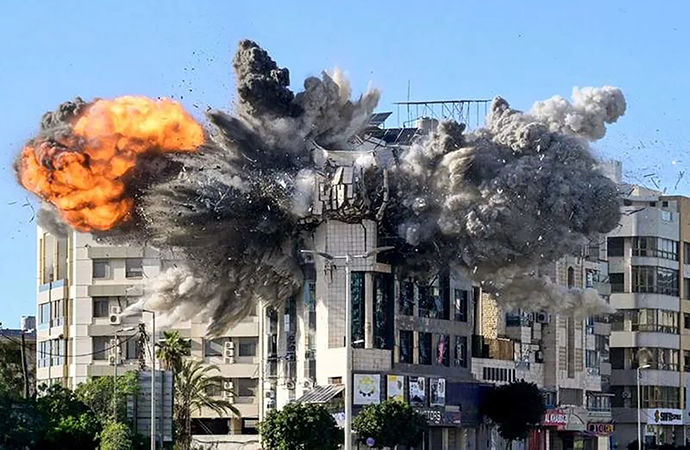
Smoke and fire come out of a building that was targeted by an Israeli air strike on the edge of Beirut southern suburb and close to the Iranian embassy. Photo: Collected
In an era when ballistic missiles, drones, and other projectiles can travel long distances to hit targets with growing accuracy, the idea of a protective buffer zone is not only faulty; it is complete nonsense. Yet this is precisely the rationale that Israel has offered for its occupation of southern Lebanon.
Territorial buffers rarely, if ever, deliver the peace and security their advocates promise. After the collapse of the Soviet Union, Ukraine was seen as a neutral cordon between Russia and NATO. Instead, it became a zone of increasingly fierce geopolitical contention, followed by open war.
French Prime Minister Georges Clemenceau made the same mistake when he assumed that the newly independent states of Central and Eastern Europe would serve as a buffer against encroachment by Bolshevik Russia. Instead, they were Hitler's early targets and ended up as part of the Warsaw Pact following his defeat.
In an era when ballistic missiles, drones, and other projectiles can hit distant strategic targets with growing accuracy, the idea of a protective buffer zone is not just faulty; it is nonsense.
Yet Israeli Defense Minister Israel Katz insists that the Israel Defense Forces must occupy a large part of south Lebanon to protect "displaced residents" living in northern Israel. He recently boasted that Israeli troops had destroyed five bridges on the Litani River, about 30 kilometers (19 miles) from the Lebanon-Israel border, thus creating a buffer zone that will be maintained "until northern Israel [is] safe." But this occupation, an obvious violation of international law, is unlikely to achieve its stated goals. If anything, it will leave Israelis, especially Israeli soldiers, more vulnerable.
After the horrors of World War II, the international community agreed that no country is permitted to take land from others by force. The "inadmissibility of the acquisition of territory by war" features prominently in the preamble of United Nations Security Council Resolution 242, which called for the "withdrawal of Israel armed forces from territories occupied in [June 1967]." Yet, in Gaza and southern Lebanon, the entire world is watching Israel deliberately acquire large swaths of land by force.
In Gaza, one of the most densely populated areas in the world, the Israeli army is reportedly occupying more than 50% of the land. In Lebanon, Israel is pursuing an indefinite occupation of roughly 850-1,060 square kilometers-nearly 10% of the country's total territory. And in the West Bank, Israel has long insisted that it must keep the Jordan Valley west of the river as a buffer zone in any peace deal.
But with Iranian missiles and drones reaching Tel Aviv, Beit Shemesh, Haifa, and Dimona-and with Ukrainian drones reaching far into Russia-the justification for such demands has collapsed. Moreover, by pushing to occupy even more land, Israel risks turning local civilians into frontline targets. Some critics even warn of a dynamic in which civilians will effectively serve as human shields, which would then provide a political/media bonanza for Israel's Hasbarists (propagandists). At the same time, by occupying southern Lebanon, Israeli soldiers themselves will be closer to Hezbollah fighters, and thus in greater danger.
As the political scientist Dominic Tierney has shown, military power alone rarely wins wars, because modern conflicts are political, social, and ideological struggles, not merely tactical battles. "While a dominant military can win battles, secure terrain, and destroy conventional forces," he explains, "it often fails to create lasting peace or achieve political objectives-known as 'winning the war'-because it cannot fix underlying issues such as lack of legitimacy, insurgency, or deep-rooted political instability."
Far from acknowledging these limitations, Israel has already declared that it will prohibit the return of Lebanese citizens who fled before its latest ground invasion began. Such a policy is hardly new. Since 1948, Israel has denied the right of return to roughly 750,000 Palestinians and their descendants, despite numerous UN resolutions urging it to provide this option.
Rather than taking more land where opponents will always exist, the wiser strategy is to pursue a political settlement. Solutions already exist for both Gaza and Lebanon, but Israeli politicians, especially Prime Minister Benjamin Netanyahu and his government, appear more interested in preserving the status quo than in making real progress.
As the ancient Chinese strategist Sun Tzu pointed out long ago, harming an enemy or simply taking land does not necessarily constitute a victory. On the contrary, a displaced enemy may return with even greater resolve, or the cost of holding the new ground may prove unsustainable. In a competitive, hostile environment, a retreating enemy can regroup, adapt his tactics, acquire new technologies, and eventually strike back. The fight never truly ends.
But no ancient wisdom is needed to understand that countries should aim to resolve underlying tensions rather than trying to create buffers. Holding territory does not erase the other side. Hezbollah's opponents within Lebanon and Palestinian leaders who oppose Hamas have offered to cooperate with Israel, but Israel has adamantly refused. Its current leaders seem to believe that perpetual conflict and occupation better serve their interests than the unpopular political concessions peace would require.
But peace is the only sustainable option. Security in Gaza and Lebanon cannot be achieved through buffer zones, but only through a political settlement that addresses humanitarian needs and the root causes of the conflict. That requires respect for international law, accountability for actions that affect civilians on all sides, and a genuine readiness to negotiate. The alternative is endless cycles of violence.
From Project Syndicate
A Independent Newsweekly
© Copyright 2026 | Designed by ARK Reepon & Developed by Cosmos Group Software Team






Leave a Comment
Recent Posts
Is the international community ...
A spate of downgraded economic projections, from Bretton Woods to Mani ...
A Childhood Lesson in Arithmet ...
As children, we learned a simple mathematical rule: if we know the pri ...
Indian authorities launched a major security crackdo ..
Police dispersed garment workers from the Azampur ro ..
Why Saudi Arabia has struggled to defend itself agai ..
Iran-backed Houthis strike Saudi oil company Aramco’ ..