



Featured 2
Travelogue: Pappu to Portugal


An Independent Newsweekly

Featured 2
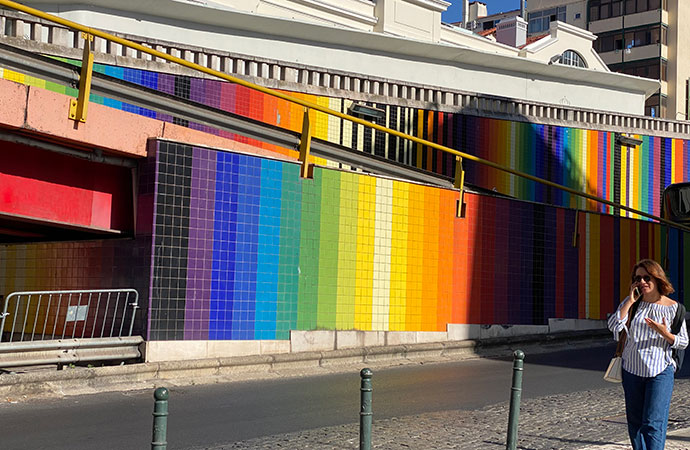
I am not a tourist, but I travel. I travel for work, which gives me the opportunity to jab around and see different landscapes. I am not a great fan of typical "scenery." The Taj Mahal doesn't impress me, but the roads leading to the Taj Mahal give me lessons on how to walk past the past.
In my childhood, I saw many of our neighbours leaving Dhaka for Karachi. A hired bus took them to the airport, and they just disappeared from my memory, never to return. In that way, I lost many childhood friends whose names I don't even remember. The very first time I ever reached the Dhaka airport was when I was in class 3 or 4; our school had arranged a welcome ceremony for a political leader, so we went to cheer him on. All I actually remember from that day are the air traffic control tower and the arched glass windows.
Traveling was never a priority for me because I was too busy prioritizing my own space of living-a home. Later, I started working with expats, mainly researchers from different parts of the world. I would listen to their travel stories and silently admire their Nike shoes and multi-pocket travel trousers.
In the 2000s, often opportunities to travel came my way, but I didn't pick any of them. I just wanted to earn, save, and build my home. I did it, too, with hard work to my profession. Gradually, though, I started feeling a lack of international exposure. I began navigating opportunities-work-related travel only, of course. Slowly, things started happening, and I began receiving invitations to workshops and conferences. I picked, I nudged, and finally, I started traveling.
Recently, I went to Portugal to participate in an international congress of Midwives organized by the International Confederation of Midwives (ICM). Thanks to the university where I work, they sponsored my trip. It took a while to actually make this trip happen-I had started the application for funding and all that jazz a year ago. Also it cost me a lot. But finally worth it.
The trip started with some surprising little hiccups. My credit card flat-out denied the payment for my Airbnb just a day before my flight to Lisbon. I communicated with the property owner, managed to soothe his nerves, and promised to pay him in cash once I reached the flat. The flight itself was good, except for a terrible 8-hour layover at the airport. Finally, I reached the Airbnb and settled down.
The Travel Card
Just a minute after my arrival at the Airbnb, the owner handed me the keys to the flat and asked for the cash. I made the payment. He promptly disappeared, and I started organizing my clothes on the rack.
Soon after, I went to the nearby metro station to buy my city travel card. It was a 40-minute walk from the Airbnb, and my sole companion was Google Maps. I went to the vending machine and tried to pay with that same horrible credit card. Naturally, it didn't work. I tried a few more times, gave up, and withdrew some cash from an ATM instead-which turned out to be a painfully costly transaction!
The Key and the "Feresta" (Angel)
Locks and keys are like the human brain-every single lock and key has a different nerve.
When I came back to the flat, I wanted to get in immediately. I was exhausted from a 32-hour journey and desperate for a shower and a bed. But to my bad luck, the lock wouldn't open. I tried all my Khul Ja Sim Sim (Open Sesame) tricks, but nothing worked. I was incredibly disappointed and frustrated. Such a silly thing to get stuck on, isn't it?
I called the owner. He replied rather brutally: "I can't come and help you, I am working and I have this and that." Suddenly, I thought, Is this a scam? Have I fallen into the wrong hands?
I took a deep breath and tried again and again. Then the owner sent me a message telling me to ask for help from the neighbours' downstairs or upstairs. I went and rang their bells, but nobody answered. Finally, I asked for help from a restaurant worker just opposite the building. He came over and successfully managed to open the gate. He was a Feresta (angel) to me. (In this journey, I encountered one more Feresta, whom I will tell you about in a moment).
Other than that, everything went smoothly. The congress concluded, and we said goodbye to everyone. Everyone seemed very busy and sporty, running here and there. I met many of my colleagues, participated in workshops and presentations, and attended a few networking events. The congress dinner ended beautifully with dancing and promises to stay in touch.
I got some mixed reactions from the Bengali community in Lisbon. There are many who will just ignore you to get rid of you-I guess they assume you're going to ask them for a favour. I'm not entirely sure, but that's my guess.
Last Friday, I went to Martim Moniz to roam around and see the multicultural neighbourhoods. It was a nice, old-town area with a vibrant culture. I particularly liked the alleys, especially the Bengali Gali, where mostly the Bengali and Pakistani diaspora live. It genuinely gives you a sense of a home away from home.
At one point, I spotted a gentleman wearing a Tupi and Panjabi, assuming he was heading to the mosque. I asked him, "Are you going to the mosque? Can I follow you?"
He literally ran away! I couldn't help but watch in amusement as he staged his great escape. Thankfully, I managed to navigate my way to the mosque with the help of another, less-skittish Deshi Bhai.
Juma prayers start at 2:00 PM, but you have to be present at the gate around 12:30 PM. Otherwise, you'll face a delay and have to wait until the second, third, or even fourth round of Zamat (there are four Zamats running from 2:00 PM to 4:30 PM).
During his sermon, the Imam expressed some disappointment about not being able to hold multiple Zamats on Fridays in the coming months. The local Portuguese authority had ordered them to hold only one Juma prayer session per month. So, from July onward, they will only be able to attend one big congregation each month. The Imam preached to respect the local authority's orders and told the crowd not to act like Hujuge Bangali (impulsive Bengalis), announcing that they should show solidarity as Muslim brothers and not create any chaos. He also translated his sermon into Portuguese and Urdu.
The absolute best part of the day, however, was the beef biryani I had after the prayers. It truly made my day.
It was incredibly easy to identify the Deshi Bhais in Lisbon; my internal radar was absolutely spot on.
I would ask, "Deshi bhai naki?" (Are you a local brother?)
They would reply, "Ho, Bhai." (Yes, brother.)
The majority of them are from the Sylhet region and speak their own distinct dialect rather than standard Bangla. They weren't impressed at all by the fact that I was traveling to Portugal to attend a conference. Instead, they just casually muttered in their dialect, "Ghurtam Aiso" (Oh, you've come to travel).
Many of them asked me, "Ei desh chere chhole jaben? Keno Bhai?" (You're going to leave this country and go back? Why, brother?) Hearing this, I could truly feel the weight of the migrant dream-to reach Europe and never look back.
Almost all of the Mini Merkaddos (mini-markets) are owned or run by Bengali brothers. Uber, Bolt, and food delivery are also their common bread and butter. I ended up having a kebab roll at a Bengali brother's restaurant; he kindly gave me a 1-Euro discount, and we even connected on Facebook after taking a selfie together.
The very last leg of my trip was highly productive. My sole objective was to spend every single cent left on my travel card. I decided to take a bus from one point to its final stop, and then a tram to reach another destination. I am glad to report that I almost achieved my objective. Only 80 cents were left on the card-which is about 100 Taka-and honestly, leaving that behind makes me a little unhappy!
The Taxi
I had an evening flight, so I naturally figured that since I was staying at an Airbnb, the owner wouldn't be in any massive rush to kick me out. I was totally relaxed, planning a nice, leisurely shower for the late afternoon.
But, not surprisingly with this guy, a message popped up: "I see that you are not checking out! You must check out by midday."
I walked over to him and asked if I could stay just a few more hours. He gave me a flat "No." Suddenly, I was in a manic rush-fixing things, packing, showering, and running around. Somehow, I managed to quickly pull myself together. I requested if I could at least leave my luggage in the living area and return to pick it up in a few hours. Thankfully, he allowed it.
I walked out with a heavy heart and became a temporary nomad. I sat on a bench at a nearby bus stop, scrolling through my phone, but nothing could make me feel comfortable. I felt completely ignored, like a piece of trash. After a few hours of sitting at that bus stop in the scorching heat, I decided to just head to the airport as soon as possible. I went back, grabbed my luggage, said goodbye to the owner, and returned to the street to catch an Uber or a taxi.
Of course, life loves a joke. Over the entire week, I had seen countless taxis waiting at that exact spot, but on that day? Not a single one. I tried ordering an Uber, but it completely refused to work with my horrible credit card. I was left in a total lurch, and my mind started spiralling into a very dark, negative place.
And then, right on cue, the second Feresta (angel) of this trip appeared.
He looked at me and asked those magic words: "Deshi Bhai Naki?"
I relief-shouted, "Yes!" We chit-chatted for a bit, and I explained my dilemma. He kindly offered to book an Uber for me on his own phone, snagging it at a surprisingly cheap rate. We commemorated the rescue with a quick selfie, and just like that, I finally said a proper goodbye to Lisbon.
A Independent Newsweekly
© Copyright 2026 | Designed by ARK Reepon & Developed by Cosmos Group Software Team



Leave a Comment
Recent Posts
The government passes the test ...
One of the cornerstones of the political earthquake Bangladesh witness ...
The government hiked the price ...
The government hiked the price of a 12kg cylinder of liquefied petrole ...
Police in France stand accused of using excessive fo ..
The India-Pakistan Cold War
A week on from DNCC’s eviction drive, Mirpur-10 rema ..
Equal Service, Unequal Pensions: Time for a Fairer S ..